
 En
En Fr
Fr Es
Es Prt
Prt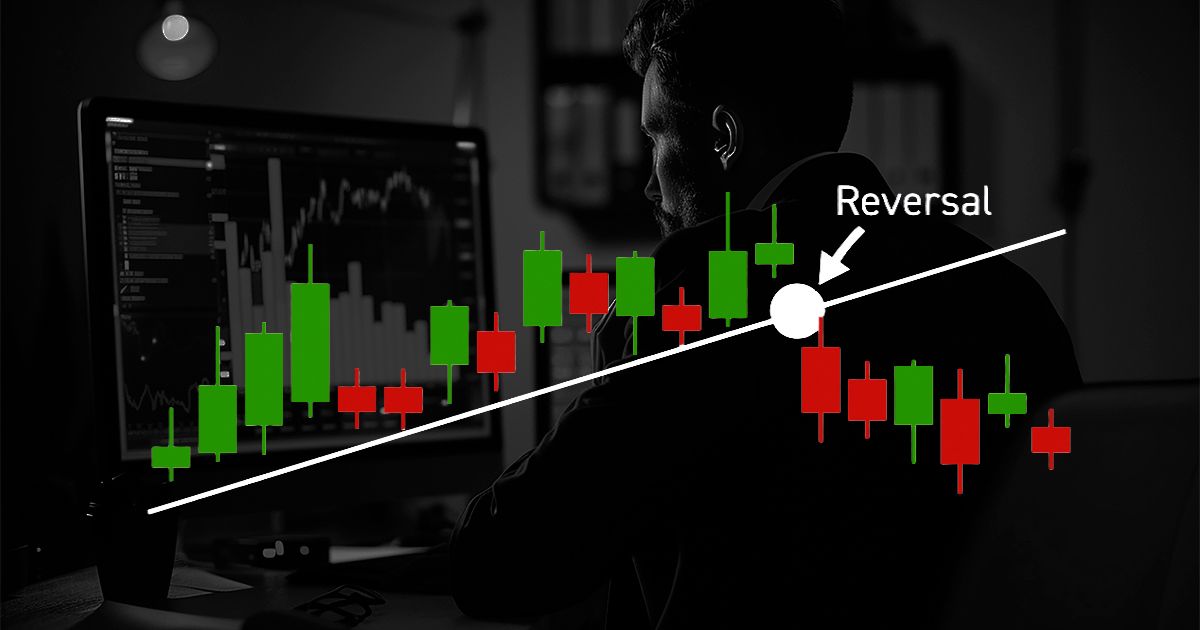
How to Recognize a Trend Reversal?
It is very important to recognize a trend reversal if you are trading. A trend reversal occurs when the market changes direction and starts to move from bullish to bearish or from bearish to bullish. If you know how to recognize these moments, you get more opportunities to earn; however, it comes with risks if you make a mistake.
A trend reversal may start with some weak signals, and you need to know how to detect them. For example, if candles don’t close lower, and there is an uptrend, it may be a sign that the market will drop. The same may happen if volumes drop. These early signs help traders prepare for possible shifts in market direction.
Technical indicators can help you also to identify trends and see when they may reverse. For example, you can use moving averages, RSI, or MACD to see if the momentum changes. For example, if RSI shows overbought levels and price begins to stall, it may suggest a reversal is near. However, you cannot rely only on indicators because they can be. It is recommended to combine price action with volume analysis to get more reliable signals.
Support and resistance levels help to identify a trend. If the price consistently cannot break above resistance in an uptrend, or fails to break below support in a downtrend, it may mean that a reversal is coming. Pay attention to this signal, because it may mark a turning point in the market.
You don’t need to guess if you want to recognize a trend reversal, but you need to observe patterns, confirm signals, and manage risk. While there is no perfect method that guarantees 100% accurate results, you can benefit from the right entries and exits and reduce risks if you know how to determine trend reversals.
Trend Reversal - Ideal Entry with Higher Risk
If you know how to detect trend reversals, you can enter a trade at the very beginning of a new trend and earn. However, you take higher risks if you do so. Reversals are not always confirmed immediately; this is why there is a possibility of a mistake.
When you are trying to catch a reversal, you believe that the market direction will soon change. For example, after a long uptrend, you may look for weakness such as double tops, bearish candlestick patterns, or divergence in indicators like MACD or RSI. If you enter at this point, you can get significant profits if the trend reverses, but if it doesn’t, you lose.
This is why it is important to understand how to manage risks. Traders often reduce position sizes or place tighter stop losses when they believe that the market will reverse. This way, they can limit potential losses and still keep exposure to a high-reward opportunity. This is why you shall place a stop-loss below recent lows in an uptrend or above recent highs in a downtrend. This will help to protect your money if the reversal signal is false.
Timing is another problem with trading trend reversals. If you enter too early, you may face extended drawdowns, but if you enter too late, you may miss most of the move. Many experienced traders wait for price to break a key support or resistance level, and only after that, they place a trade.
Reversal trades are risky, but they also offer some of the most attractive opportunities in trading. If you catch a reverse trend early, you can indeed earn a lot.
Beware of Important Fundamentals
Technical analysis is valuable when looking for reversals, but ignoring fundamentals is the worst mistake that you may make. Economic news, central bank decisions, and geopolitical events often trigger sudden and powerful trend reversal movements.\
For example, a currency pair may be in a strong downtrend, but if a central bank unexpectedly raises interest rates, the market could shift direction. In such cases, traders who don’t know about fundamental analysis may not know how to react to the market changes. This is why you should always pay attention to the news; this will help you to catch reversals at the right time.
Earnings reports, inflation data, unemployment numbers, or speeches from policymakers - all these events can cause a reversal. A stock that has been declining may suddenly reverse after reporting better-than-expected profits. Commodities can change direction due to supply disruptions, weather events, or shifts in demand.
Market sentiment is another important element that you shall understand and consider. Even without direct news, rumors or expectations can drive price reversals. For example, if investors anticipate a change in monetary policy, they may adjust positions ahead of the official announcement. This creates early reversal signals that may still be invisible in technical charts.
Fundamental analysis helps traders confirm whether a technical reversal may happen. For instance, if the charts show a possible bullish reversal in a stock, but the company has to deal with negative news, the reversal may be weak or short-lived. But if all fundamentals are positive, there may be a successful reversal.
Learn how to use technical and fundamental analyses together. This will help you to make better trades and earn more. Charts may show when a reversal is expected to happen, but fundamentals often explain why it happens. This is why never ignore fundamental analysis; otherwise, you may not assess the market correctly and lose money. But if you use technical and fundamental analysis together, you will understand the market better and will know when to place the right trades.
Avoid Pointless, Complicated Solutions
When it comes to identifying trend reversals, you may make a mistake that many traders make: overcomplicating your analysis. If you use too many indicators, conflicting strategies, or unnecessary methods, this is wrong. In reality, it doesn’t require complex solutions to spot a trend.
The most effective approach is often the simplest: watch price action, volume, and a few reliable indicators. For example, have a look at candlestick patterns, such as head-and-shoulders, double tops, or double bottoms, and they can give early reversal signals. If there is confirmation from RSI divergence or MACD crossovers, it is even better. This straightforward approach is usually more effective than stacking multiple unnecessary tools.
Don’t switch strategies all the time. There is no perfect method. No system can predict reversals with 100% accuracy. Instead, consistency and discipline are more important.
Don’t rely on lagging indicators only. Yes, these tools can confirm a reversal, but they often react after the move has already started. Combine real-time price action analysis with your favorite indicators, and this will make your analysis simple and efficient. Remember that fewer signals with higher quality are always better than dozens of mixed, unreliable signals.
If you manage to avoid too much complexity, you will get better results. It will help you to act confidently when reversal opportunities arise, without hesitation that may lead to losses.
Conclusion
One of the most important skills in trading is knowing how to recognize a trend reversal. If you know how to do it, you can enter trades early and earn more. However, this comes with higher risks, too. This is why we recommend to combine several methods, use technical analysis, check for support and resistance levels, and look for confirmation signals.
Never forget that simplicity is more important than complexity. Avoid pointless, complicated strategies to keep decisions clear and reduce hesitation. Focus on price action, volume, and a few reliable indicators, as it usually works better than relying on too many tools.
The market will always move in cycles of uptrends, downtrends, and consolidations. If you know how to recognize when one phase ends and another begins, you can develop the ability to adapt. This adaptability is what separates consistent traders from those who rely on luck.


