

AI in Trading

Apr 15, 2026 - 9 min

●●●Advanced

AI Stock Predictor Tools: Smarter Screening or False Confidence?

AI Stock Predictor Tools: Smarter Screening or False Confidence?

An AI stock predictor sounds like a shortcut to better trades. The reality is more useful and more limited than the headlines suggest. This guide breaks down what artificial intelligence tools actually do, how to use them step by step, and exactly where they stop working.

Justin Freeman
Reviewed by:
Share

AI Stock Predictors at a Glance: Key Facts

QuestionAnswer
What is an AI stock predictor?Software using machine learning to identify stock opportunities from market data.
What data does it process?Price history, volume, earnings reports, news sentiment, and technical indicators.
Can it guarantee profits?No. The SEC flags guaranteed-return claims as a fraud signal.
Who uses these tools?Retail traders, quant funds, robo-advisors, and institutional desks
What AI methods are most common?LSTM neural networks, support vector machines, and natural language processing
Where does AI prediction fail?Unprecedented events and sudden shifts in market regimes.

What an AI Stock Predictor Actually Does
What an AI Stock Predictor Actually Does

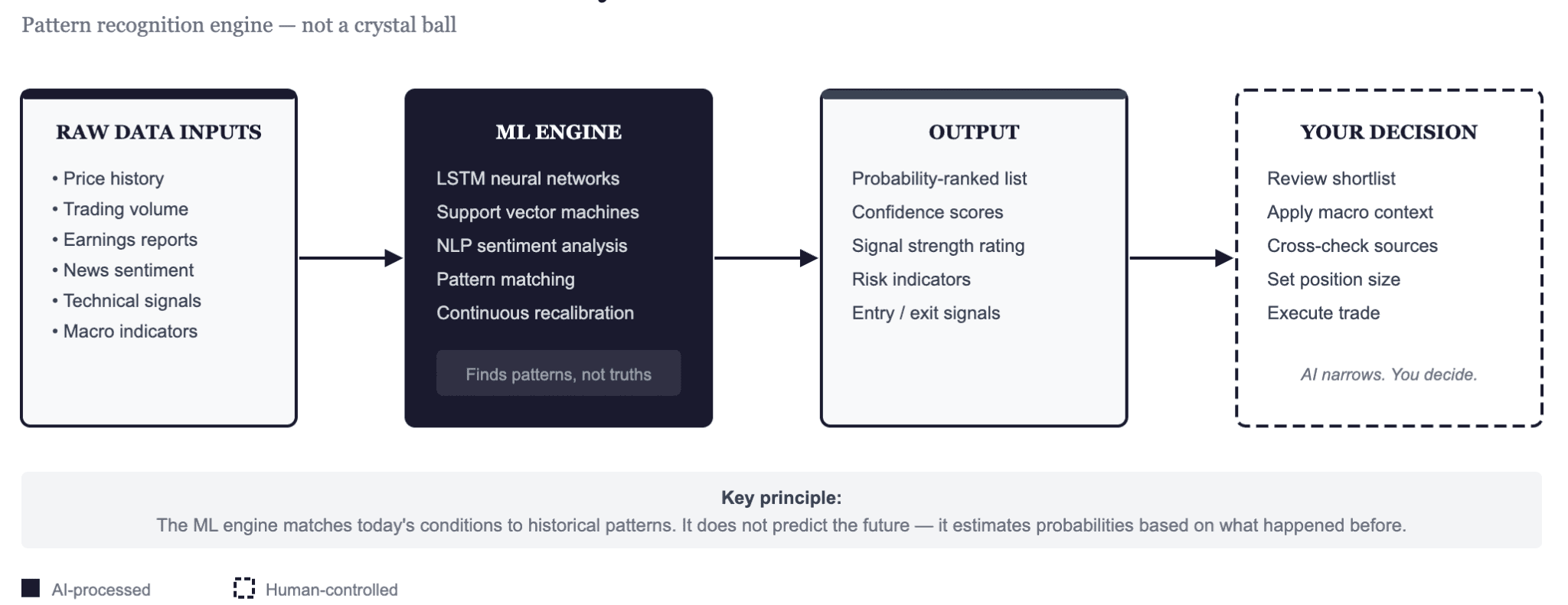
AI stock analysis tools do one thing at their core: they find patterns in data faster than any human can. Before you trust any output, you need to understand the engine behind it.

How Machine Learning Reads Market Data

Machine learning algorithms train on large datasets and identify repeatable patterns. A model built on years of price data learns which signal combinations preceded price moves. It does not think. It matches patterns.

Support vector machines, long short-term memory networks, and artificial neural networks are the most widely used methods for stock market prediction. Historical closing prices are the most common data input across research studies.

These systems recalibrate continuously. Each new session adds fresh data, and the model adjusts its output. The result is a probability estimate, not a certainty. Every number an AI tool shows you is a calculation based on what happened before.

Neural Networks vs. Rule-Based Algorithms

Rule-based systems follow fixed logic. If the price crosses a moving average, the system fires a signal. Neural networks identify non-linear relationships that no programmer explicitly defined.

Deep learning models such as LSTM and CNN-LSTM hybrids significantly outperform traditional approaches. 

They capture both short-term patterns and long-term dependencies in price data. The practical difference matters. A rule-based system fires identically every time conditions match. A neural network assigns different weights to signals based on context.

“Neither approach removes the need for human review before executing a trade.”

Key takeaway: An AI stock predictor is a pattern-recognition engine trained on historical data. It produces probability estimates based on what similar conditions have produced in the past. The output is a research tool, not a trading instruction. No AI system predicts the future with certainty.

Steps to Use AI to Pick Stocks
Steps to Use AI to Pick Stocks

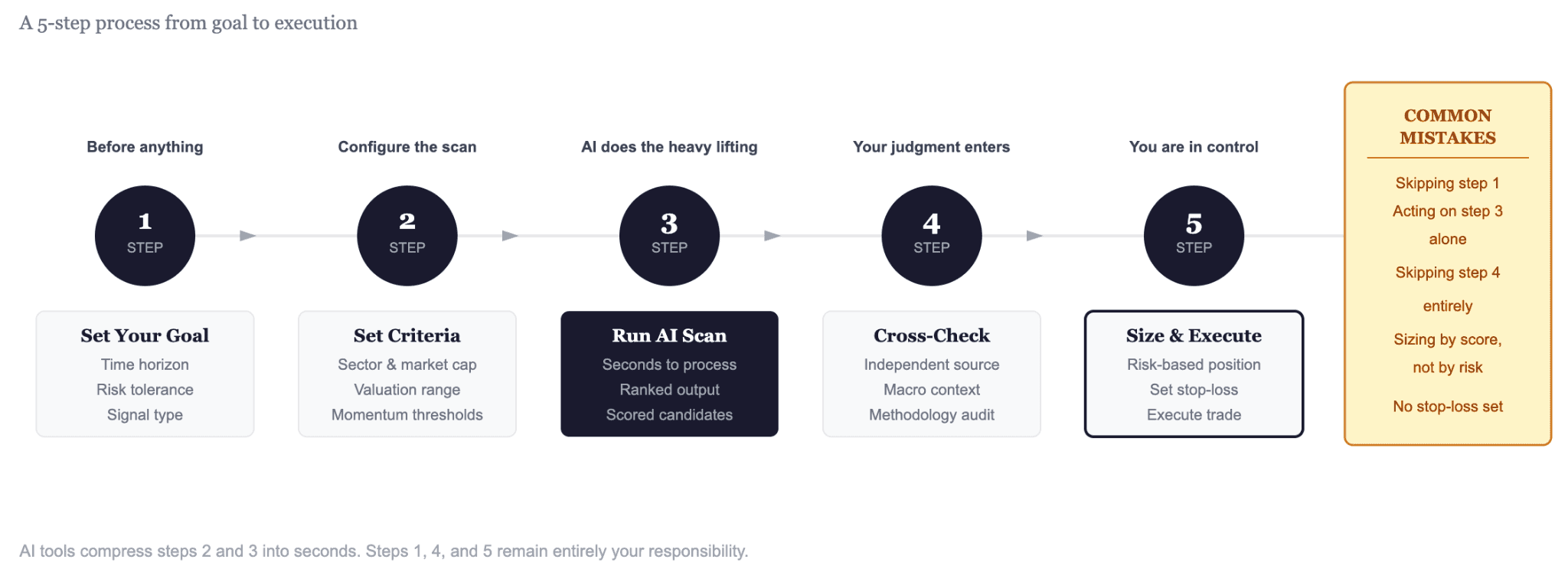
Knowing how to use AI to pick stocks requires more than opening an app and running a scan. The process has a logical sequence. Skipping steps produces poor results.

Set Your Goal Before You Open Any Tool

Every AI-powered trading software filters data based on criteria you define. Without a clear objective, the output defaults to generic results that may not fit your strategy.

Answer these three questions first:

  • What is your time horizon?
  • What risk level suits your position sizing?
  • Growth, value, or income signals?

Your answers determine which indicators the AI weights most. A long-term value investor needs different settings than a swing trader chasing momentum breakouts. Feed the tool vague inputs, and you get vague outputs back.

How to Use AI to Pick Stocks Step by Step

The standard workflow for using AI to pick stocks follows a consistent sequence:

  1. Define sector, market cap, and P/E range
  2. Set momentum or sentiment thresholds
  3. Run the scan and review the ranked output
  4. Cross-check each pick independently
  5. Size position on your risk rules, not the AI score
Become a Confident Trader

Master trading with our structured course designed for beginners and intermediate traders.

Step-by-step lessons
Real strategies
Risk management training

Join 10,000+ traders improving their skills

Start Course Now

AI-powered systems process real-time data and synthesize ranked candidate lists in seconds. That speed compresses hours of manual screening into minutes. It does not replace judgment at the final decision point.

What to Look for in AI Analysis Tools

Not all platforms deliver the same quality. This table separates functional tools from marketing products:

FeatureWhat to Look ForRed Flag
Data freshnessReal-time or same-day feedsDelayed data, no timestamp shown
TransparencySignals behind each score explainedBlack-box output, no methodology
BacktestingReal historical performance shownCherry-picked time periods only
Risk indicatorsDrawdown, volatility, position sizingUpside only, no downside metrics
Regulatory standingLicensed and registered platformGuaranteed winning picks claimed

The SEC explicitly warns that any AI trading system that promises guaranteed results is a red flag.

Key takeaway: Using AI to pick stocks is a structured process, not a one-click solution. Define your goal first. Use the scan to narrow your field. Apply human judgment to the shortlist. Tools that score stocks without explaining their methodology are the hardest to trust and the easiest to misuse.

Where AI Stock Predictors Work and Where They Fail

Where AI Stock Predictors Work and Where They Fail

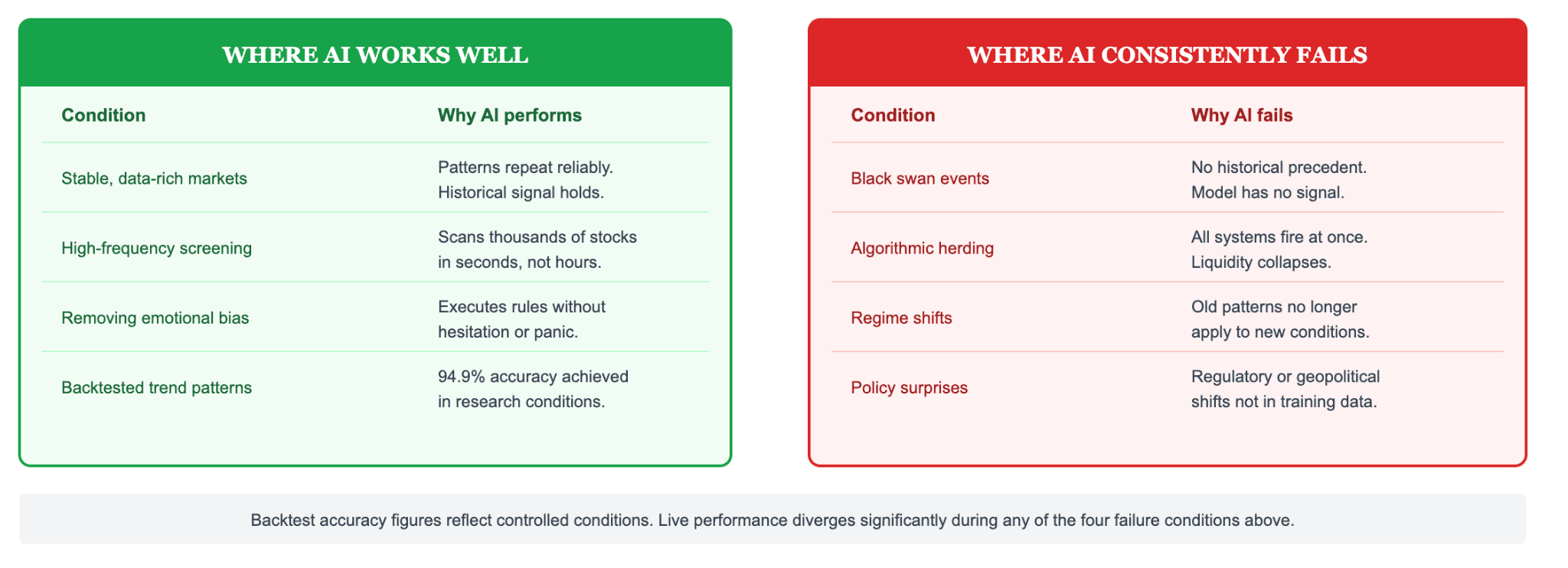
AI performs well in stable, data-rich conditions. Understanding where these models break down is the most important thing most guides leave out entirely.

What the Data Says About AI Accuracy

Can AI pick stocks in 2026? Research on AI prediction accuracy shows strong results in backtests. Live market performance is more variable. A deep learning model tested across four major financial indices achieved an average accuracy of 94.9% in trend prediction. Random forest reached 85.7%. Logistic regression reached 52.45%. 

A study combining machine learning with large language model signals across NASDAQ-100 stocks showed strong cumulative returns under monthly rebalancing from 2020 to 2025. The study used a rolling-window approach to simulate real-time conditions and avoid lookahead bias.

“Published accuracy figures reflect controlled backtests. Treat them as upper-bound estimates rather than performance guarantees.”

Three Market Conditions That Break AI Models

AI stock prediction tools have a consistent set of failure modes. Each one below represents a real, documented event where automated systems underperformed or amplified losses.

Black Swan Events

Black Swan Events

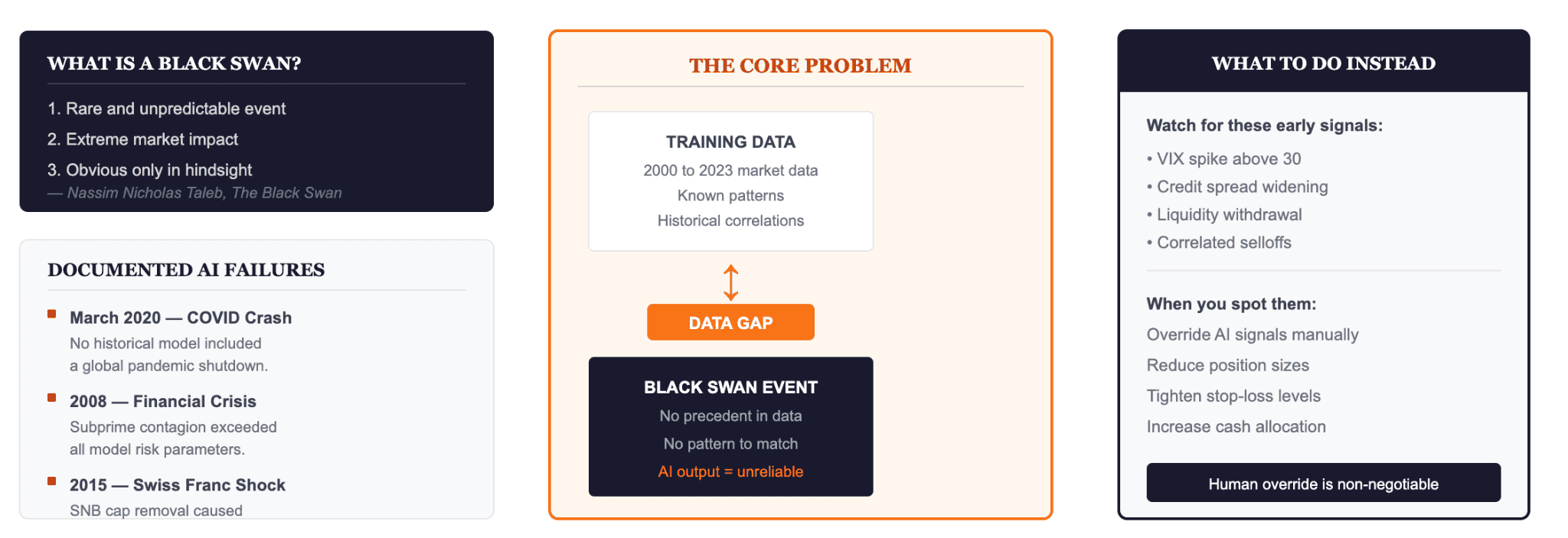
Black swan events have no historical precedent. AI models train on past data. No past data means no usable signal. Many AI models failed to predict the March 2020 market crash. There was no historical precedent for a global pandemic-induced economic shutdown. Several quant hedge funds underperformed significantly during that period while traditional funds gained.

Algorithmic Herding

Algorithmic Herding

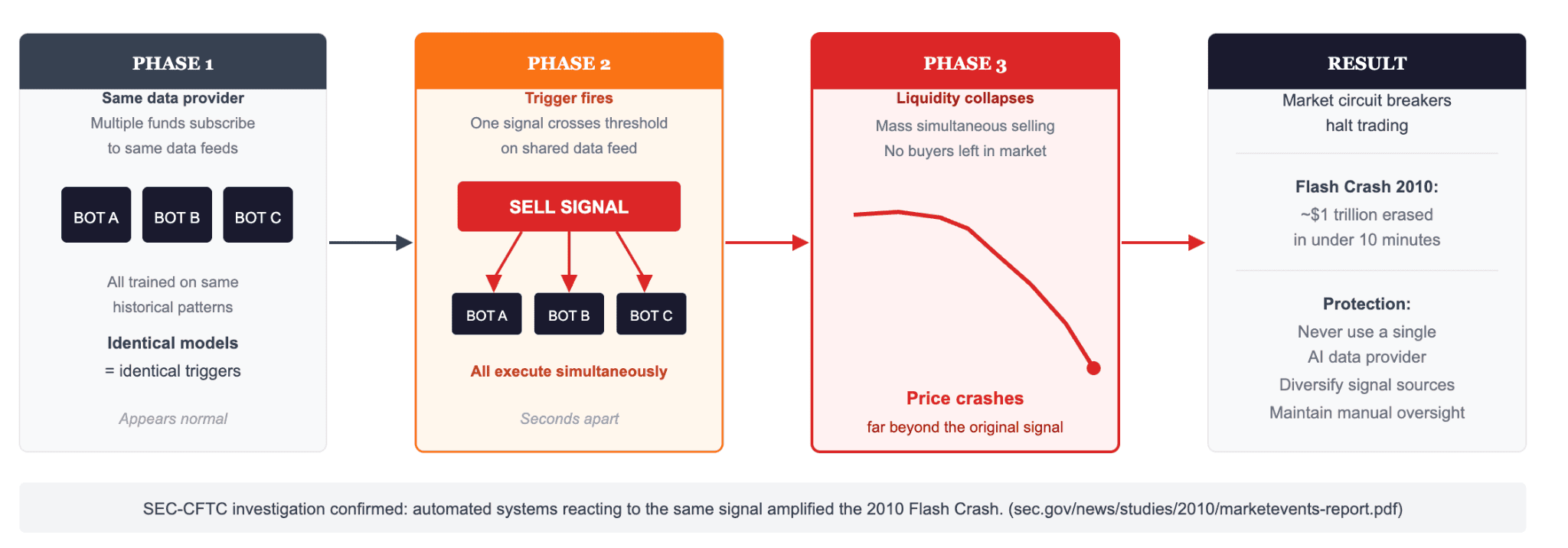
When many systems use the same model or data provider, they generate identical signals at the same moment. The 2010 Flash Crash erased roughly one trillion dollars in market value within minutes. High-frequency trading algorithms reacted to the same signals simultaneously. They increased selling pressure and immediately withdrew liquidity. As AI adoption grows across retail and institutional platforms, this convergence risk increases.

Regime Shifts

Regime Shifts

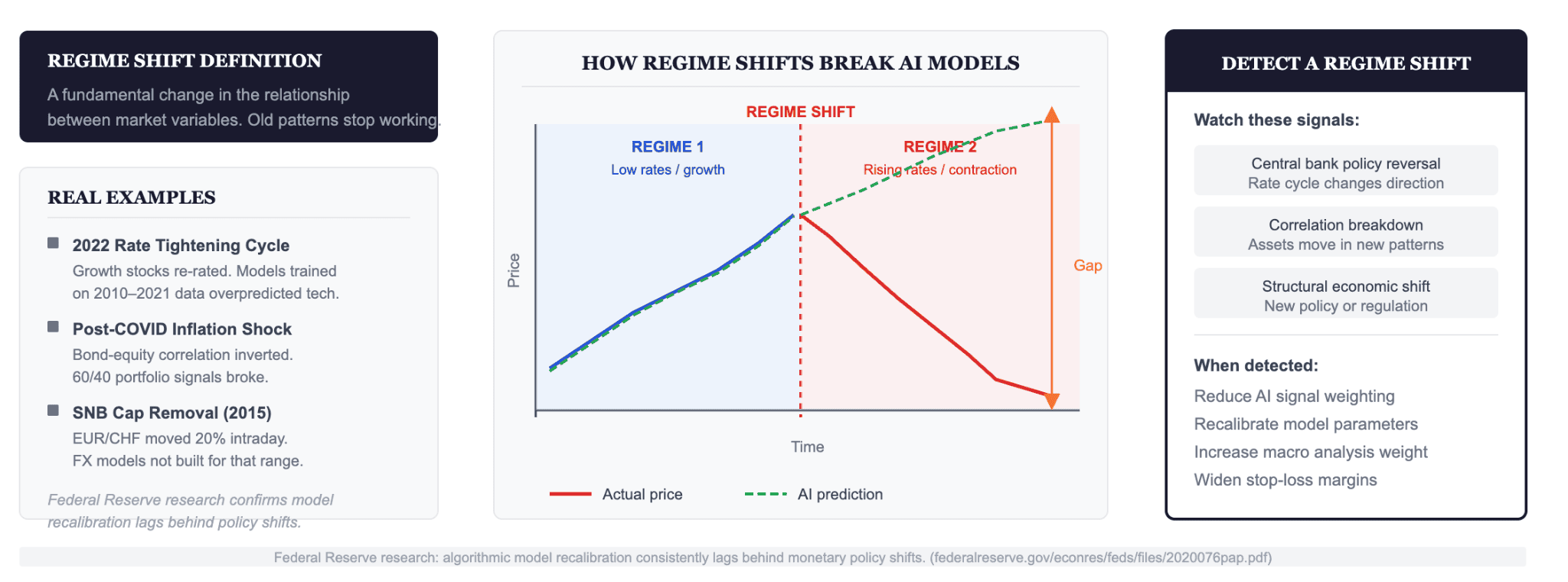
A regime shift happens when the relationship between market variables changes fundamentally. A new monetary policy, a rate-cycle reversal, or structural economic change can all trigger one.

Many machine-learning algorithms struggle when market behavior changes due to new regulations, wars, or global crises. A model trained during a low-rate environment will misread signals in a tightening cycle.

Key takeaway: AI stock predictors show strong accuracy in backtests and stable conditions. Three conditions consistently break them. Black swan events leave no historical signal. Algorithmic herding fires identical outputs simultaneously. Regime shifts make past patterns irrelevant.

Scan AI Stock Picks Without Losing Control

The ability to scan how AI picks stocks at scale is a genuine research advantage. The risk is delegating too much of the final decision to the output.

Trading Signals and Automated Systems

AI-generated trading signals flag when a stock meets predefined technical or fundamental conditions. Some platforms execute trades automatically when conditions trigger.

Automated systems remove emotional hesitation at entry and exit. They also execute bad trades at scale, faster than you can intervene. Reinforcement learning, deep learning, and sentiment analysis are increasingly combined in automated systems to improve execution speed and signal accuracy. Before enabling automated execution, run the system in paper trading mode. 

“Test for at least 30 days across varying conditions. Confirm that stop-loss triggers are active and cannot be overridden by the system.”

How to Verify What the Bot Recommends

Every AI recommendation should pass a three-point check before you act:

  1. Source check: Where is the data coming from?
  2. Methodology check: Which signals drove this output?
  3. Context check: Does this fit current macro conditions?

Key challenges in AI-based stock prediction include data noise, nonstationarity, overfitting, and black-box interpretability. Platforms that expose their methodology and let you inspect the underlying signals give you the ability to catch these problems before they cost you money. A recommendation that makes no sense against the current macro picture is a recommendation to skip.

Key takeaway: AI scans compress hours of research into minutes. That speed is the main practical advantage. Maintain control by verifying the data source, checking the methodology, and applying a macro-context check before acting. 

Key Takeaways: What You Need to Know About AI Stock Predictors

An AI stock predictor processes data at a scale no human analyst can match. It simultaneously finds patterns in price history, earnings data, and market sentiment. The output is a ranked shortlist, not a guarantee. These tools work best when you use them to narrow your research field and apply your own judgment to the final pick. Three conditions consistently break AI models: black swan events, algorithmic herding, and regime shifts.

Frequently Asked Questions

Disclaimer: This article is for informational purposes only and does not constitute financial advice. Trading involves risk and may result in loss of capital.

Related Articles

The First Move Is Yours

Discover how Supertrade can transform your trading career. Explore challenges, access instant funding, and join a growing community of Supertraders.

Stay Ahead of the Game

Sign up to receive exclusive tips, market insights, and the latest updates from Supertrade. Don’t miss out on opportunities to grow your trading success.
how it works

Our Community

Do not skip any beat.

The Ultimate Trading Community. Join our Discord server to get the latest updates, news and more.

2026 Supertrade. All rights reserved
DiscordFacebookInstagramTelegramYouTubeXTikTok
Trading involves significant risk. Past performance is not indicative of future results. This is a simulated trading environment. Supertrade provides educational trading services.
Supertrade
Supertrade Ltd, a company incorporated under the laws of Saint Lucia with registered number 2024-00699, located at Ground Floor, Rodney Court Building, Rodney Bay, Gros Islet, Saint Lucia, LC01 101, operates and owns this website, as well as provides services under the Terms and Conditions posted on the website. Supertrade Prop Ltd, a company incorporated under the laws of England and Wales with registered number 16234284, located at 52-56 Standard Road, London, England, NW10 6EU, acting as a payment agent.