

Fundamental Analysis

Apr 15, 2026 - 11 min

Beginner

Bull Market vs Bear Market: What's the Difference and How Do You Trade Each?

Bull Market vs Bear Market: What's the Difference and How Do You Trade Each?

A bull market and a bear market are not just labels. They define the rules of the game you are playing. Miss the shift between them and you trade the wrong strategy at the wrong time. This 2026 guide breaks down what each phase means, how to spot the current one, and what works in each.

Justin Freeman
Reviewed by:
Share

Bull and Bear Market at a Glance

  • Bull market: 20% gain from recent low
  • Bear market: 20% drop from recent high
  • Average bull lasts 1,011 days historically
  • Average bear lasts 286 days historically
  • S&P 500 averages one correction per year
  • Bears cover 38% of all market time
  • 1 in 4 corrections turns into bear
  • Midterm years average 18% intra-year drawdown

What Is the Bull and Bear Market Definition?
What Is the Bull and Bear Market Definition

The terms bull and bear describe the direction of prices over a sustained period. They are not about a single day or a single event. Each phase carries distinct economic conditions, distinct investor behaviour, and a distinct set of trading rules.

What Is a Bull Market in 2026: Real Numbers Talk

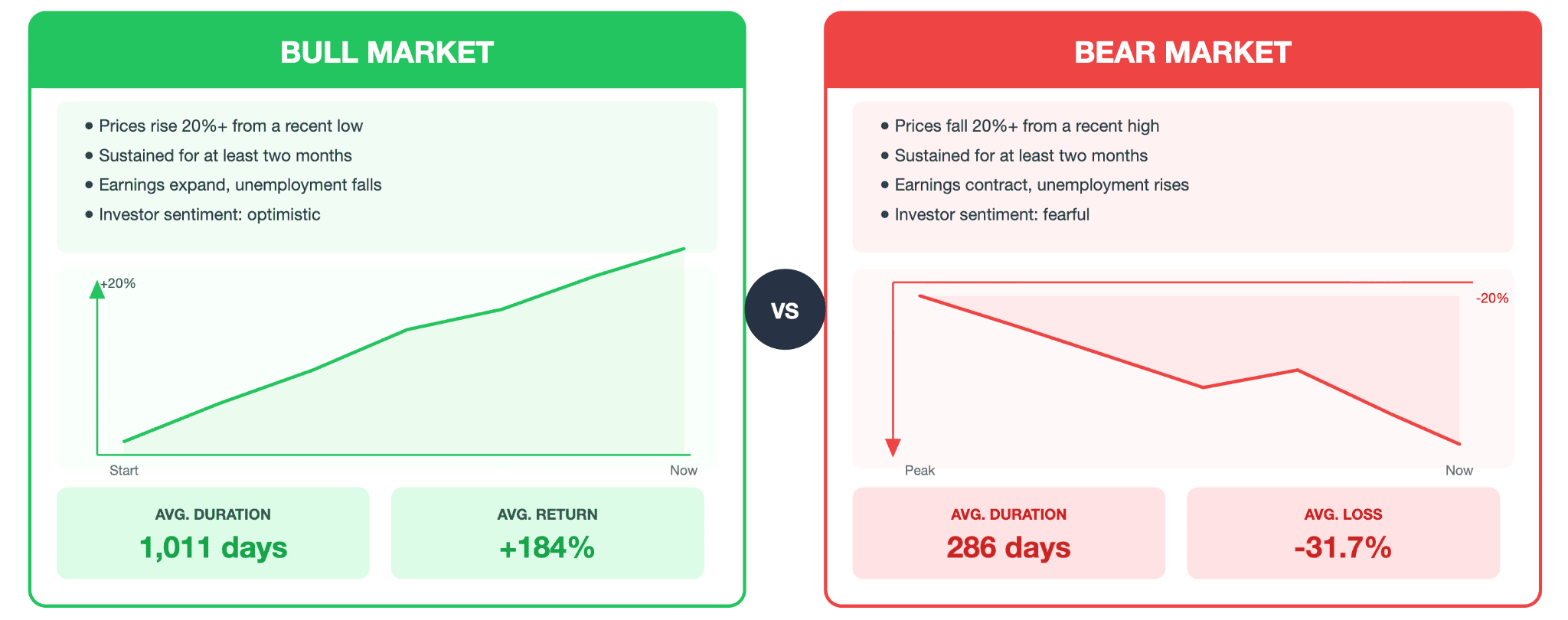
A bull market starts when a major stock market index climbs 20% or more from its recent low. That gain must hold for at least two months to qualify. The current S&P 500 bull market started in October 2022. Since that low, the index has returned 92% through early 2026. 

Bull markets do not move in a straight line. Pullbacks and corrections happen inside them. What defines the phase is the overall direction. Prices make higher highs over time. Corporate earnings expand, unemployment stays low, and investor sentiment stays net positive. The 2009 to 2020 bull run lasted nearly 4,000 days and survived multiple corrections along the way. 

"A bull market does not mean every stock is going up. It means the tape is pulling in your favour. Your job is to stay aligned with that pull and not fight it."

What Is a Bear Market: The Starting Point
What Is a Bear Market: The Starting Point

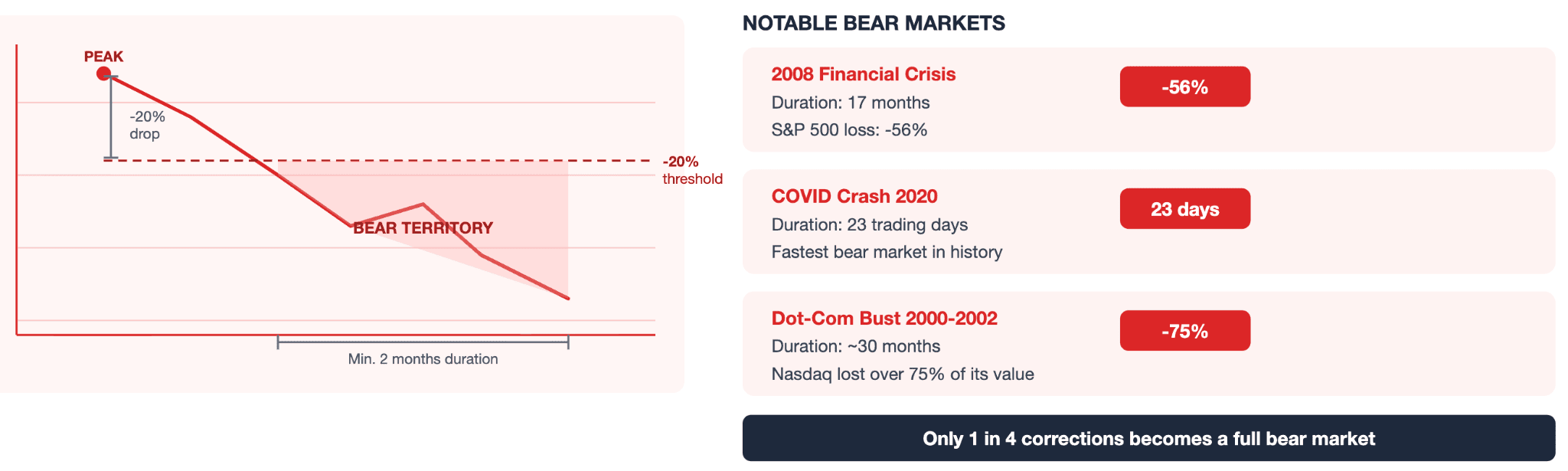
A bear market begins when a major index falls 20% or more from its recent high. That decline must persist for at least two months. Price drops below that threshold are corrections. Only about one in four corrections deepens into bear territory. 

Bear markets run shorter than bull markets on average, but they feel longer. Prices fall faster than they rise. Volatility spikes and news flow turns persistently negative. The 2008 bear lasted 17 months and wiped roughly 56% off the S&P 500. The COVID crash of 2020 reached bear territory in just 23 trading days. 

Key takeaway: Bull and bear markets are defined phases with specific thresholds and minimum durations. Everything between those thresholds is a correction.

What Is the Difference Between a Bear and Bull Market?

Direction is the obvious answer. But traders who stop at the direction miss more important differences. How long each phase lasts, how much ground it covers, and what drives the people inside it all matter. Those mechanics shape everything from entry timing to stop placement.

How Do Price Thresholds and Duration Compare?
How Do Price Thresholds and Duration Compare

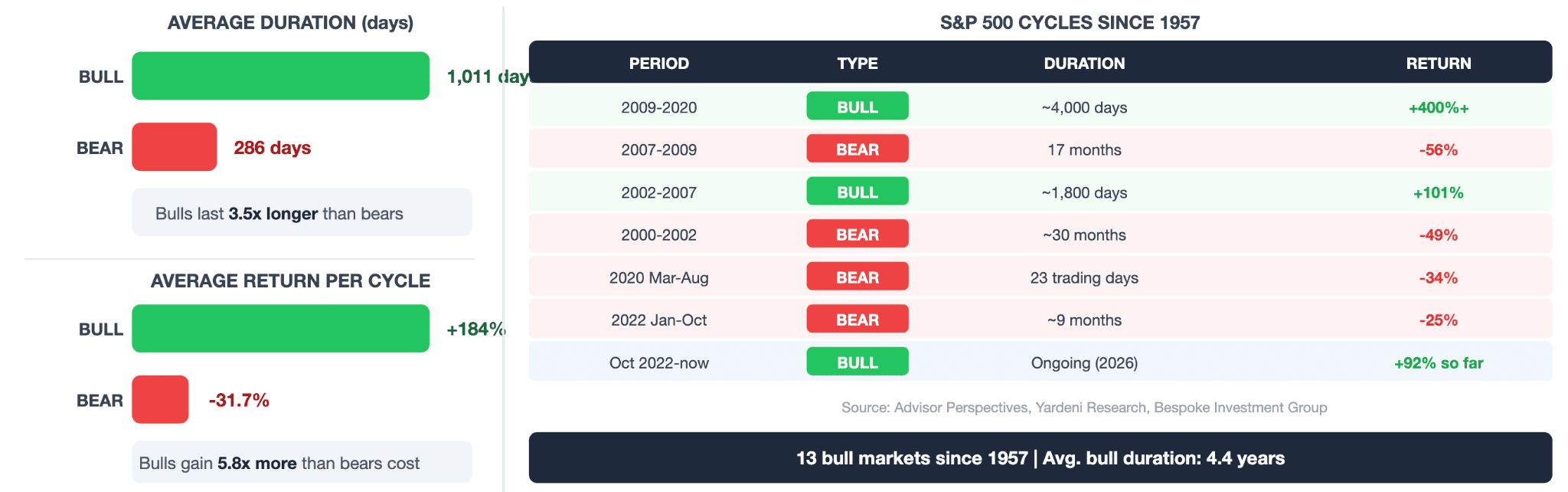
A bull market clears 20% from a recent low. A bear market crosses 20% down from a recent high. Since 1957, the S&P 500 has recorded 13 bull markets averaging 4.4 years each. Bear markets over the same period averaged under one year. 

The return gap tells the bigger story. Past S&P 500 bull markets have delivered an average gain of 184% per cycle according to Yardeni Research. Average bear market losses sit around 31.7%. Secular bull years outnumber secular bear years 92 to 57 since 1871. That asymmetry explains why long-term equity exposure produces positive returns despite periodic crashes.

How Does Investor Sentiment Differ?

In a bull market, rising prices attract more buyers. More buyers push prices higher. That cycle feeds itself until valuations stretch too far or economic conditions shift. Greed dominates. Risk appetite expands. Traders take larger positions with more leverage.

Bear markets run on a different fuel entirely. Margin calls force liquidations at any price. Credit tightens and reduces the pool of available buyers. News gets interpreted negatively regardless of the underlying data. The index stops reflecting economic conditions and starts driving them.

FactorBull MarketBear Market
Price directionRising 20%+ from lowsFalling 20%+ from highs
Average duration1,011 days286 days
Average S&P 500 return+184% per cycle-31.7% per cycle
Volatility patternLower, trendingHigher, erratic
Dominant emotionGreedFear
Economic backdropGrowth, low unemploymentContraction, rising unemployment

The S&P 500 nearly entered bear territory in April 2025 on tariff shock. It recovered to finish the year up 16%. Phase labels describe direction over time, not any single moment.

Key takeaway: Bull markets last longer and deliver more than bear markets take away. Bear markets move faster, hit harder, and punish the unprepared. The difference between a correction and a bear market is not just 10 percentage points.
Are We in a Bull or Bear Market Right Now?

Become a Confident Trader

Master trading with our structured course designed for beginners and intermediate traders.

Step-by-step lessons
Real strategies
Risk management training

Join 10,000+ traders improving their skills

Start Course Now

Are We in a Bull or Bear Market Right Now

That question matters more in April 2026 than it did twelve months ago. Markets hit all-time highs in January 2026 then reversed. Several major indices entered correction territory. The picture is not settled.

Where Does the S&P 500 Stand in April 2026?

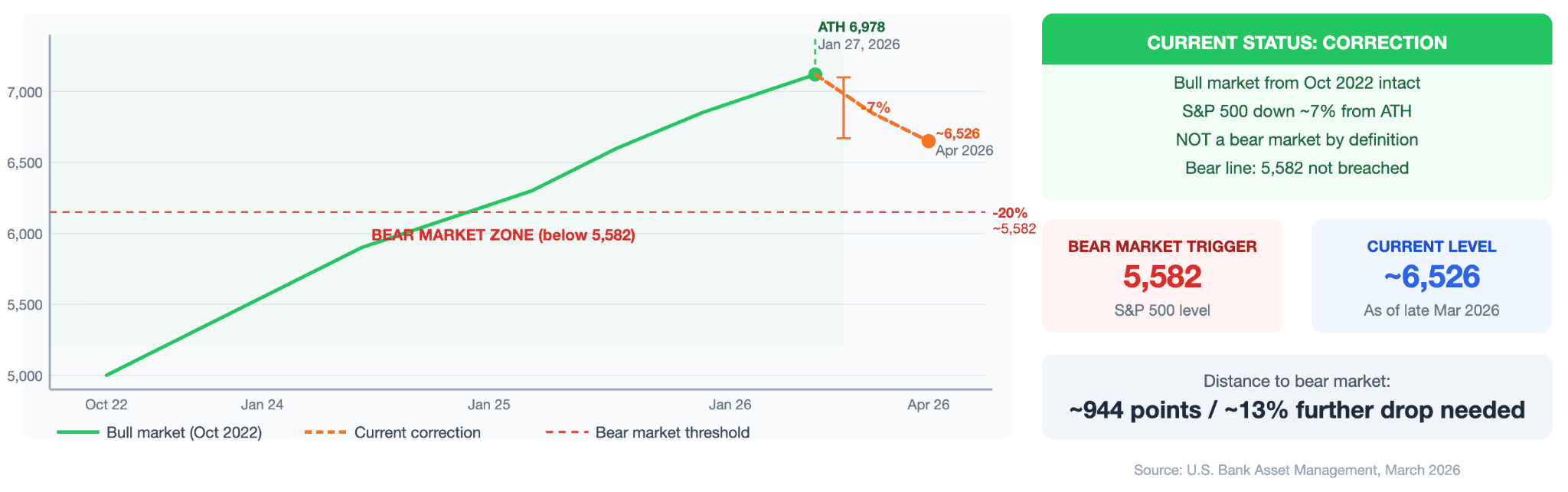
The S&P 500 hit its all-time high close of 6,978 on January 27, 2026. By late March it pulled back roughly 7% from that peak, sitting around 6,526. The Nasdaq Composite fell more than 10% from its high, entering official correction territory. The Dow also dipped into correction briefly before recovering. 

The bull market that started in October 2022 remains technically intact. A 20% decline from the January peak requires the index to fall below roughly 5,582. That has not happened. The S&P 500 is in a correction inside an ongoing bull market, not a bear market by the standard definition.

"The market is in a correction right now, not a bear market. Traders who treat every 7% pullback as a regime change end up on the wrong side of the next move."

What Risk Factors Are Shaping the Market Cycle?

What Risk Factors Are Shaping the Market Cycle

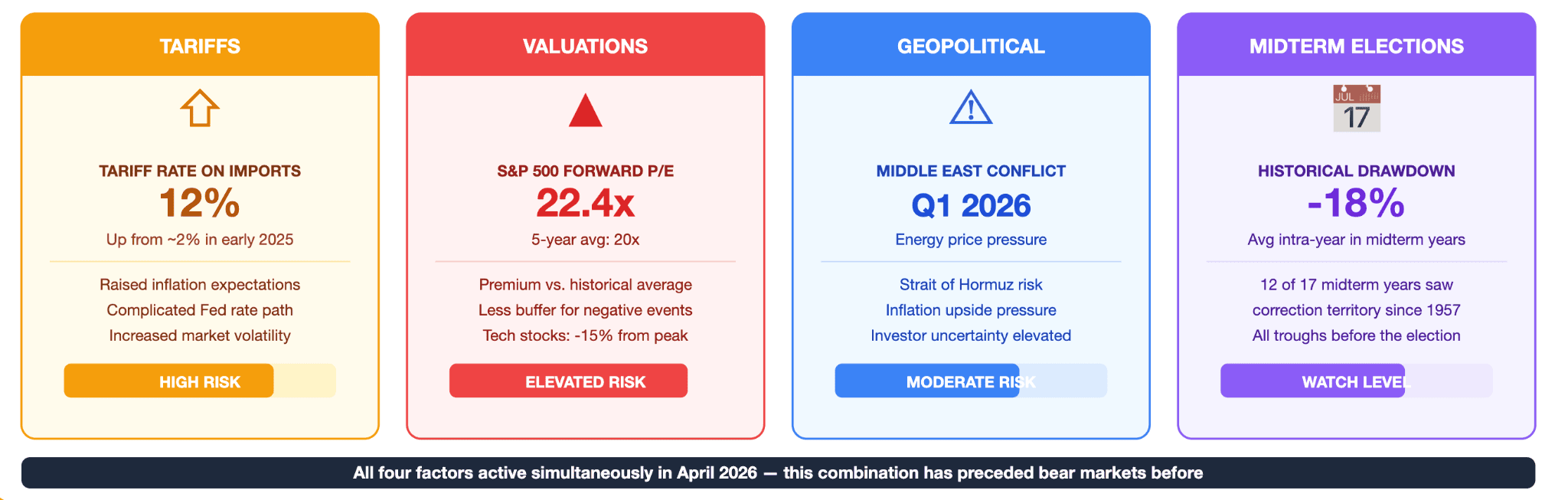
Several pressures built through late 2025 and accelerated into 2026. Average US tariff rates rose to approximately 12% on imported goods, up from roughly 2% at the start of 2025. The shift raised inflation expectations and complicated the Federal Reserve rate path. 

The S&P 500 entered 2026 at 22.4 times forward earnings against a five-year average of 20 times. Stretched valuations leave less room for error. The Morningstar US Market Index entered correction territory in February 2026 with technology stocks down over 15% from their peak. Middle East conflict and energy price pressure added further drag in Q1 2026. 

Midterm election years add a statistical layer. Since 1957, the S&P 500 entered correction territory in 12 of 17 midterm years. The average intra-year drawdown is 18%. All midterm troughs historically occurred before the election. The six months following midterms averaged a 14% gain.

Key takeaway: The data points to correction, not bear market. Three active risk factors are running simultaneously: tariffs, stretched valuations, and the midterm pattern. That combination has preceded bear markets before. 

How Do You Trade a Bull vs Bear Market?

How Do You Trade a Bull vs Bear Market

Strategy does not exist in a vacuum. The same setup that works in a trending bull market fails in a volatile bear. Knowing the phase you are in is not background information. It is the first input into every trade decision.

What Works in a Bull Market?

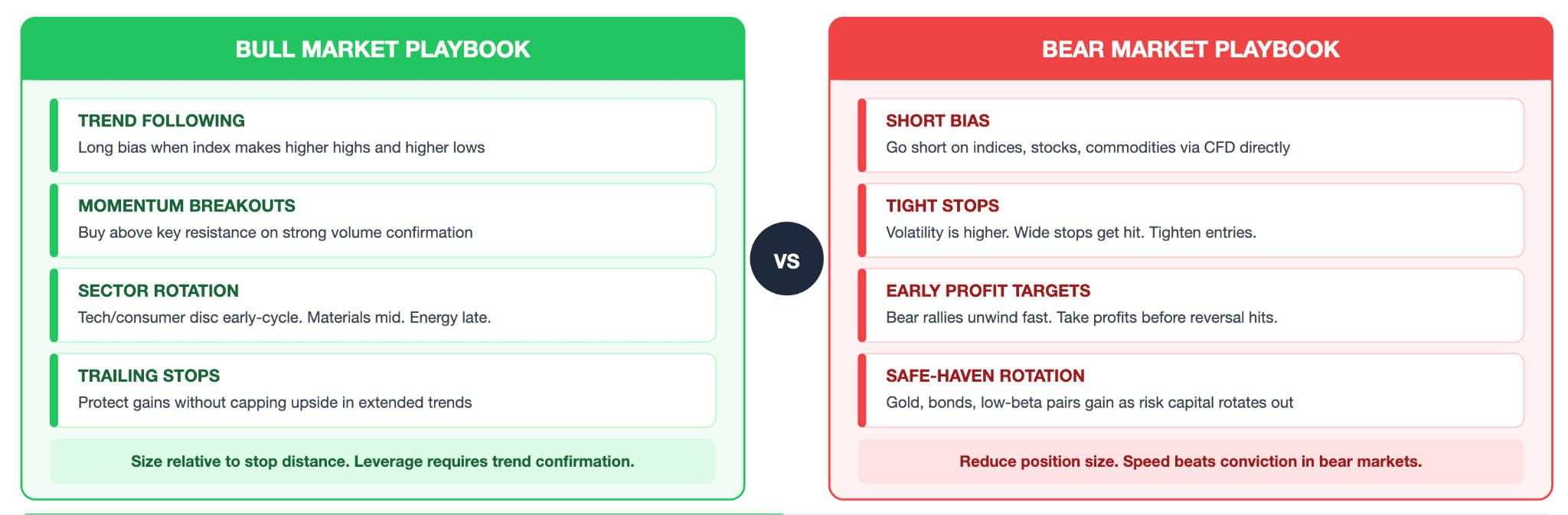
Trend following is the default approach. When prices make higher highs and higher lows across major indices, long bias is justified. The risk is staying long too close to the top. Three adjustments that improve results:

  1. Buy breakouts above key resistance on volume
  2. Use trailing stops over fixed profit targets
  3. Scale in as trend strength confirms

Sector rotation matters inside a bull run. Technology and consumer discretionary tend to lead early-cycle. Industrials and materials often take over mid-cycle. Energy and commodities can lead to late-cycle phases.

What Works in a Bear Market?

Short bias replaces long bias. In CFD markets you can go short on indices, stocks, and commodities directly. Bear markets are fully tradeable with the same tools you use on the long side. The key difference is execution speed. Prices cover more ground in less time and reversals are sharp.

Three adjustments that matter in bear conditions:

  1. Tighten stops: volatility punishes wide entries
  2. Take profits early: bear rallies unwind fast
  3. Reduce size: larger swings hit harder

Safe-haven assets shift in priority. When stock market direction turns negative, capital moves toward bonds, gold, and low-beta currency pairs.

"In a bear market, speed beats conviction. The trader who takes a 2% gain and moves on beats the one holding for 10% through three violent reversals."

How Do Prop Traders Approach Market Cycles?

How Do Prop Traders Approach Market Cycles

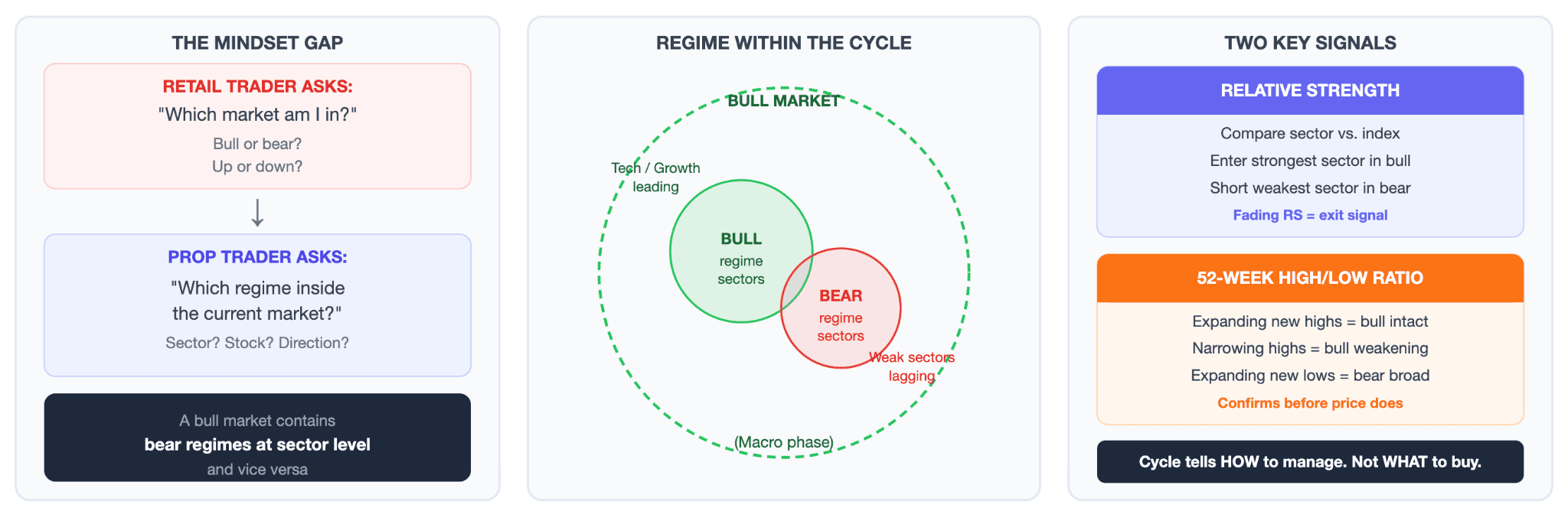
Retail traders ask which market they are in. Prop traders ask which regime they are trading inside the current market. The distinction matters. Even a confirmed bull market contains bear regimes at the sector or individual stock level.

A prop trader working a bull market does not go long everything. They identify sectors with the strongest relative strength versus the broader index. They enter after a pullback to a key level and exit when that relative strength starts to fade. They also watch the ratio of new 52-week highs to new lows across the index. When that ratio narrows, the internal structure of the bull is weakening before price confirms it. 

In a bear market, the focus moves to sectors with the worst relative strength. Short entries come after dead-cat bounces into resistance, not at new lows into thin air. Breadth deterioration and expanding new lows confirm that selling pressure is broad, not isolated to one sector.

"The market cycle does not tell you what to buy. It tells you how to manage what you buy."

Key takeaway: Bull markets reward patience and trend-following. Bear markets reward speed and discipline. Prop traders go further and identify the regime within the regime. Relative strength and the new highs-to-lows ratio show where real momentum sits. 

Final Words

A bull market clears 20% from a recent low and holds for at least two months. A bear market crosses 20% down from a recent high on the same timeline. Everything else is a correction. The S&P 500 has averaged 184% per bull cycle and lost 31.7% per bear cycle since records began.

As of April 2026 the market is in correction territory, not a bear market. The bull run from October 2022 remains intact. Tariffs, stretched valuations, and geopolitical risk are the live pressure points. The 5,582 level on the S&P 500 is the line between correction and bear market right now.

Frequently Asked Questions

Disclaimer: This article is for informational purposes only and does not constitute financial advice. Trading involves risk and may result in loss of capital.

Related Articles

The First Move Is Yours

Discover how Supertrade can transform your trading career. Explore challenges, access instant funding, and join a growing community of Supertraders.

Stay Ahead of the Game

Sign up to receive exclusive tips, market insights, and the latest updates from Supertrade. Don’t miss out on opportunities to grow your trading success.
how it works

Our Community

Do not skip any beat.

The Ultimate Trading Community. Join our Discord server to get the latest updates, news and more.

2026 Supertrade. All rights reserved
DiscordFacebookInstagramTelegramYouTubeXTikTok
Trading involves significant risk. Past performance is not indicative of future results. This is a simulated trading environment. Supertrade provides educational trading services.
Supertrade
Supertrade Ltd, a company incorporated under the laws of Saint Lucia with registered number 2024-00699, located at Ground Floor, Rodney Court Building, Rodney Bay, Gros Islet, Saint Lucia, LC01 101, operates and owns this website, as well as provides services under the Terms and Conditions posted on the website. Supertrade Prop Ltd, a company incorporated under the laws of England and Wales with registered number 16234284, located at 52-56 Standard Road, London, England, NW10 6EU, acting as a payment agent.