

Day Trading

Apr 23, 2026 - 9 min

Beginner

How to Do Day Trading in 2026: Basics, Tips, and Tools Explained

How to Do Day Trading in 2026: Basics, Tips, and Tools Explained

Intraday trading has become one of the most active corners of global markets. So what is day trading, and how does it work in 2026? The practice involves buying and selling the same asset within a single trading session. This 2026 guide covers the mechanics, strategies, and risks. Plus, you’ll get some practical tips to master it on your own.

Justin Freeman
Reviewed by:
Share

Day Trading at a Glance

QuestionAnswer
What is day trading?Buying and selling within one session.
Who regulates it in the US?FINRA and SEC.
Min. capital for day trading?No fixed floor after April 2026.
Holding period?Seconds to hours.
Success rate?About 1 to 15 percent long-term.
Best assets?Liquid stocks, crypto, options, futures, and forex.

What Is Day Trading?

What Is Day Trading

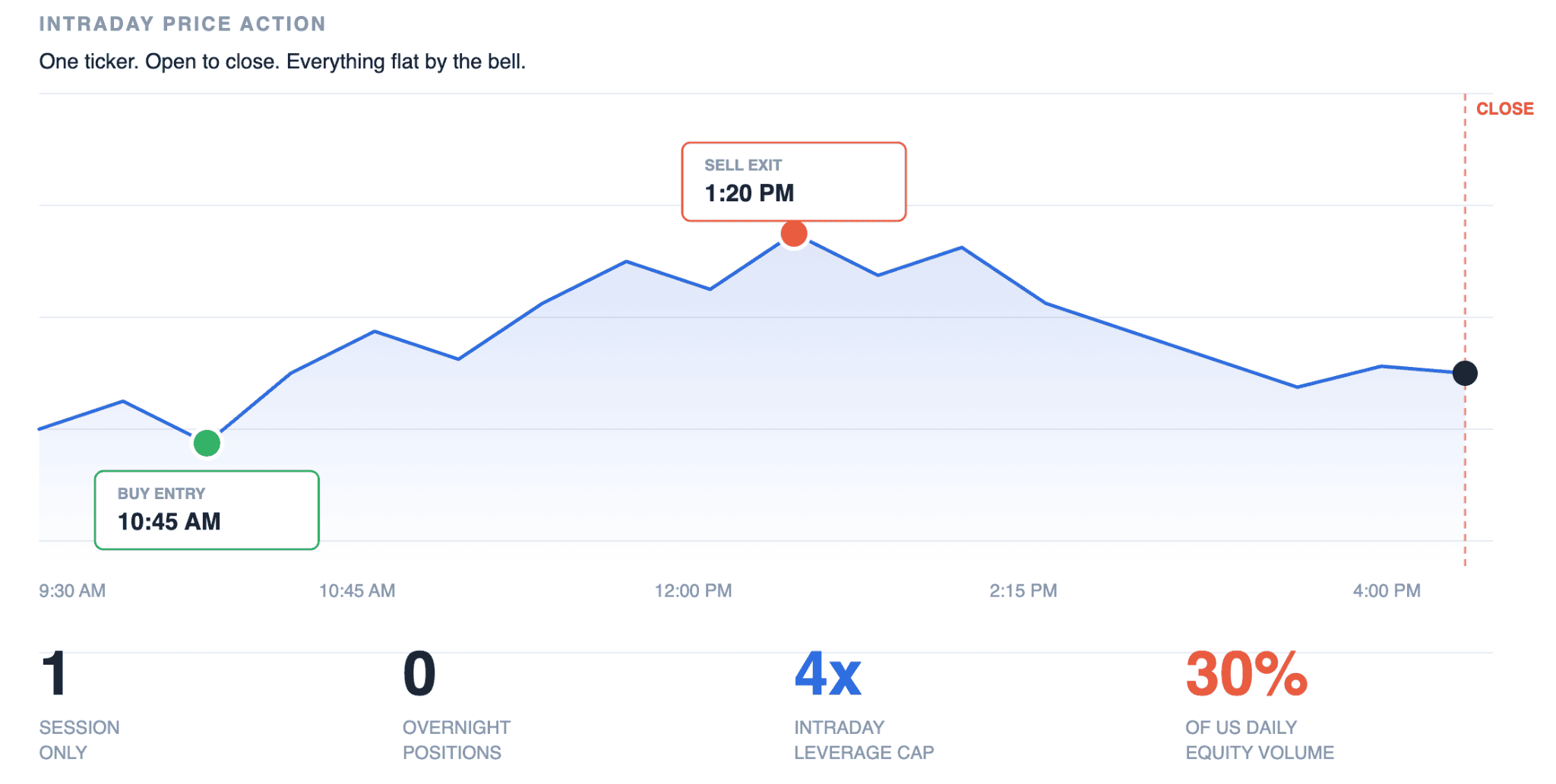
Day trading is the practice of opening and closing trades within the same market session. Positions last anywhere from a few seconds to a handful of hours. They never cross overnight. Traders earn from small price moves rather than a company's long-term story.

The idea sounds clean on paper. A trader buys at 9:45, sells at 11:20, and pockets the difference. Markets rarely move that smoothly in practice. Volatility, spread widening, and sudden news disrupt most setups, which is why so few newcomers survive year one.

"Day trading is not the romance that social media makes it look like. It rewards pattern recognition under pressure, and most people underestimate the discipline it demands."

Who Typically Day Trades

Two groups dominate intraday flow. Institutional desks at banks, hedge funds, and prop firms use algorithms, direct market access, and deep research budgets. Retail traders? Sure. They work from home or a small office. Retail activity now accounts for 30 to 37 percent of daily US equity trading volume, up from roughly 10 percent a decade ago.

Day Trading vs. Long-Term Investing

These two approaches share almost nothing beyond a ticker. One waits for fundamentals to compound over the years—the other lives on the 1-minute chart.

FactorDay TradingLong Term Investing
Holding periodMinutes to hoursYears
FocusPrice and volumeFundamentals
Risk levelVery highModerate
Tax treatmentShort-term ratesLong-term rates
Tools neededReal-time data, chartsAnnual reports

Many professionals run both in parallel. A day trading account covers active income. A long-term portfolio builds lasting wealth.

Key takeaway: Day trading means buying and selling within a single trading session. It runs on price action, not fundamentals, and demands full attention. Institutions and retail traders share the tape, but not the resources. That gap often separates a career from a losing hobby.

How Does Day Trading Work?
How Does Day Trading Work

How does day trading work once the bell rings? Traders watch live price feeds, scan setups, pick their spot, and execute. Success depends on liquidity, volatility, and discipline when a trade moves against them.

Entry and Exit Within the Same Session

A day trade opens after a setup forms. The trader enters with a stop loss, a profit target, and a defined position size. If the price hits the target, the gain gets booked. If the price hits the stop, the loss gets taken quickly. Nothing stays open past the closing bell, which removes overnight gap risk. Speed trips up most new traders. A 30-minute setup can be invalidated in five.

The Role of Leverage and Margin

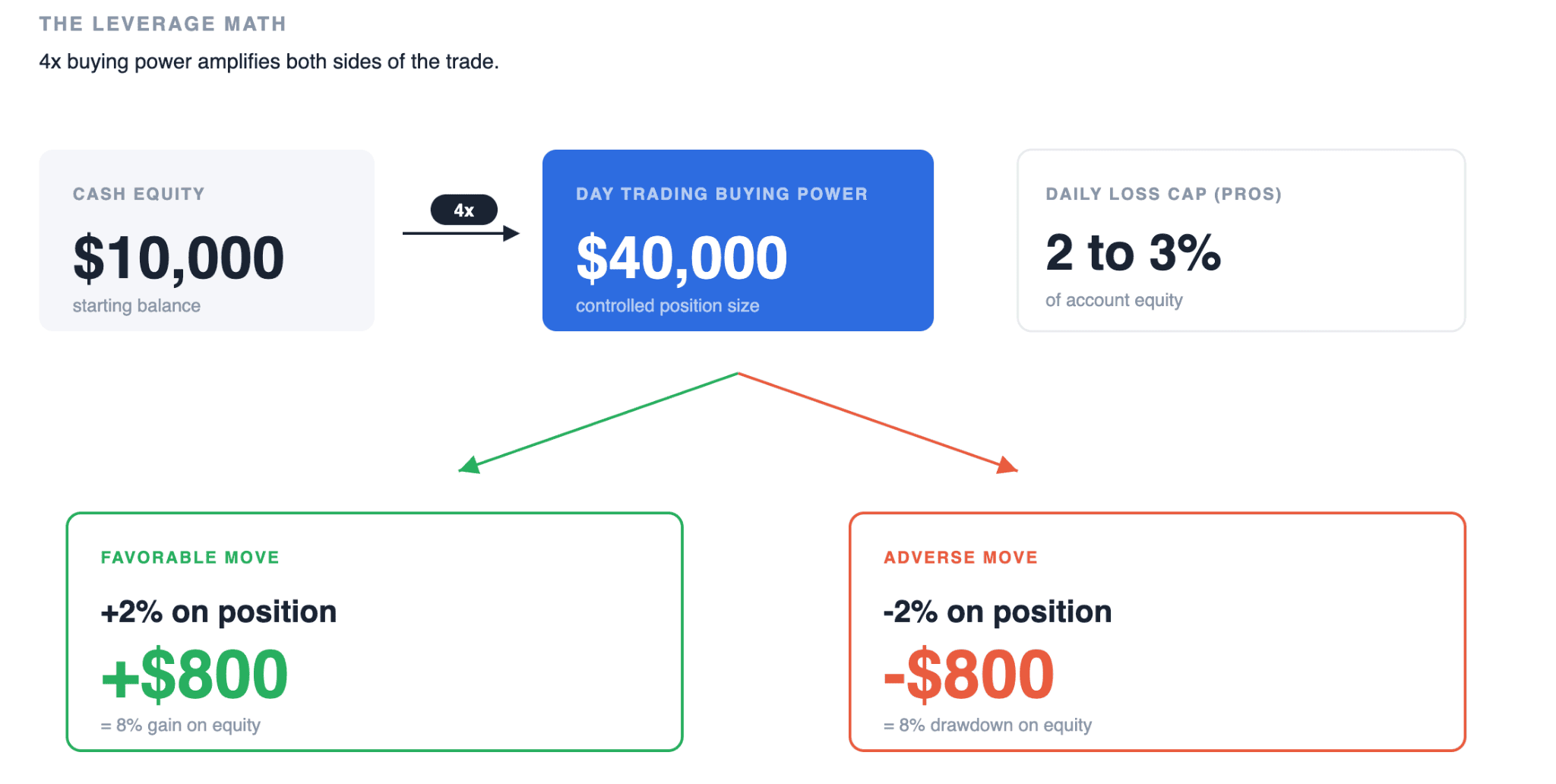
Margin accounts let traders control positions larger than their cash balance. US traders have historically accessed up to 4x day-trading buying power above the maintenance margin. The math cuts both ways. A 2 percent adverse move becomes an 8 percent hit to the account at 4x exposure. Research on 450,000 Taiwan traders from 1992 to 2006 showed that only a small top group earned positive returns after costs.

"Leverage does not create an edge. It amplifies whatever edge or weakness a trader already has."

Key takeaway: Day trading captures small intraday price moves through real-time data, tight risk controls, and liquid markets. Leverage expands both profits and losses. The mechanics stay simple, while execution is where most traders lose money.

Day Trading Rules After the 2026 FINRA Change
Day Trading Rules After the 2026 FINRA Change

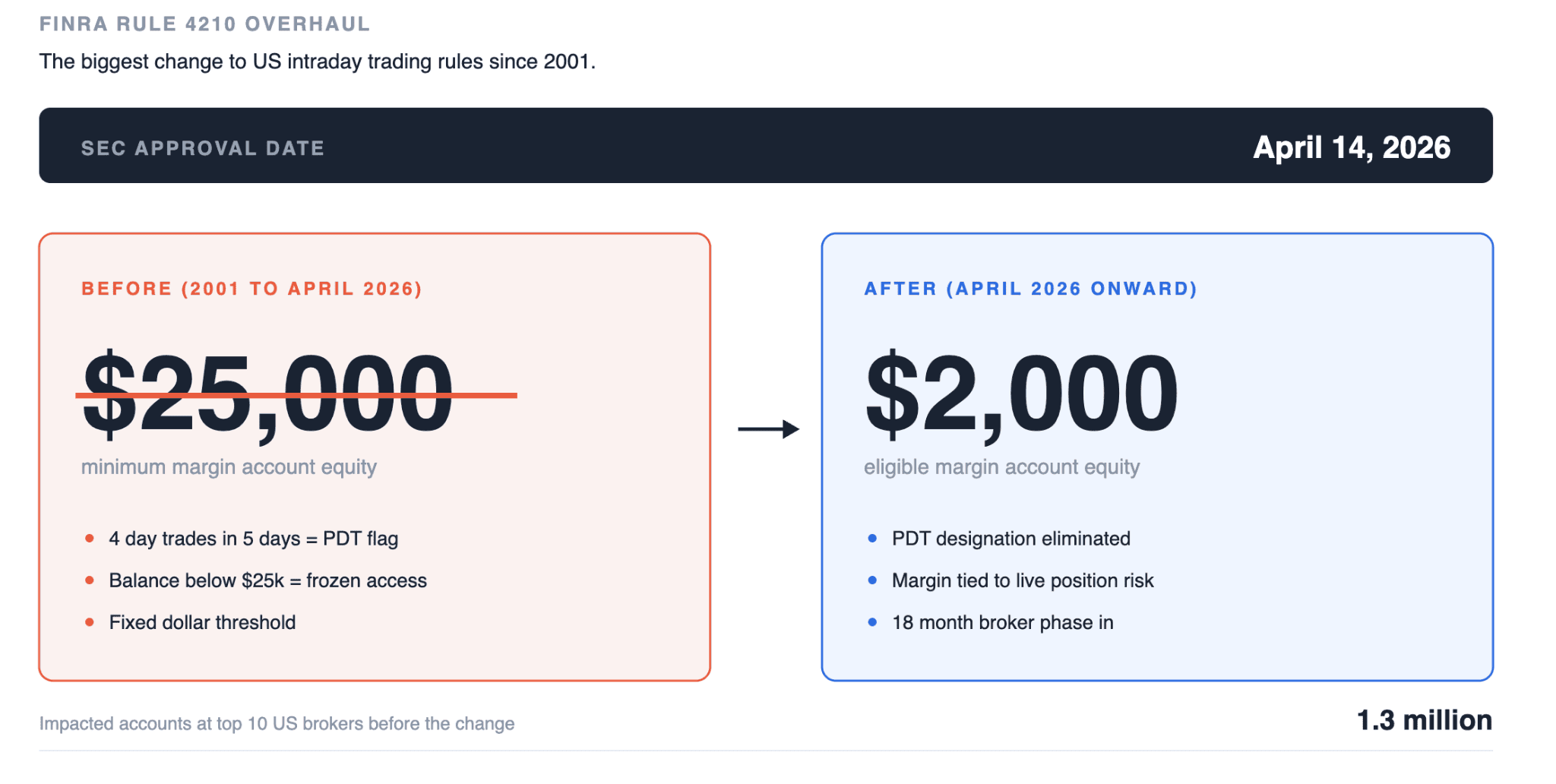
US rules for intraday trading changed on April 14, 2026. The SEC approved FINRA's overhaul of Rule 4210, removing the pattern day trader designation and the $25,000 minimum equity requirement. A framework built on intraday margin standards replaces it. These are the new basics of day trading every US retail trader needs to know.

What the Pattern Day Trader Rule Used to Require

The PDT rule, introduced in September 2001, targeted any margin account that made four or more day trades in five business days. Flagged accounts had to maintain a $25,000 balance at all times. Falling below that line froze day trading access until the balance returned. Roughly 1.3 million accounts across the ten largest US brokers carried the PDT label before the change.

What Replaces the $25,000 Minimum

Brokers now set day-trading buying power based on real-time intraday exposure rather than a fixed dollar threshold. Margin accounts with more than $2,000 in equity qualify for intraday trading. 

Firms can choose between live monitoring and end-of-day checks. The effective date starts 45 days after FINRA's Regulatory Notice, with up to 18 months for firms to transition. Traders should check with their broker before assuming the old rules no longer apply.

Key takeaway: The April 2026 overhaul ended the $25,000 pattern-day-trading floor. New intraday margin rules reflect actual position risk, and accounts above $2,000 can now day trade on margin. Every broker handles the transition on its own timeline. Smaller accounts gain access, while undercapitalized traders face new exposure.

The Most Common Day Trading Strategies
The Most Common Day Trading Strategies

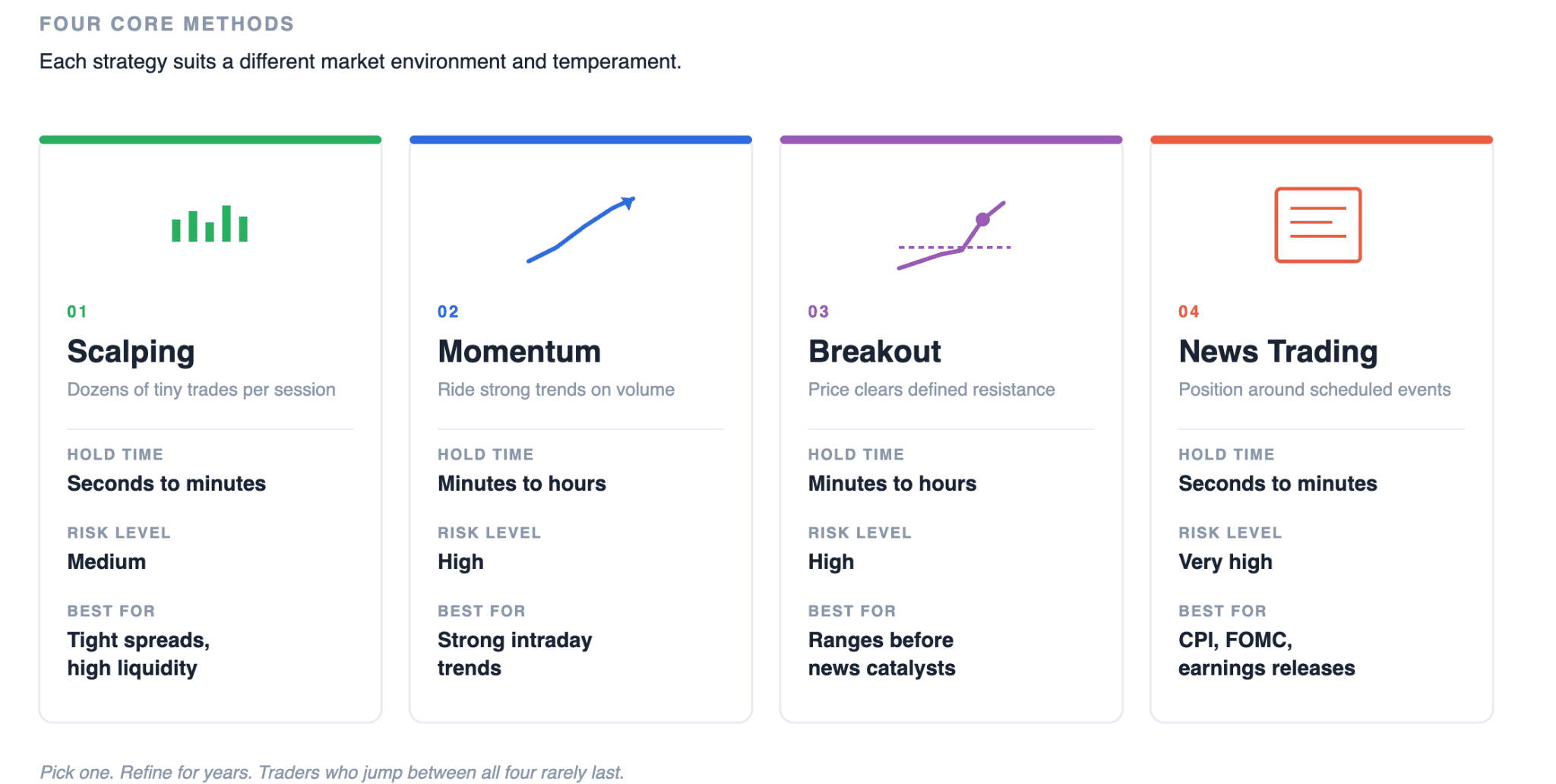
No single strategy works in every market. The four methods below cover most of what serious retail traders actually use.

Scalping

Scalping chases small profits across dozens of trades per session. A scalper holds positions for seconds to a minute or two, targeting a few cents per share. Volume matters more than any single winner. Hundreds of small gains compound into real returns, though transaction costs can drain a scalper in the wrong conditions.

Momentum Trading

Momentum trading enters after a breakout on unusual volume, often around earnings or macro news. Traders buy strength, sell into more strength, and exit the moment momentum fades. A clean momentum day can carry a trader through the entire week. Fading momentum looks identical to continuing momentum until the trend cracks.
Breakout Trading

Breakout setups wait for the price to punch through a clearly defined level. Once a stock clears resistance on strong volume, buyers tend to pile in and extend the move. False breakouts remain the main danger. Without volume confirmation, roughly half of them reverse within the hour.

Become a Confident Trader

Master trading with our structured course designed for beginners and intermediate traders.

Step-by-step lessons
Real strategies
Risk management training

Join 10,000+ traders improving their skills

Start Course Now

News Trading

News traders position around scheduled releases. Fed meetings, CPI prints, and earnings reports all trigger fast, large moves. Spreads widen sharply in the first 30 seconds, making execution expensive. Most retail news traders either wait for the dust to settle or skip the trade.

StrategyHolding TimeRiskBest Market Condition
ScalpingSeconds to minutesMediumTight spreads, high liquidity
Momentum tradingMinutes to hoursHighStrong intraday trends
BreakoutMinutes to hoursHighQuiet ranges before the news
NewsSeconds to minutesVery highScheduled economic releases

Traders who tend to specialize. Picking one method and refining it for years beats jumping across setups.

Key takeaway: Scalping, momentum trading, breakouts, and news trading cover most retail approaches today. Each method demands a different edge, toolset, and risk appetite. Mastering one beats sampling all four. Commitment to a tested method separates winners from the crowd.

Tools Every Day Trader Needs

Tools Every Day Trader Needs

Good tools will not save a weak strategy, though poor tools can sink a good one. Newcomers often underestimate this part of the business.

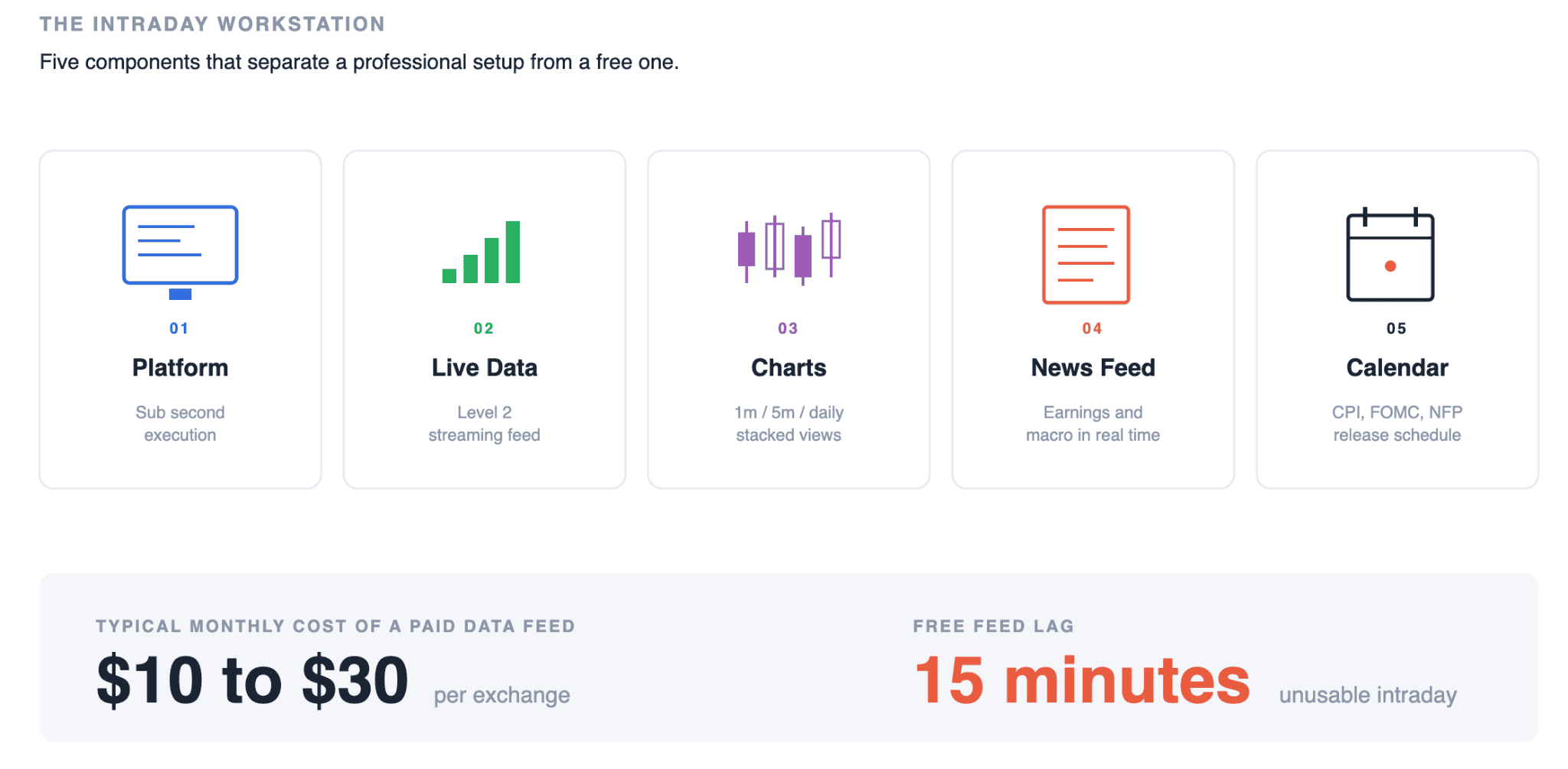
A complete intraday setup covers the following:

  • Fast trading platform
  • Real-time market data
  • Multiple chart views
  • Live news feed
  • Economic calendar

Each element supports the others. Stale data paired with a slow platform costs money on every trade.

Trading Platform and Real-Time Data

The broker's platform is the cockpit. Level 2 quotes, direct order routing, and sub-second execution separate professional tools from retail toys. Free data feeds often lag by 15 minutes, which is unusable for intraday work. Paid real-time feeds typically cost $10 to $30 per month through most US brokers.

Charting and Technical Indicators

Most day traders watch several time frames at once. The 1-minute chart handles entries. The 5-minute show has structure. The daily provides context. VWAP, moving averages, and volume indicators form the core toolkit. Anything beyond that comes down to personal preference.

News Feeds and Economic Calendars

Markets react to news within milliseconds, and social media often beats official wires. A Bloomberg or Benzinga feed delivers earnings revisions, analyst notes, and M&A headlines as they land. Economic calendars flag Fed meetings, CPI, NFP, and GDP prints for the week.

Reliable internet access and a backup order-entry method round out the day trading basics that every professional relies on.

Key takeaway: Day trading tools cover platform speed, real-time data, multi-time frame charts, and fast news. They form the operating infrastructure of any serious trader. A modest monthly budget for data and charting outperforms a free setup on almost every decision. Building the workspace comes before risking real capital.

How to Start Day Trading Step by Step

How to Start Day Trading Step by Step

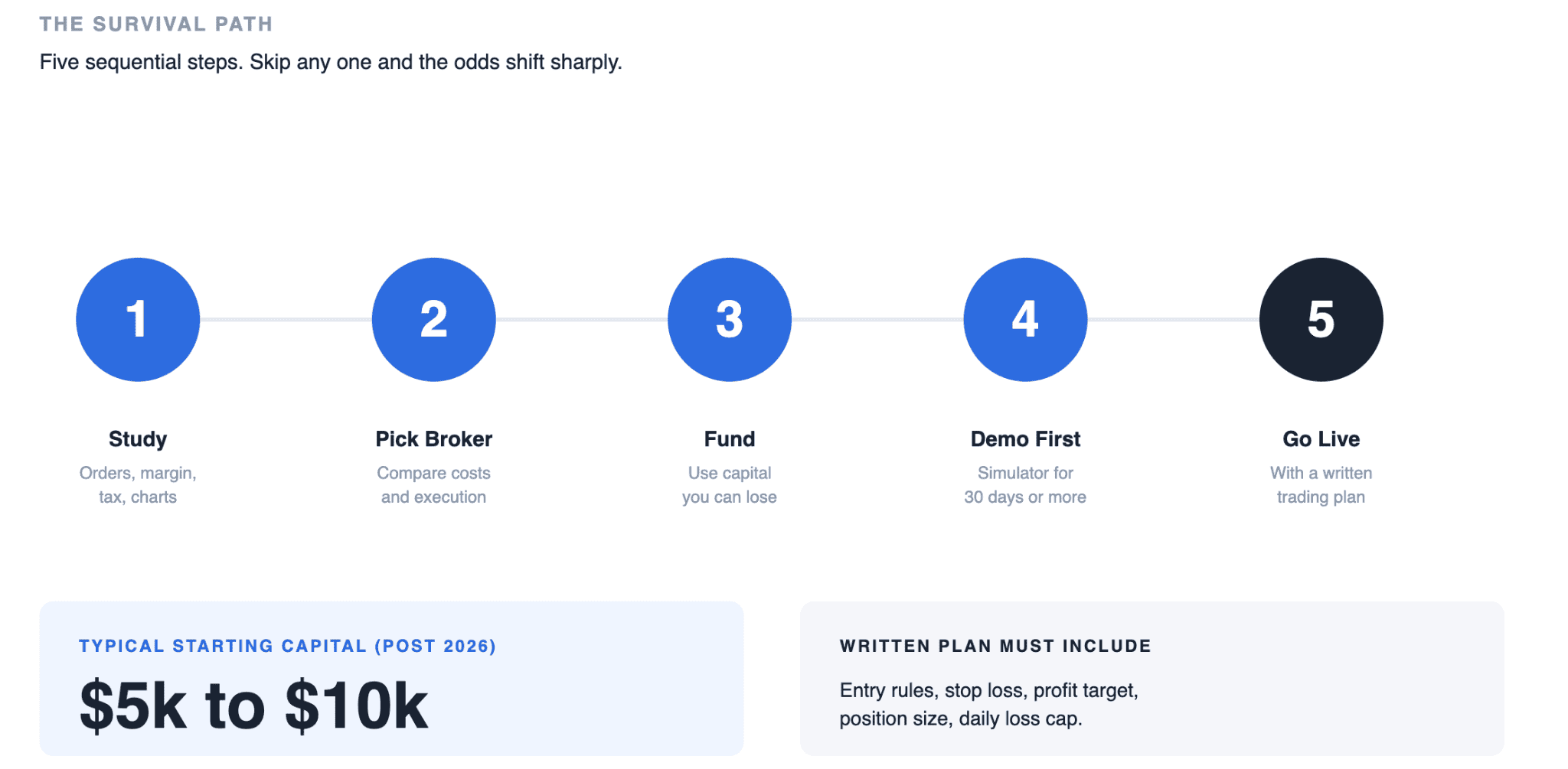
Starting takes patience more than capital. Learning how to do day trading the right way begins long before the first live order. Most newcomers skip preparation and pay for it within six months.

The basic path covers these steps:

  1. Study market mechanics
  2. Open a broker account
  3. Fund with disposable capital
  4. Run a demo first
  5. Go live with a written plan

Each step matters. Skipping any of them reduces the odds of long-term survival.

Learn the Fundamentals of Day Trading

Reading comes before risking. New traders should study order types, margin mechanics, tax treatment, and chart patterns. Mark Douglas on trading psychology and Linda Raschke on setups remain standard references. The fundamentals of day trading are not glamorous, though they separate the prepared from the guessers.

Choose a Broker and Fund Your Account

Compare commissions, execution quality, platform features, and margin rates before signing up. Interactive Brokers, Charles Schwab, and TradeStation are common choices for serious US retail. With the PDT rule gone, many traders can now start with $5,000 to $10,000 rather than the old $25,000 floor.

Practice Before Going Live

Running a strategy in a simulator for at least a month builds pattern recognition. Paper trading cannot replicate the emotional weight of a real loss, though it surfaces plan weaknesses fast. A trade journal from day one is non-negotiable. Weekly review catches mistakes before they repeat.

How to Day Trade Stocks with a Written Plan

A written plan is the habit with the highest ROI in retail trading. It defines entry rules, stop-loss levels, profit targets, position size, and maximum daily loss. Anyone learning how to day trade stocks should start here before placing a single live order.

"Traders who survive keep losses small and let the market teach them, not their ego. Meanwhile, most losing traders never commit their rules to paper."

Key takeaway: Learn the mechanics, pick a broker, fund an account that can absorb losses, and run a demo before going live. A written plan removes emotion from decision-making. Process beats talent over any twelve-month window. Skipping these steps turns trading into guessing.

Who Actually Makes Money from Day Trading

The profitability data has been consistent for 25 years. Regulators and academic researchers reach the same conclusion across every market studied.

Institutional Traders and Their Edge

Institutional desks win more often because they own the infrastructure. Direct market access, colocated servers, millisecond execution, and research teams create structural advantages. A 2009 study by Barber, Lee, Liu, and Odean showed that institutional traders in Taiwan earned a 1.5-percentage-point annual performance boost, while individuals lost 3.8 percentage points.

The Reality for Retail Traders

Retail day traders face a much steeper slope. FINRA's 2020 retail data showed 72 percent of day traders ended the year with net losses. The Barber paper on Taiwan identified only the top 500 of hundreds of thousands as consistently profitable. 

Those top traders earned roughly 38 basis points per day after costs. The minority that succeeds follows a clear playbook. They risk 1-2 percent per trade. They stop at a daily loss limit. They never trade in revenge.

Key takeaway: Institutional traders win because they have tools, capital, and research that retail cannot match. Most retail day traders lose money, and 80 percent quit within two years. A small minority earns consistent profits through discipline rather than raw talent. The odds favor preparation, not aggression.

The Main Risks of Day Trading

The Main Risks of Day Trading

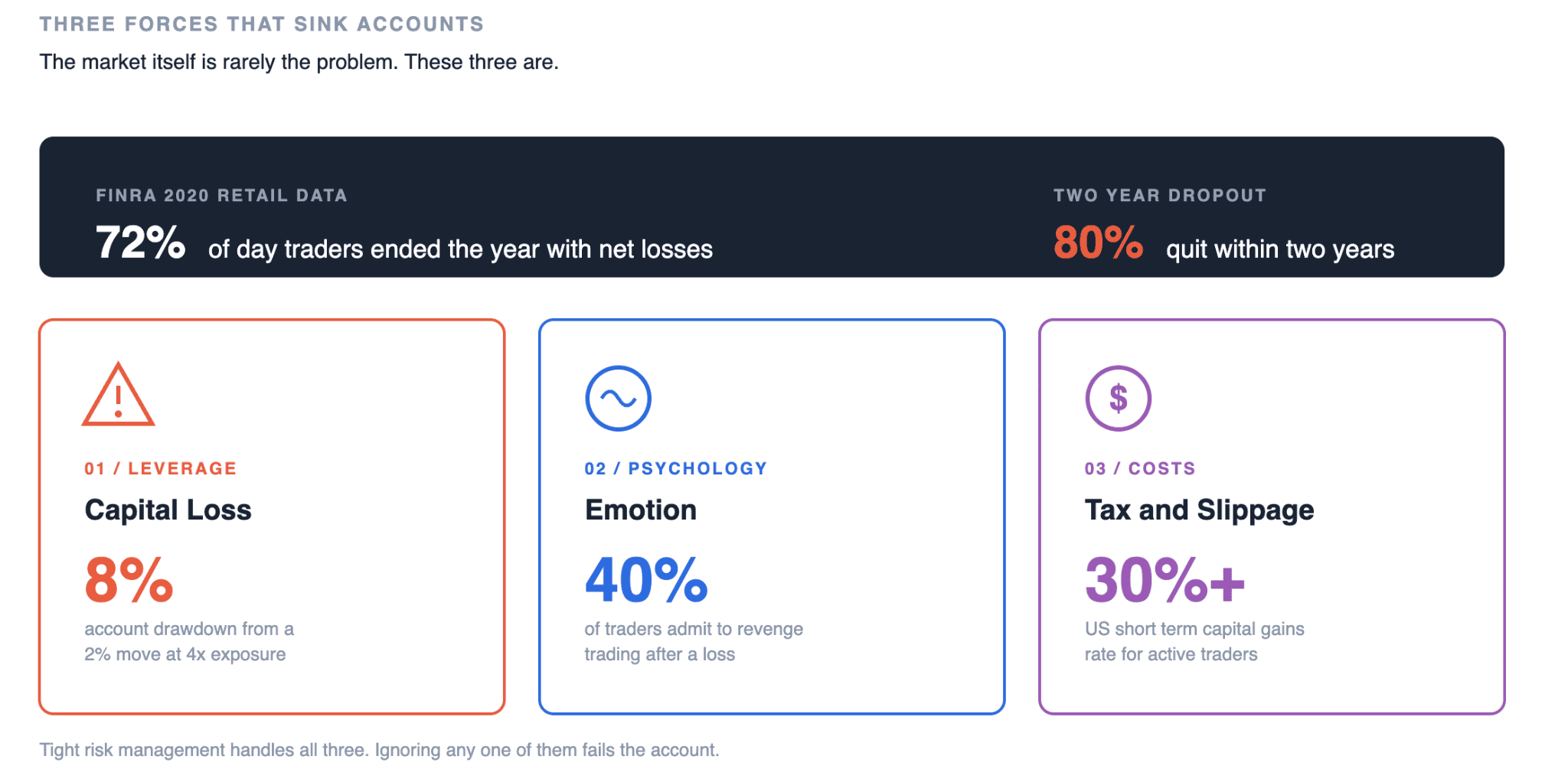
Every day trader works against three forces that sink most accounts. The market itself is rarely the problem. Leverage, emotion, and costs do far more damage than any single bad trade ever could. Understanding how each one works is the first step toward building defenses that actually hold under pressure.

Capital Loss and Leverage Amplification

Leverage is the fastest way to lose serious money quickly. A 2 percent adverse move at 4x exposure becomes an 8 percent account drawdown. Five of those in a month wipes out 30 percent of capital. Professional desks cap daily loss at 2 to 3 percent of equity for exactly this reason.

Emotional and Psychological Pressure

Trading is a psychological test dressed up as a financial activity. Fear blocks good trades. Greed holds losers too long. Revenge drives the worst decisions of all. Most new traders quit after an emotional blow-up rather than a gradual loss.

"Discipline is not a personality trait. It is a system built around the trader to keep emotion out of execution."

Costs, Taxes, and Slippage

Hidden costs wear down returns. Commissions, platform fees, data feeds, exchange fees, and slippage stack up across hundreds of monthly trades. Short-term capital gains in the US are taxed at ordinary income rates, which can top 30 percent for active traders. The difference between a winning and losing year often comes down to cost control. Risk management is the discipline that keeps these three enemies contained.

Key takeaway: Capital loss, psychology, and costs are the three main risks of day trading. Leverage multiplies the first. Emotion drives the second. Frequent trading creates the third. Strict risk-management rules address all three, while ignoring them is how most accounts fail.

Wrapping It Up

Day trading

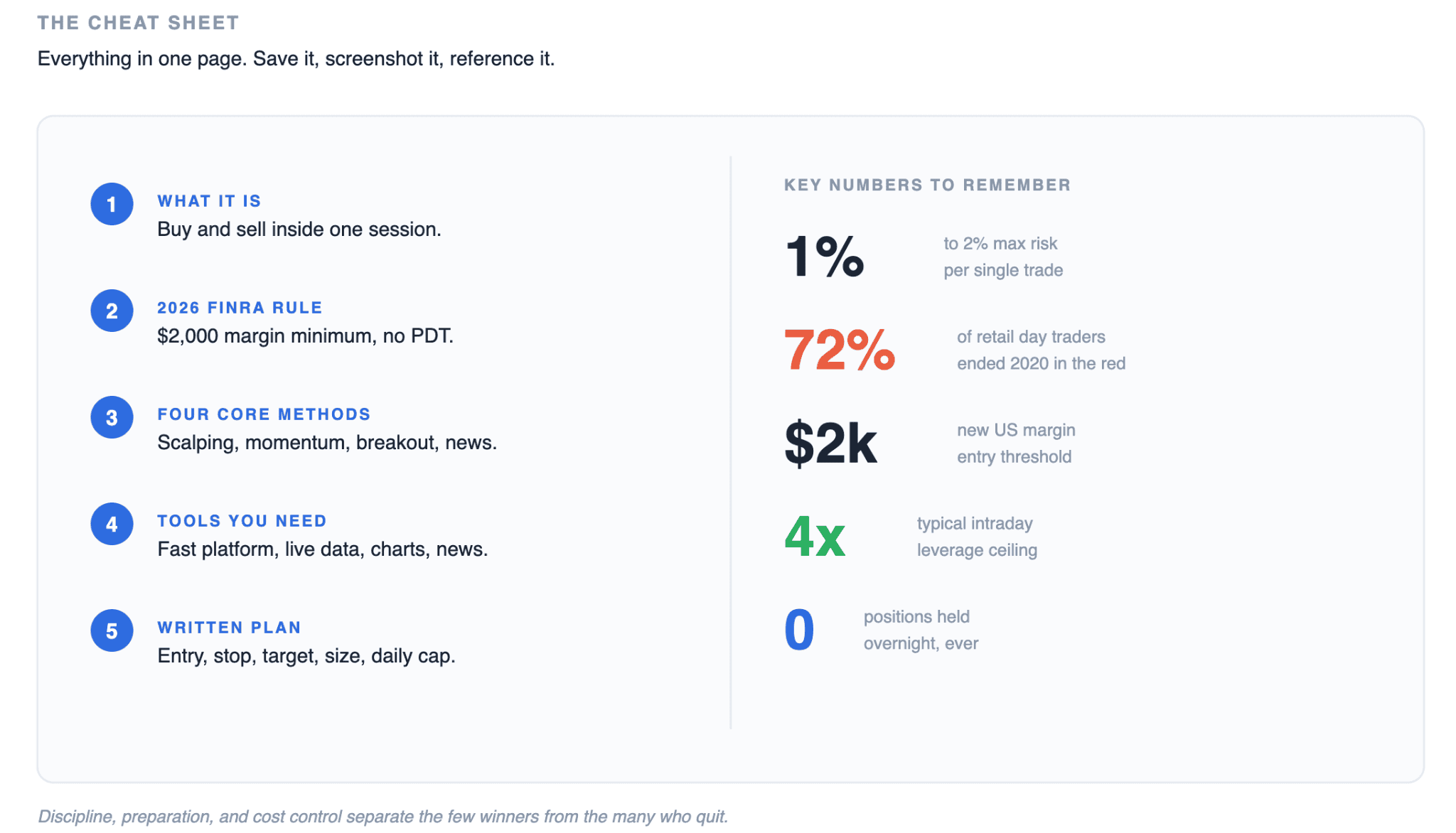
Day trading is a short-term strategy focused on buying and selling within one market session. The US removed the $25,000 pattern day trader minimum in April 2026, replacing it with intraday margin rules. Four core strategies cover most retail activity. 

Most traders lose money regardless of which one they pick. Strict risk management, a written plan, and genuine preparation separate the rare winners from the 80 percent who quit.

Frequently Asked Questions

Disclaimer: This article is for informational purposes only and does not constitute financial advice. Trading involves risk and may result in loss of capital.

Related Articles

The First Move Is Yours

Discover how Supertrade can transform your trading career. Explore challenges, access instant funding, and join a growing community of Supertraders.

Stay Ahead of the Game

Sign up to receive exclusive tips, market insights, and the latest updates from Supertrade. Don’t miss out on opportunities to grow your trading success.
how it works

Our Community

Do not skip any beat.

The Ultimate Trading Community. Join our Discord server to get the latest updates, news and more.

2026 Supertrade. All rights reserved
DiscordFacebookInstagramTelegramYouTubeXTikTok
Trading involves significant risk. Past performance is not indicative of future results. This is a simulated trading environment. Supertrade provides educational trading services.
Supertrade
Supertrade Ltd, a company incorporated under the laws of Saint Lucia with registered number 2024-00699, located at Ground Floor, Rodney Court Building, Rodney Bay, Gros Islet, Saint Lucia, LC01 101, operates and owns this website, as well as provides services under the Terms and Conditions posted on the website. Supertrade Prop Ltd, a company incorporated under the laws of England and Wales with registered number 16234284, located at 52-56 Standard Road, London, England, NW10 6EU, acting as a payment agent.