

Trading Basics

Apr 3, 2026 - 10 min

Beginner

What Is Paper Trading? Definition, How It Works, and Where to Start

single article hero

Traders lose real money when they skip the learning phase. Paper trading gives you a way to practice buying and selling financial instruments using virtual funds, so you build skill before you risk capital. Today’s article explains what paper trading is, its real meaning, how simulators work in 2026, and exactly where to start.

Justin Freeman
Reviewed by:
Share
Listen to this article
0:000:00

Paper Trading: Fast Facts for 2026

What is paper trading?Simulated trading with virtual money, no real capital at risk
Who uses it?Beginners and experienced traders alike
Same as a demo account?Yes, a demo is the digital version of paper trading
How long to practice?1 to 3 months with documented, consistent results
Does it help for live trading?It covers mechanics, but not emotional pressure
Making real money from it?No, all gains and losses are virtual.

What Is Paper Trading?

What Is Paper Trading?

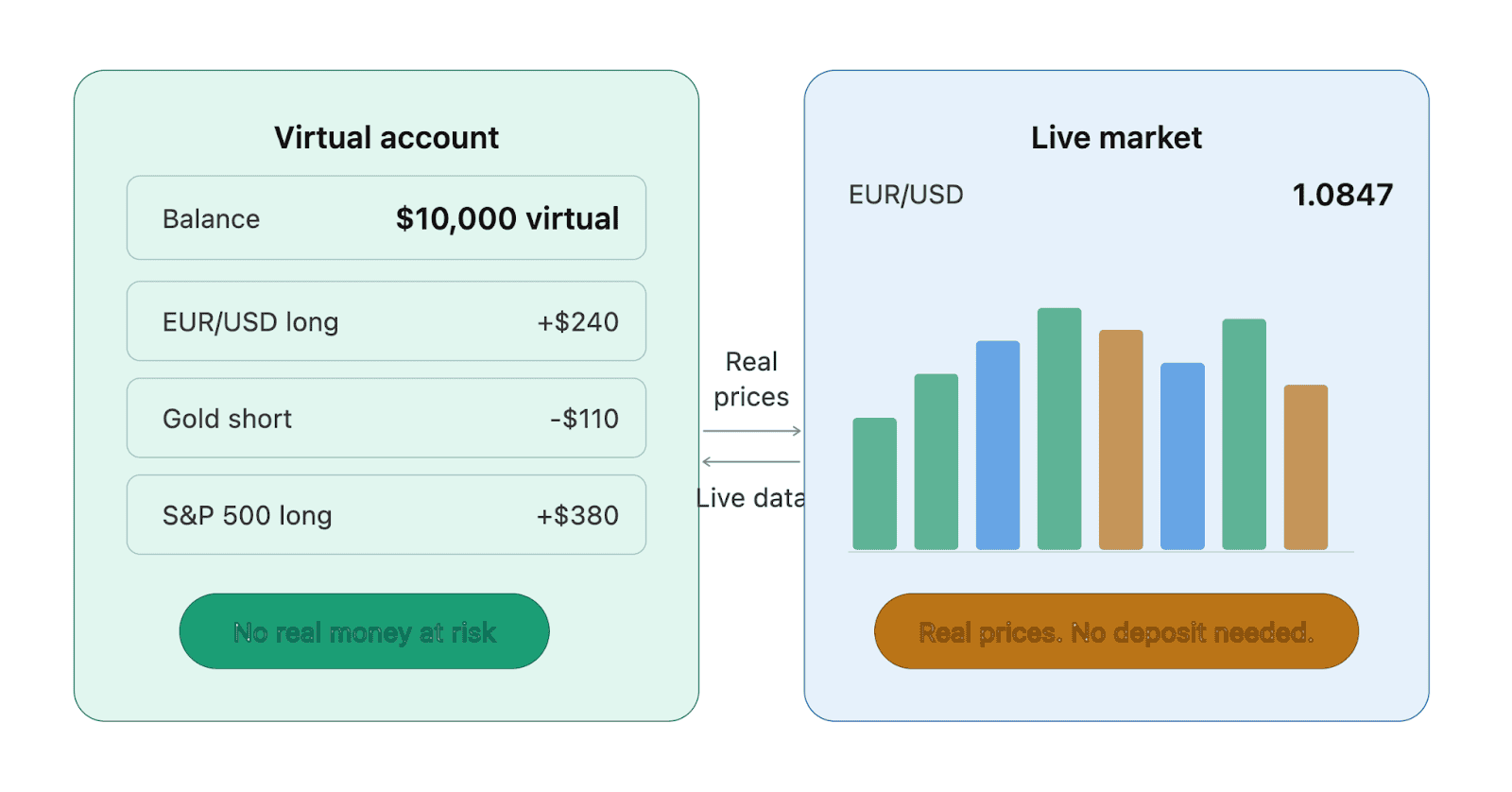
Paper trading is the practice of executing simulated trades in real market conditions with virtual funds rather than real capital. You place orders, track positions, and measure results exactly as you would in a live account. The only difference is that no real money moves.

The name comes from a time when traders literally wrote hypothetical trades on paper, tracking prices by hand to see how their ideas would have performed.

Paper Trading Meaning in Simple Terms

The paper trading definition is straightforward. You get a virtual account loaded with a set amount of simulated funds. You use those funds to buy and sell assets at real market prices.

“Your gains and losses are tracked, but none of it affects your actual finances.”

Think of it as a full-scale rehearsal in a real market environment. The prices, volatility, and order types are real. Only the money is not.

How a Paper Trade Works Step by Step
How a Paper Trade Works Step by Step

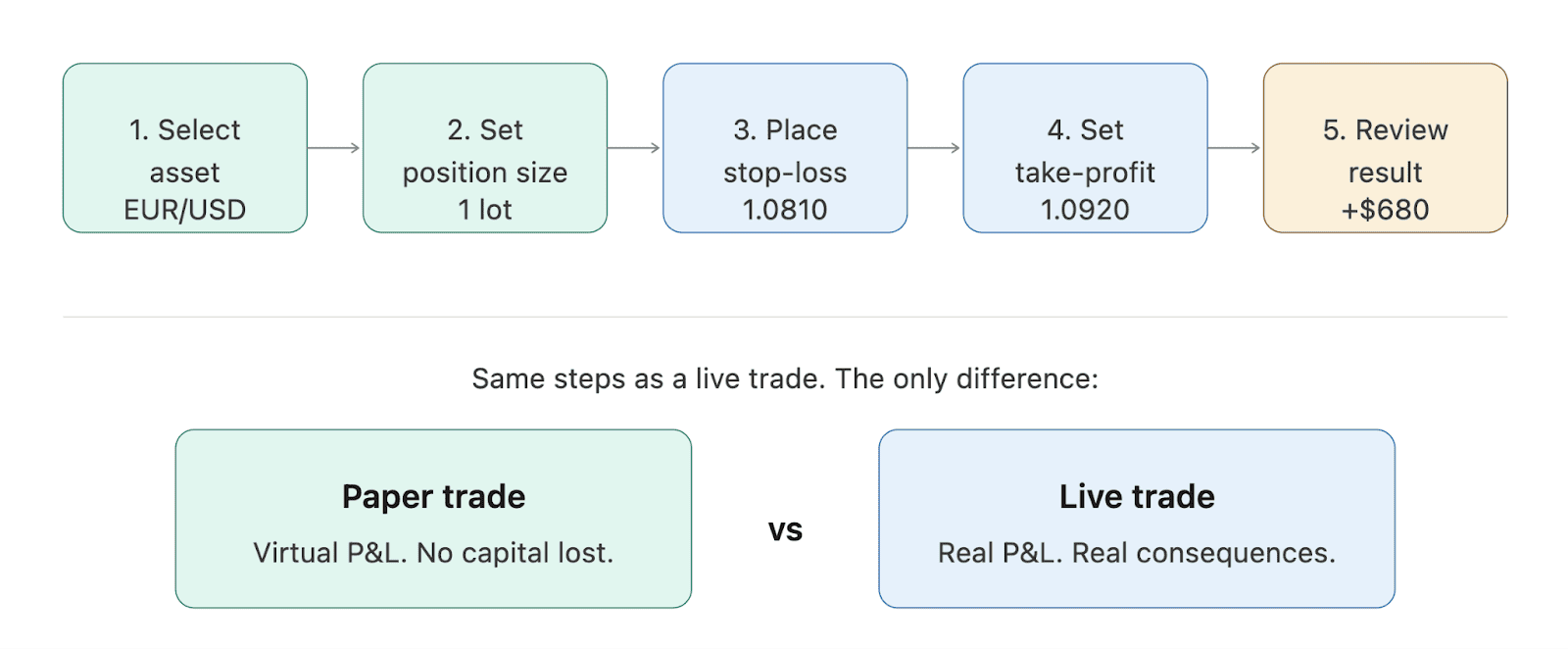
A paper trade follows the same process as a live trade. You select an asset, choose an order type, set your position size, and execute. The platform records the fill at the current market price and updates your virtual portfolio accordingly.

The key variables you practice include:

  • Entry and exit timing
  • Position size vs virtual balance
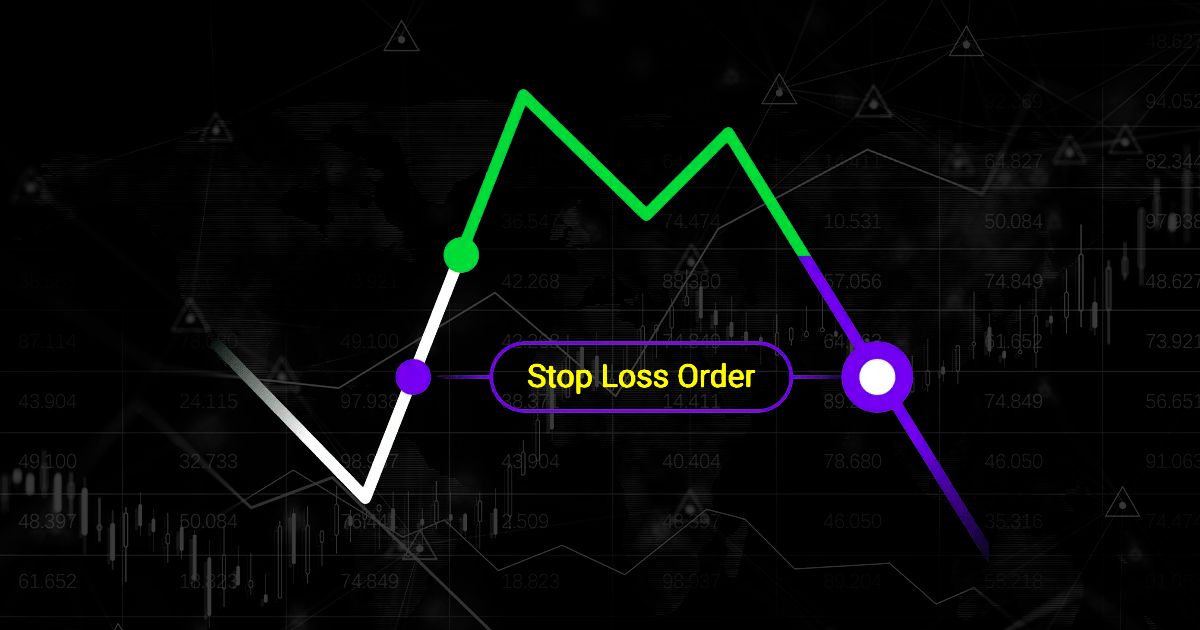
  • Stop-loss and limit order placement
  • Reading price action under volatility

Practicing these steps repeatedly builds the muscle memory you need before you switch to a live account. 

Key takeaway: Paper trading is simulated trading in real market conditions using virtual funds. It originated as a manual practice and evolved into digital simulators that mirror live platforms.

Paper Trading vs Live Trading: Key Differences

Simulated and live trading share the same market structure, instruments, and order logic. The differences are significant enough that treating them as equivalent leads to costly surprises.

The table below covers the most important points of comparison:

FactorPaper TradingLive Trading
Capital at riskCapital at riskNoneReal money
Emotional pressureMinimalHigh
Order fillsOften idealSubject to slippage
Costs modeledSometimes excludedAlways apply
Hard to developHard to developConstantly tested
Result validityIndicativeReal

Understanding where they diverge helps you use the practice phase more effectively.

What Paper Trading Cannot Replicate

The mechanics of a virtual account are accurate. The psychology is not. When you trade with real money, fear and greed affect every decision you make. You hesitate on entries. You hold losing positions too long. You close winners too early. None of that happens the same way when the money is not real.

“Overconfidence built in a simulated environment is one of the most studied problems in trading psychology.” 
Become a Confident Trader

Master trading with our structured course designed for beginners and intermediate traders.

Step-by-step lessons
Real strategies
Risk management training

Join 10,000+ traders improving their skills

Start Course Now

Research published in the Journal of Finance documents how investors overreact to private signals and underreact to public ones. Paper trading does nothing to correct this bias because there is no real consequence to reinforce discipline.

Market impact, liquidity, and frictional costs may contribute to slippage. This matters most in volatile conditions, where the gap between expected and actual fills can entirely change the outcome of a trade.

When to Move from Paper to Live

The transition from simulated to live trading should be based on documented performance, not confidence alone. Set a specific threshold before you start the practice phase. Aim for a win rate and risk-reward ratio that hold up over at least 50 executed trades. 

“When your results are consistent, and your process is documented, the move to a live account becomes a structured step rather than a leap.”

Investopedia recommends that paper trading simulate actual trading conditions as closely as possible, including starting with the same capital amount you plan to use in a live account. That discipline in the practice phase is what makes the transition meaningful.

Key takeaway: Paper and live trading share the same market mechanics but differ sharply in psychology, fills, and cost modeling. Simulated results do not guarantee live performance. Move to a live account only after you have documented consistency across a meaningful sample of trades.

Who Uses Paper Trading and Why

Who Uses Paper Trading and Why

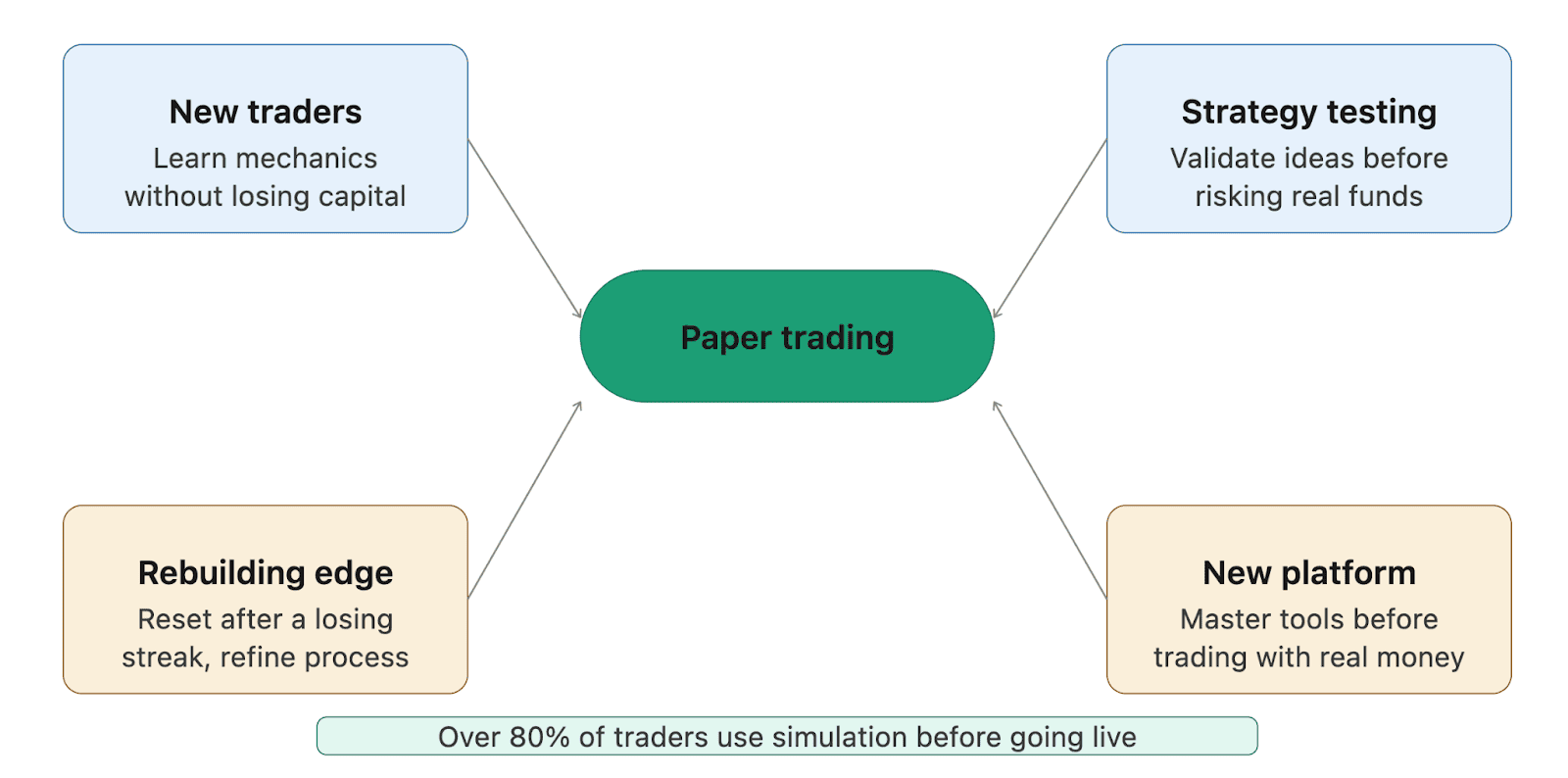
The assumption that simulators are only for beginners is wrong. Experienced traders use virtual environments regularly to stress-test new ideas without exposing active capital. The Corporate Finance Institute describes paper trading as a tool for any individual making trades without committing real money, regardless of experience level. Still wondering why it’s worth trying?  

Let’s check them below.

Testing a New Trading Strategy

Before you apply any new approach to a live account, you need evidence that it works under current market conditions. A demo environment lets you run a strategy across multiple market scenarios, track the results, and refine your entry and exit rules before you commit real funds.

Getting Comfortable With a New Platform

Every trading platform has its own layout, order-entry logic, and risk-management tools. Learning a new interface under live-market pressure is a fast way to make execution mistakes. The paper trading platform first removes that variable entirely. When you move to a live account on a platform you have already practiced, your attention stays on the trade rather than on finding the right button. 

Key takeaway: Simulators serve traders at every level. New traders use them to learn market mechanics. Experienced traders use them to validate strategies and master new platforms. The common thread is reducing avoidable risk before real capital is involved.

Where to Start Paper Trading as a CFD Trader

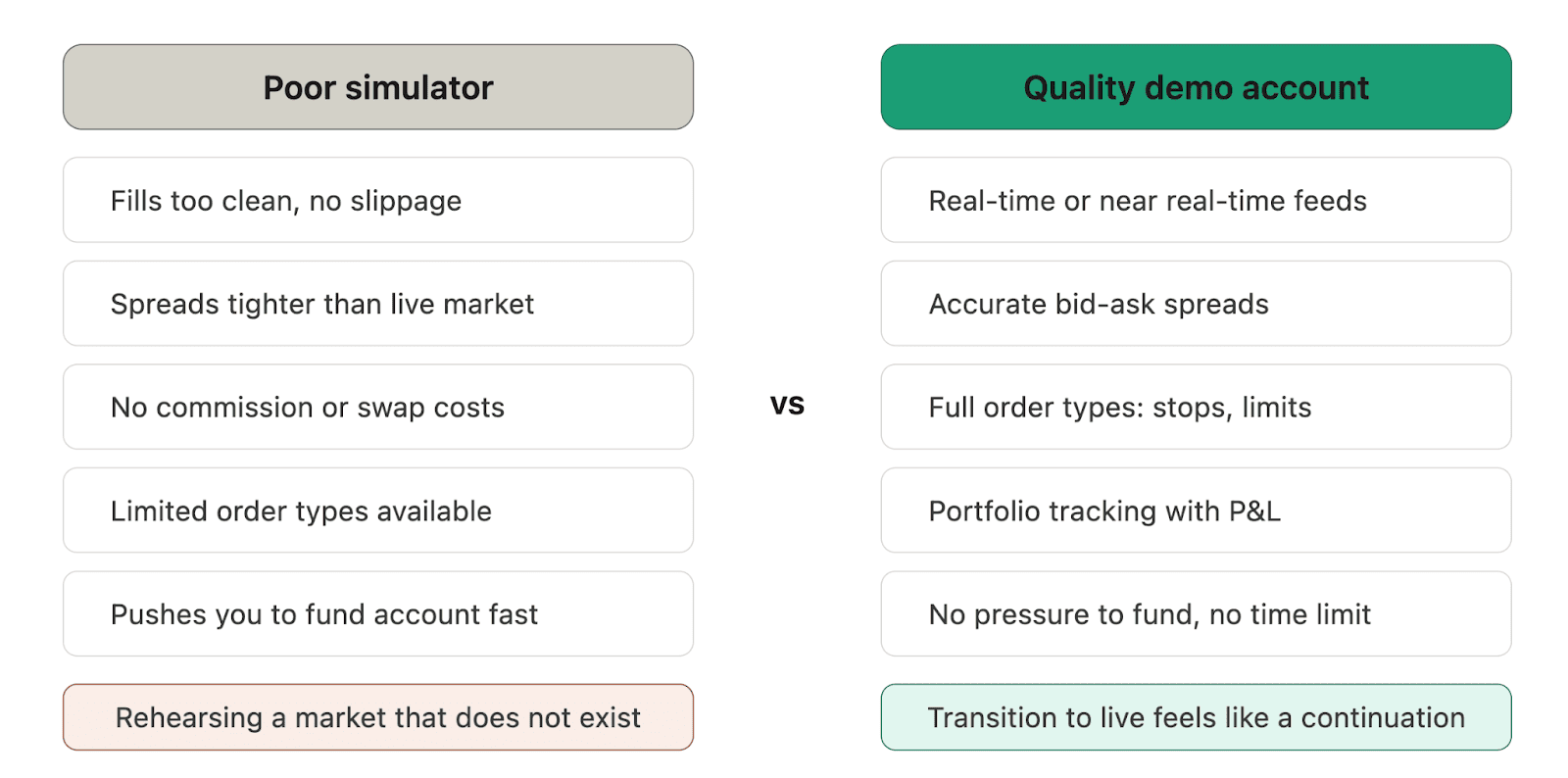
Not all simulators are built the same way. A quality demo account should mirror the live trading environment as closely as possible. That means real spreads, real order types, and execution behavior that matches what you will encounter when real capital is at stake.

“The gap between a realistic simulator and a simplified one matters more than most beginners expect.” 

If your practice environment gives you fills that are too clean, spreads that are too tight, or none of the costs you will face in a live account, you are rehearsing for a market that does not exist.

5 Things to Look for in a Paper Trading Environment

5 Things to Look for in a Paper Trading Environment

A simulator that actually prepares you for live trading should include the following:

  • Real-time or near real-time price feeds
  • Accurate bid-ask spreads on all instruments
  • Full range of order types, including stops and limits
  • Portfolio tracking with entry, exit, and running P&L
  • No pressure to fund a live account to maintain access

These features ensure your testing phase reflects real conditions rather than an idealized version of them. The closer the simulator is to the live environment, the shorter and less painful your adjustment period will be.

How to Start Paper Trading: A Practical Checklist

Starting a simulated trading practice is straightforward if you apply the same discipline you would to a live account. 

Follow this sequence:

  1. Match the virtual balance to your planned deposit
  2. Define your strategy before your first trade
  3. Apply the same position sizing rules throughout
  4. Record every trade with your entry reasoning
  5. Review results weekly, not just after wins
  6. Set a clear performance target before going live

The journal is not optional. The habits you build during paper trading carry directly into live trading. If you skip the documentation step in a simulated account, you will skip it in a live account too. That makes it impossible to identify what is working and what needs to change.

“Match your practice conditions to your intended live trading environment. The goal is to make the transition to a live account feel like a continuation rather than a new experience.”

Key takeaway: Start paper trading with the same discipline you plan to bring to a live account. Match your virtual balance, position sizing, and journaling habits to your real trading plan. The simulation phase builds the process. The live account tests it.

Final Words: What You Need to Know About Paper Trading

Paper trading is a simulated practice method that lets you trade real markets with virtual funds. It covers mechanics, strategy testing, and platform familiarity without financial risk. It does not replicate the psychological pressure of real capital, so treat it as a structured phase with a clear endpoint.

Frequently Asked Questions

Disclaimer: This article is for informational purposes only and does not constitute financial advice. Trading involves risk and may result in loss of capital.

Related Articles

The First Move Is Yours

Discover how Supertrade can transform your trading career. Explore challenges, access instant funding, and join a growing community of Supertraders.

Stay Ahead of the Game

Sign up to receive exclusive tips, market insights, and the latest updates from Supertrade. Don’t miss out on opportunities to grow your trading success.
how it works

Our Community

Do not skip any beat.

The Ultimate Trading Community. Join our Discord server to get the latest updates, news and more.

2026 Supertrade. All rights reserved
DiscordFacebookInstagramTelegramYouTubeXTikTok
Trading involves significant risk. Past performance is not indicative of future results. This is a simulated trading environment. Supertrade provides educational trading services.
Supertrade
Supertrade Ltd, a company incorporated under the laws of Saint Lucia with registered number 2024-00699, located at Ground Floor, Rodney Court Building, Rodney Bay, Gros Islet, Saint Lucia, LC01 101, operates and owns this website, as well as provides services under the Terms and Conditions posted on the website. Supertrade Prop Ltd, a company incorporated under the laws of England and Wales with registered number 16234284, located at 52-56 Standard Road, London, England, NW10 6EU, acting as a payment agent.