
Trading Basics

May 20, 2025 - 20 min

Beginner

Updated: Jun 1, 2026

What Is Trading: How It Works, What You Can Earn, and Where to Start

What Is Trading: How It Works, What You Can Earn, and Where to Start

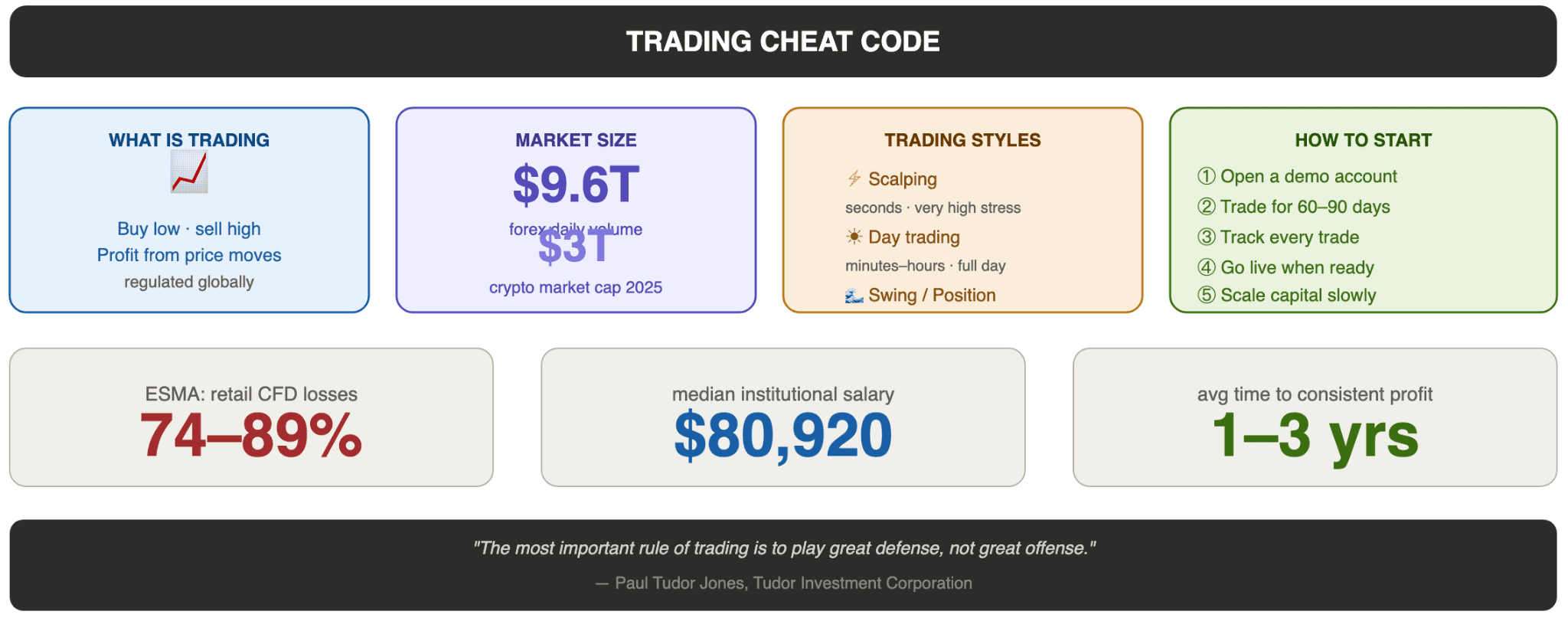
Trading is the buying and selling of financial assets to profit from price movements. Understanding the point of what is trading and how it works is the first real step toward participating in the largest markets on earth. The forex market alone processes $9.6 trillion every single day. This guide covers how trading works, what you can trade, the different styles that exist, and what it genuinely takes to build a profitable approach from scratch.

Justin Freeman
Reviewed by:
Share

Trading at a Glance: Six Key Facts

Before going deeper, here are the numbers that define the trading world in 2026. Every figure below comes from a primary regulatory or institutional source.

  • Trading definition: buying and selling assets to profit from price changes
  • Forex daily volume: $9.6 trillion (BIS, April 2025)
  • Global crypto market cap end-2025: $3.0 trillion
  • NYSE average daily equity volume: $80.6 billion (Cboe, Nov 2025) 
  • Main tradeable markets: stocks, forex, commodities, indices, crypto
  • Key regulators: SEC, CFTC, FCA, ESMA

Key takeaway: Trading spans trillions in daily volume across multiple regulated markets worldwide. You can start learning through a free demo account before committing any real capital.

Trading Meaning: What Trading Actually Is
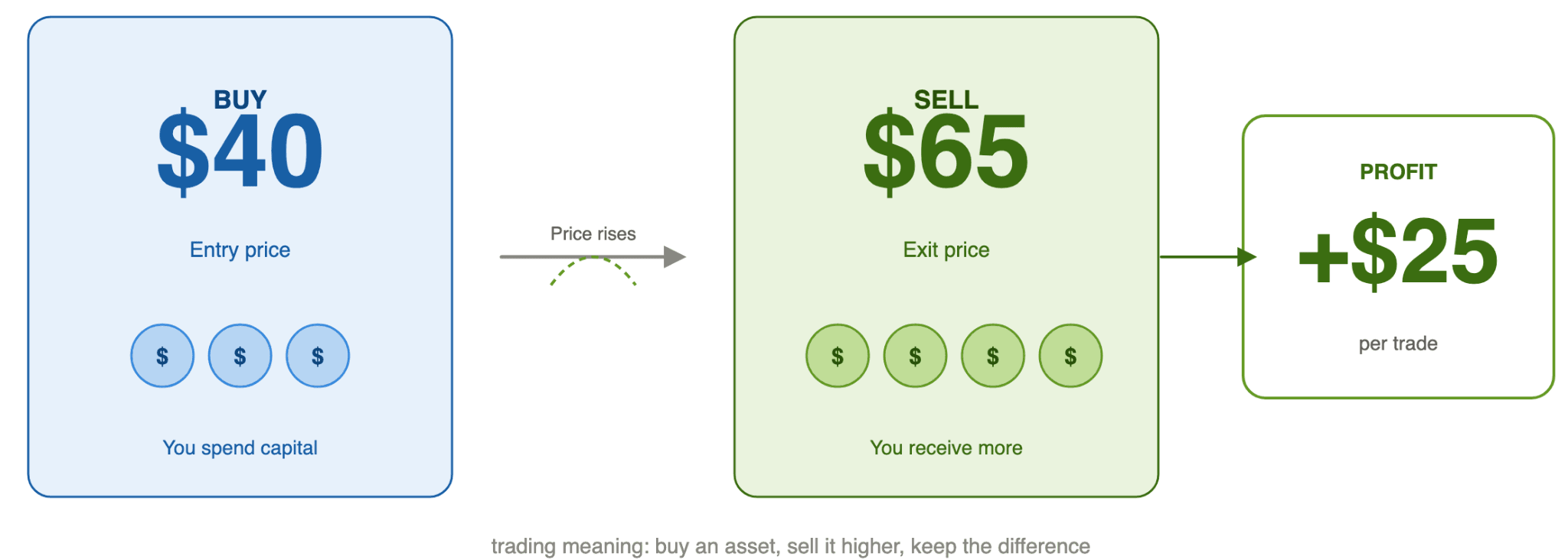
Trading Meaning: What Trading Actually Is

Trading is the active buying and selling of financial assets to profit from price movements. You take a position on whether a price rises or falls. When the price moves in your direction, you profit. When it moves against you, you lose.

That single mechanism applies across thousands of markets globally. A day trader in forex and a swing trader in US tech stocks operate on the same core principle. The asset, timeframe, and tools differ. The underlying logic stays identical.

How Trading Differs from Investing

Investing means buying an asset and holding it for months or years to benefit from long-term appreciation or dividend income. Trading means entering and exiting positions over much shorter timeframes to capture specific price movements.

An investor buys Apple shares because they believe in the company's five-year growth trajectory. A trader buys Apple shares because an earnings release is due in two days, and they expect a short-term spike. One bets on the long gam—the other targets the next move.

How Trading Differs from Speculation

All trading involves some degree of uncertainty. Speculation sits at the end of that scale. A position trader who holds gold futures for six weeks based on inflation data applies a structured, rule-based approach. 

A retail trader who puts 40% of their capital into a single crypto token based on a social media trend speculates without a defined edge. The line separating the two is risk management and process, not the asset class being traded.

Key takeaway: Trading is structured, short-term market participation driven by price movement analysis. It differs from investing in time horizon and from speculation in the application of rules and risk controls.

How Does Trading Work?
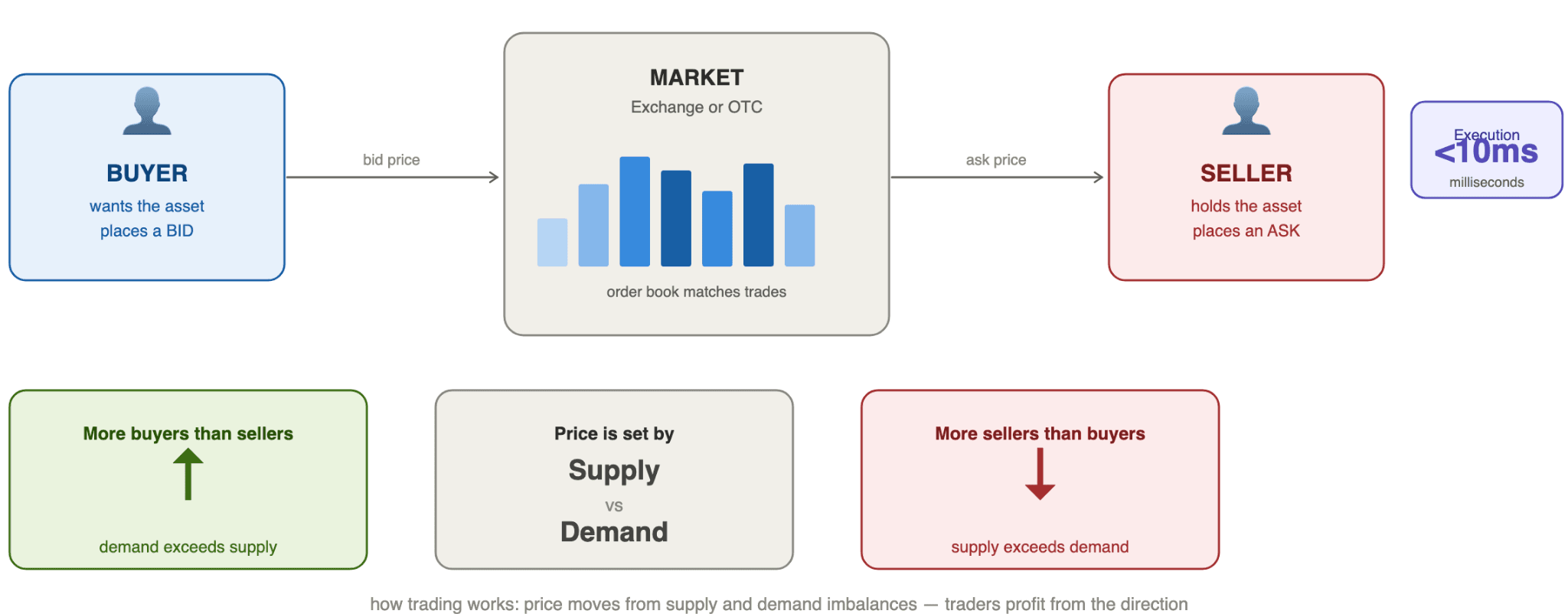
How Does Trading Work

Every trade exists because another participant takes the opposite side. You think EUR/USD goes up. Someone else thinks it falls. The market connects you, matches your order, and records the transaction. That exchange happens through infrastructure most traders never see directly: order books, matching engines, and clearing houses.

Understanding three things covers everything you need as a beginner: what moves prices, where trades execute, and how an order actually travels from your click to an open position.

Supply, Demand, and Price Movement

Price moves because of imbalances between buyers and sellers. More buyers than sellers push the price higher. More sellers than buyers pull it lower. Those imbalances come from earnings reports, central bank decisions, geopolitical shifts, inflation data, and changes in market sentiment.

The NYSE processed an average daily equity volume of $80.6 billion in late 2025. That figure represents millions of individual buy and sell decisions hitting the market simultaneously every single trading day.

Exchanges vs OTC Markets

Trades happen in two main venues, and knowing the difference matters for every beginner. Your broker type, your access to markets, and your execution speed all depend on which venue your trades route through.

A centralized exchange is a regulated marketplace with standardized contracts, public pricing, and a central counterparty that guarantees settlement. NYSE, Nasdaq, and CME Group are the primary examples. 

The OTC market operates directly between two parties, typically a trader and a broker or dealer. No central location exists. Forex operates almost entirely OTC, which explains its $9.6 trillion daily volume and 24-hour availability.

FeatureExchangeOTC
Price transparencyPublic order bookNegotiated between parties
Trading hoursSet exchange hours24 hours for forex and crypto
ContractsStandardisedCustomisable
Counterparty riskCleared centrallyExists between parties
ExamplesNYSE, CME, CboeForex spot, CFDs

How a Trade Executes: Step by Step

The execution process looks complex from the outside, but follows a clear sequence every time. Here is exactly what happens from the moment you click "buy" to the moment your position appears open in your account.

  • Place an order on your trading platform
  • Platform routes orders to a broker or exchange
  • Order matches with a counterparty at the agreed price
  • Trade confirms, and the position opens instantly
  • Settlement occurs according to market rules

Each step happens in milliseconds on modern platforms. For retail traders using CFDs or forex, execution completes nearly instantly through the broker's system.

Key takeaway: Price moves because supply and demand imbalances drive buyers and sellers to act simultaneously. Trades execute either on centralized exchanges or through OTC networks, and the full process from order to open position takes milliseconds.

What Can You Trade? Asset Classes Compared
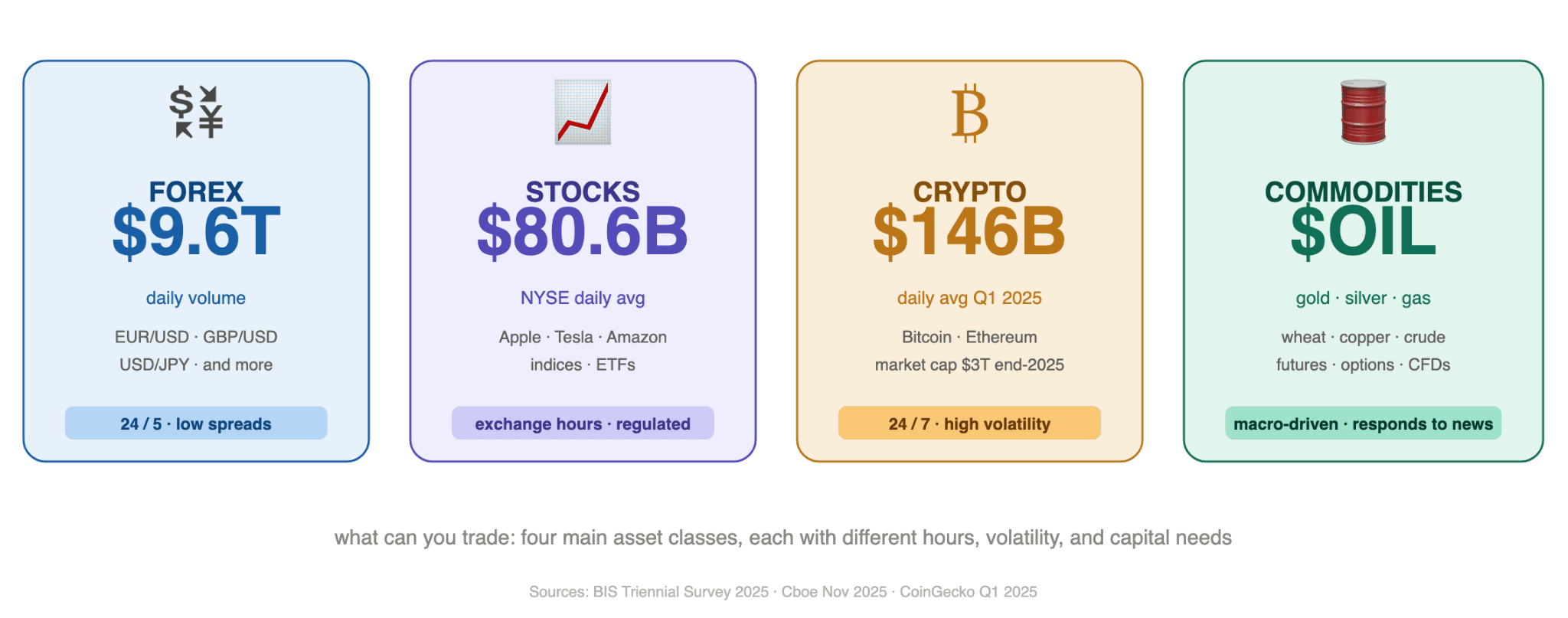
What Can You Trade? Asset Classes Compared

Financial markets give traders access to thousands of instruments across several distinct asset classes. Each class behaves differently in terms of volatility, trading hours, and capital requirements. Choosing the right market matters as much as choosing the right direction on any given trade.

Stocks and Indices

Stocks represent ownership shares in publicly traded companies. Traders profit from price changes without necessarily owning the underlying shares by using CFDs or other derivatives. An index bundles dozens or hundreds of stocks into a single instrument, allowing traders to take positions in entire market segments at once.

The NYSE averaged $80.6 billion in daily equity volume in late 2025. US stock market capitalization is projected to reach $60.4 trillion in 2026, making it the deepest equity market on earth.

Forex

Forex is the largest financial market in existence, and it runs around the clock. The Bank for International Settlements recorded an average daily forex trading volume of $9.6 trillion in April 2025, a 28% increase from $7.5 trillion in 2022. The market runs 24 hours a day, five days a week, across Tokyo, London, New York, and Sydney.

The UK alone posts $1.77 trillion in daily forex turnover, nearly triple the US figure of $593 billion. Seven currency pairs account for 66% of all global forex volume.

Commodities

Commodities cover physical goods that drive the global economy. Crude oil, gold, silver, natural gas, wheat, and copper all trade actively through futures contracts, options, or CFDs rather than physical delivery.

Oil and gold attract the most active global trading. Commodity prices respond directly to supply disruptions, geopolitical events, weather patterns, and macroeconomic data releases. That sensitivity to real-world catalysts makes commodities a natural fit for traders who closely follow macro events.

Cryptocurrencies

Crypto is the newest mainstream asset class in active trading. Total crypto market capitalization ended 2025 at $3.0 trillion. CME Group reported nearly $3 trillion in crypto futures and options volume for full-year 2025, with Q4 volume up 92% year over year as institutional participation accelerated.

Average daily crypto trading volumes reached $146 billion in Q1 2025. Crypto trades around the clock, seven days a week, making it accessible across every timezone without exception.
Become a Confident Trader

Master trading with our structured course designed for beginners and intermediate traders.

Step-by-step lessons
Real strategies
Risk management training

Join 10,000+ traders improving their skills

Start Course Now
Asset ClassAvg Daily VolumeTrading HoursVolatilityMin Capital
Forex$9.6 trillion (BIS 2025)24/5MediumLow via leverage
US Equities$80.6 billion (NYSE)Exchange hoursMediumLow via fractional
Crypto$146 billion (CoinGecko Q1 2025)24/7HighVery low
CommoditiesVaries by contractExchange hoursMedium to HighMedium

Key takeaway: Every asset class offers a distinct combination of volatility, liquidity, and access requirements. Match your market to your schedule, risk tolerance, and existing knowledge before committing real capital.

Types of Trading by Style

How long you hold a position defines your trading style more than anything else. Your style determines what tools you need, how many hours per day you commit, and what psychological demands the market places on you. No single style universally beats the others. The right one fits your actual schedule and personality.

"The most important rule of trading is to play great defense, not great offense." — Paul Tudor Jones, founder of Tudor Investment Corporation, averaged 19.5% annual returns over 25 consecutive years without a single losing year.

Day Trading

Day traders open and close all positions within the same trading session. There is no overnight exposure, so price gaps caused by after-hours news cannot hurt an open position. Day trading demands real-time data, fast execution software, and quick decision-making under sustained pressure. The style fits highly liquid markets: major forex pairs, large-cap stocks, or index futures where spreads stay tight and orders fill without slippage.

Swing Trading

Swing traders hold positions for days to weeks, targeting larger price moves than day traders capture in a single session. Technical analysis identifies entry and exit points, and traders accept overnight and weekend risk in exchange for bigger potential gains per trade.

Swing trading suits people who cannot monitor screens throughout the day. It demands patience to hold through short-term price noise while waiting for the full setup to develop.

Scalping

Scalpers hold positions for seconds to minutes, capturing tiny price movements across dozens or hundreds of trades per day. Individual profits stay small. Volume and consistency across many trades drive the overall result.

Ultra-low spreads, fast execution, and exceptional sustained focus are non-negotiable for scalping. Psychologically, it places more continuous demand on a trader than any other style.

Position Trading

Position traders hold for weeks to months based on macroeconomic analysis: central bank policy, earnings cycles, commodity supply data, and long-term trend structure. Short-term volatility barely affects their decision-making.

Position trading requires the least daily screen time of any active style. It ties up capital for longer periods but demands the least reactive, emotion-driven decision-making.

Which Trading Style Fits Your Life?

Before picking a style, answer three honest questions about your actual daily situation. Your answers narrow the field faster than any technical comparison.

  • Work full-time with limited screen time? → Swing or position trading
  • Available to watch markets most of the day? → Day trading
  • Want maximum trades and fast feedback? → Scalping
  • Prefer minimum stress and infrequent decisions? → Position trading

No style works if it conflicts with your real schedule. A swing trader who panics and checks positions every hour defeats the entire purpose of the style.

Key takeaway: Trading style defines your daily time commitment, tool requirements, and psychological pressure. Match your style to your actual life before putting real money to work.

Is Trading Legit?

Trading is legal, heavily regulated, and operates under government-mandated oversight in every major economy. The question matters because many newcomers first encounter trading through social media ads, paid signals sellers, and influencer accounts that earn their income from beginners rather than from markets. The activity itself carries full legal standing worldwide. Parts of the industry surrounding it sometimes do not.

How Trading Is Regulated

Every major trading market operates under strict, mandatory government oversight. Here are the primary regulatory bodies governing trading activity across the world's largest financial markets.

  • SEC — regulates US equity markets 
  • CFTC — oversees US futures and retail forex 
  • ESMA — sets minimum standards across EU member states 
  • FCA — regulates brokers serving UK clients 

Regulated brokers face capital requirements, client fund segregation rules, and mandatory risk disclosures on all marketing materials. A broker operating without a license from one of these bodies is a serious red flag that warrants immediate caution.

Legitimate Trading vs Predatory Schemes

Legitimate trading and predatory schemes look similar on the surface. Knowing the specific markers of each protects you before you deposit a single dollar. Here is how to tell them apart quickly.

Three signs of a legitimate operation: the broker carries a verifiable license from the SEC, CFTC, FCA, or ESMA; the platform shows real-time market prices with disclosed spreads; and risk warnings appear prominently in all communications. Three signs of a scheme: guaranteed profit promises, unregulated offshore registration, and pressure to deposit more capital after initial losses.

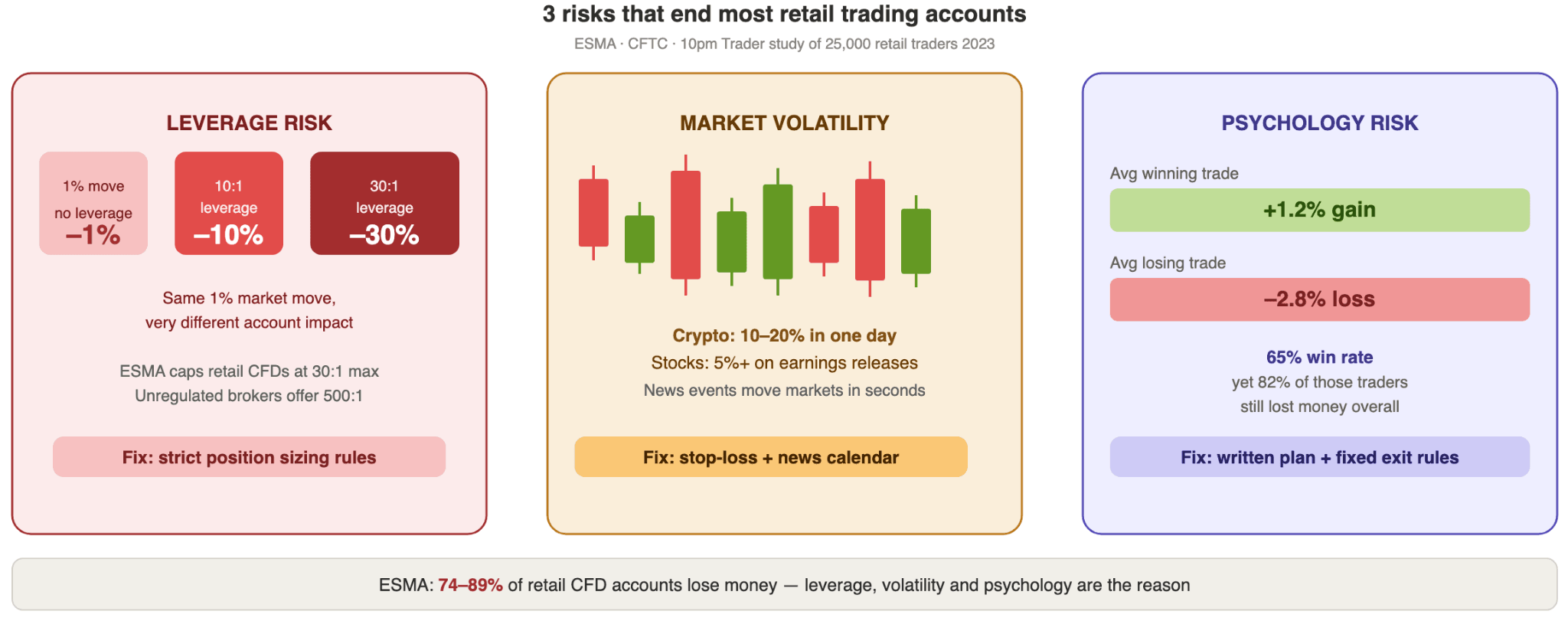
ESMA found that between 74% and 89% of retail CFD accounts lose money. That figure reflects traders entering markets without proper preparation, not evidence that markets are unfair. Professionals trade the same instruments and consistently profit.

Key takeaway: Trading is fully legal and regulated globally. Losses among beginners reflect skill gaps and process failures, not market manipulation. Regulated brokers, a structured learning plan, and proper risk management address all three.

How to Make Money Trading: Realistic Expectations

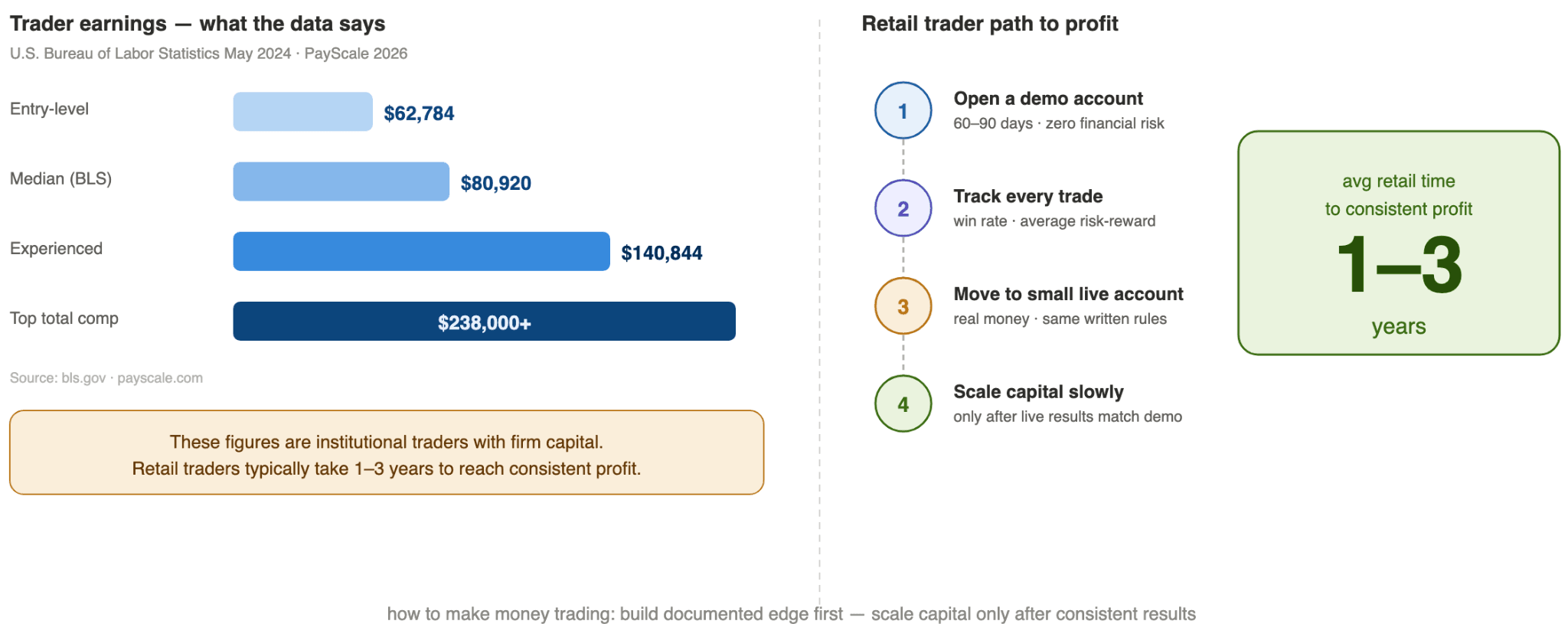
How to Make Money Trading: Realistic Expectations

Making money from trading is achievable. Making consistent money from trading takes structured learning, honest self-assessment, and time. Traders who reach consistent profitability treat it as a skill-based profession with a real learning curve, not a shortcut to income.

"He who lives by the crystal ball will eat shattered glass." — Ray Dalio, founder of Bridgewater Associates, from Principles for Dealing With the Changing World Order

What Actually Drives Profit

Profit in trading comes from one source: a statistical edge applied consistently with disciplined risk management. An edge means your winning trades outperform your losing trades by enough to cover all costs and generate net positive returns across a large sample of trades over time.

Edge comes from technical setups with documented historical performance, fundamental catalysts, or structured order flow analysis. It does not come from tips, social media signals, or intuition operating without a written plan.

What Traders Realistically Earn

The earnings range for traders spans a wide range depending on capital, skill level, and institutional access. These figures give you an honest baseline before you set income expectations.

The US Bureau of Labor Statistics reports a median annual wage of $80,920 for business and financial occupations as of May 2024. Experienced commodities traders earn a median base salary of $140,844, with total compensation reaching $238,000 at the top of the range. Those figures reflect salaried professionals at institutions with infrastructure, risk limits, and firm capital behind them.

Retail traders building independent income face a longer learning curve. Most take 1 to 3 years of consistent, structured practice before achieving reliable profitability.

How to Start Without Large Capital

Starting without a large account is entirely possible if you follow a structured sequence. Most beginners skip steps two and three and pay for it with real money losses that a demo account would have prevented.

  • Step 1: Open a free demo account at any regulated broker
  • Step 2: Trade demo markets for 60 to 90 days with a written strategy
  • Step 3: Track every trade, record your win rate, and average risk-reward
  • Step 4: When demo results show a consistent edge, move to a small live account
  • Step 5: Scale capital only after live results match demo performance

For traders who want live market exposure without risking personal savings, prop trading programs provide funded accounts after a structured evaluation process. These programs set defined drawdown limits and profit-split agreements, giving serious traders access to real capital and real market conditions from day one.

Key takeaway: Professional traders earn strong incomes backed by institutional capital and years of skill development. The path for retail traders runs through demo trading, documented results, and slow, deliberate scaling of real capital.

What Are the Risks of Trading?

What Are the Risks of Trading

Every trade carries risk. Naming the specific risks and understanding how to manage each one separates traders who build lasting results from those who lose their starting capital in the first month. Risk is not the enemy of trading. Unmanaged risk is.

"It's not whether you're right or wrong, but how much money you make when you're right and how much you lose when you're wrong." — George Soros, The Alchemy of Finance

Leverage Risk

Leverage lets you control a larger position with a smaller deposit. The math moves fast in both directions. A 10:1 leverage ratio turns a 1% market move into a 10% gain or loss on your deposited capital. ESMA restricts retail CFD leverage to between 2:1 and 30:1, depending on the asset class. Some unregulated offshore brokers offer 500:1, a level that wipes accounts in a single adverse move.

Market Volatility

Markets do not move in straight lines, and the biggest moves rarely announce themselves in advance. Earnings surprises, central bank statements, geopolitical events, and economic data releases can shift prices by 5% or more in minutes. Crypto regularly moves 10% to 20% in a single session.

Three tools manage volatility exposure effectively. Each one addresses a different dimension of the same problem.

  • Stop-loss orders cap maximum loss per trade
  • Position sizing controls capital at risk per trade
  • News calendars flag high-impact events before they hit

Each tool works independently. Together, they form the minimum viable risk management framework for any active trader.

Emotional and Psychological Risk

Emotion destroys more trading accounts than bad analysis does. The data on this is consistent and specific. A 2023 study of 25,000 retail traders found that 65% had win rates above 50%, yet 82% still lost money overall. Their average winning trade gained 1.2%. Their average losing trade cost 2.8%.

Traders closed winners too early out of fear and held losers too long, hoping for a recovery. That behavior pattern has a name: the disposition effect. It cannot be solved by better analysis alone. A written trading plan with pre-defined entry rules, exit rules, and fixed position sizes before every trade solves it.

Key takeaway: Leverage misuse, unexpected volatility, and emotional decision-making cause the majority of retail trading losses. All three respond directly to rules, position sizing, and a written plan followed without exception.

Key Takeaways: What You Need to Know About Trading

What You Need to Know About Trading

Trading is the buying and selling of financial assets to profit from price movements across heavily regulated global markets. Beginners who build lasting results start on demo accounts, follow written rules, and manage risk before they chase returns.

Frequently Asked Questions

Disclaimer: This article is for informational purposes only and does not constitute financial advice. Trading involves risk and may result in loss of capital.

Related Articles

The First Move Is Yours

Discover how Supertrade can transform your trading career. Explore challenges, access instant funding, and join a growing community of Supertraders.

Stay Ahead of the Game

Sign up to receive exclusive tips, market insights, and the latest updates from Supertrade. Don’t miss out on opportunities to grow your trading success.
Discord

Our Community

Do not skip any beat.

The Ultimate Trading Community. Join our Discord server to get the latest updates, news and more.

2026 Supertrade. All rights reserved
DiscordInstagramTelegramYouTubeX
Trading involves significant risk. Past performance is not indicative of future results. This is a simulated trading environment. Supertrade provides educational trading services.
Supertrade
Supertrade Ltd, a company incorporated under the laws of Saint Lucia with registered number 2024-00699, located at Ground Floor, Rodney Court Building, Rodney Bay, Gros Islet, Saint Lucia, LC01 101, operates and owns this website, as well as provides services under the Terms and Conditions posted on the website. Supertrade Prop Ltd, a company incorporated under the laws of England and Wales with registered number 16234284, located at 52-56 Standard Road, London, England, NW10 6EU, acting as a payment agent.