
Technical Analysis

May 6, 2026 - 12 min

Beginner

What Is Technical Analysis in Trading

What Is Technical Analysis in Trading

Price charts hold more information than most traders ever use. Technical analysis (TA) is how traders turn price, volume, and momentum into actionable signals. A survey of Hong Kong FX dealers found that over 85% used both fundamental and technical analysis. This 2026 guide shows you how to read TA and use it to improve your results on different markets.

Justin Freeman
Reviewed by:
Share

Technical Analysis at a Glance

QuestionAnswer
What is technical analysis?A method of reading price and volume data on charts to identify trade entry and exit points.
When did it originate?Charles Dow published its foundations across 255 Wall Street Journal editorials between 1900 and 1902.
What markets does TA apply to?Stocks, forex, commodities, indices, crypto, and CFDs.
What are the main tools?Moving averages, RSI, MACD, Bollinger Bands, trend lines, support, and resistance levels.
How does TA differ from fundamental analysis?Fundamentals assess company value. Technicals assess price behavior and market trends.
Do professionals use TA?Yes. Over 90% of London-based forex traders assigned significant weight to technical analysis in a Bank of England survey.

Core Principles of Technical Analysis

Core Principles of Technical Analysis

Charles Dow wrote 255 editorials in The Wall Street Journal between 1900 and 1902. Those editorials became the foundation of technical analysis as a formal discipline. Robert Rhea codified them into Dow Theory in 1932, and the framework has not changed at its core since.

The three principles Dow identified still underpin every chart-based decision traders make today. They are observed patterns in market behavior across cycles, asset classes, and timeframes.

Three Assumptions Traders Build On

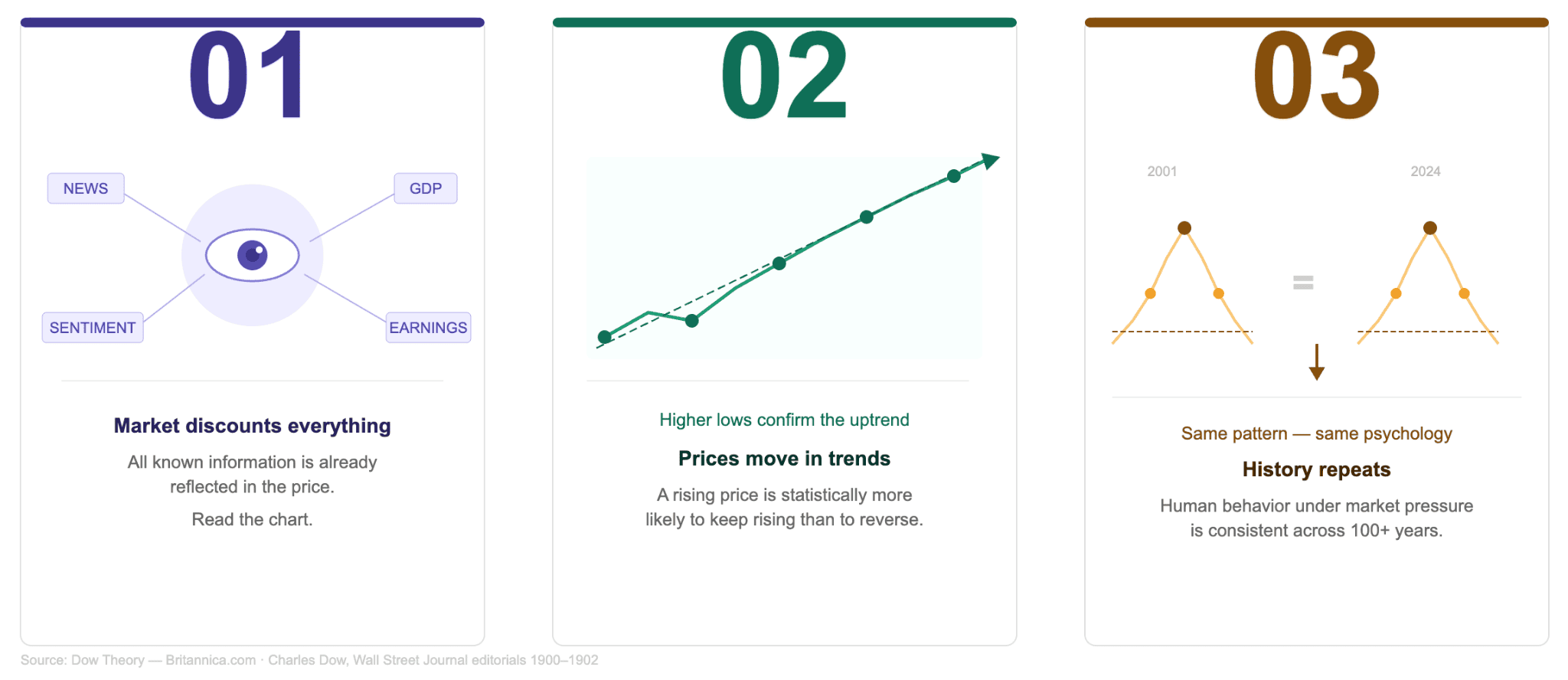
The first assumption is that the market discounts everything. Price at any given moment reflects all available information, from earnings reports to geopolitical events. You do not need to read the news separately. The chart already shows you what the collective market has concluded about it.

The second assumption is that prices move in trends. A rising price is statistically more likely to continue rising than to reverse without cause. Trend-following strategies are built entirely on this observed behavior.

The third assumption is that history repeats. Market participants respond to similar conditions in similar ways. Research covering 6,406 technical trading rules across 41 markets over up to 66 years found that technical rules outperformed a simple buy-and-hold strategy in the majority of those markets.

Technical vs Fundamental Analysis

What is technical analysis in investing compared to fundamental analysis? The two disciplines answer different questions. Fundamental analysis asks whether an asset is worth owning based on financial data. Technical analysis asks whether the current price action supports entering or exiting a position now.

A fundamental analyst studies revenue, earnings, and balance sheets. A technical analyst studies price charts, volume data, and price patterns. Neither approach makes the other irrelevant. Many institutional traders use fundamentals to decide what to trade and technicals to decide when to act.

Key takeaway: Technical analysis rests on three principles first published by Charles Dow in The Wall Street Journal over 120 years ago. Price reflects all known information. Trends persist until broken. Patterns repeat because human behavior under market pressure is consistent. A study of 6,406 trading rules across 41 markets confirmed these patterns hold across both developed and emerging markets.

Charts, Trends, and Price Patterns
Charts, Trends, and Price Patterns

Every technical analysis basics education starts with the chart. A chart is not decoration. It is a compressed record of every buy and sell decision made in a market over a given period. Reading one correctly gives you more actionable information than most market commentary does.

66% of traders use daily charts as their primary timeframe for market observation. The timeframe you choose changes the signals you see. Getting the chart type and timeframe right before analyzing anything else is a necessary first step.

Chart Types and What They Show

A line chart connects closing prices over time. It shows direction clearly but strips out intraday detail. A bar chart adds the open, high, low, and close for each period. A candlestick chart presents the same four data points in a visual format that makes the battle between buyers and sellers immediately readable.

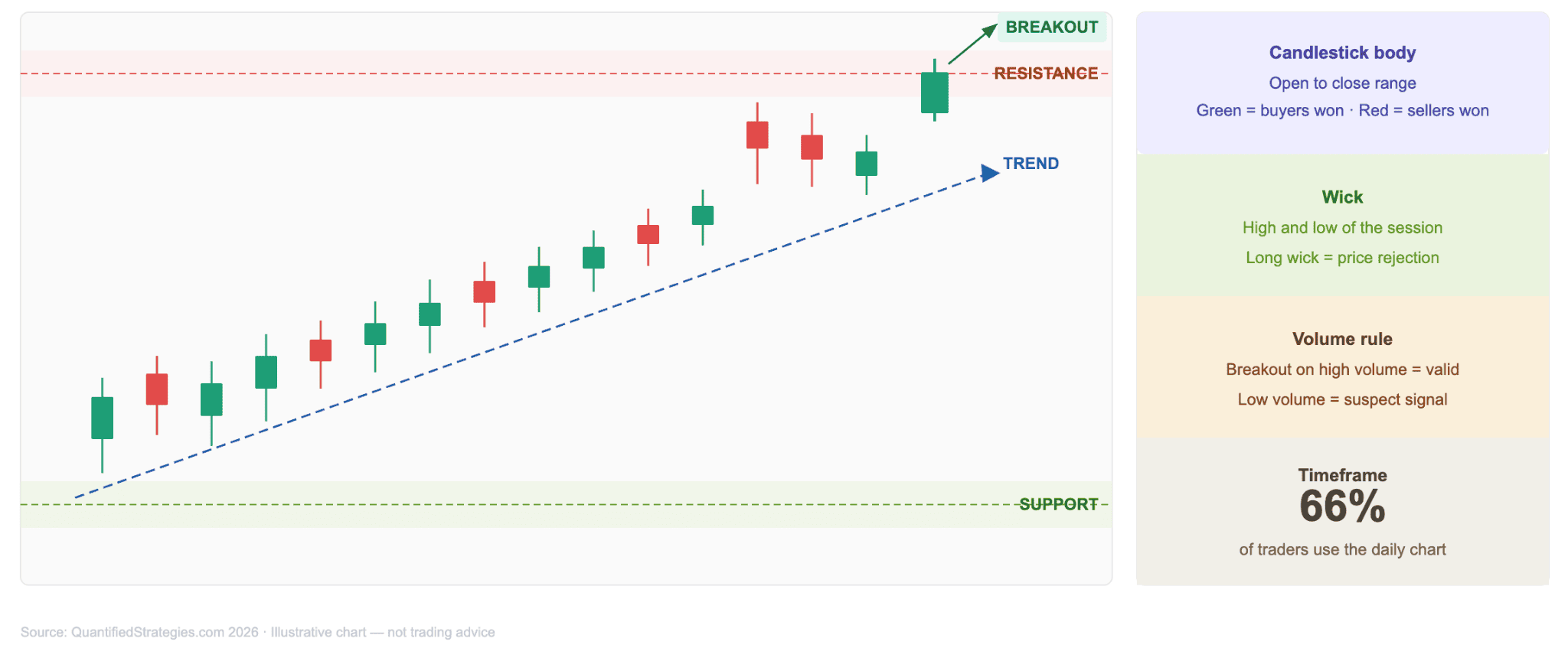
Candlestick charts are the professional standard. Each candle body shows the range between open and close. Green bodies mean the price closed higher than it opened. Red bodies mean the opposite. The thin lines above and below, called wicks, show where the price traveled before pulling back.

Trend Lines, Support, and Resistance

A trend line connects a series of higher lows in an uptrend or lower highs in a downtrend. Its slope shows both direction and momentum. When price breaks a trend line on rising volume, traders treat that as a signal worth acting on.

Support is a price level at which buyers have historically appeared in sufficient numbers to stop the price from falling further. Resistance is where sellers have historically held the upper hand. The more times a price has tested and respected a level, the more significant that level becomes for participants watching it.

Price Patterns That Repeat

Price patterns fall into two groups. Continuation patterns, such as flags and triangles, suggest the existing trend will resume after a consolidation period. Reversal patterns, such as head-and-shoulders or double tops, signal a potential change in direction.

No pattern produces a guaranteed outcome. Pattern reliability increases sharply when three conditions align: the pattern forms at a key support or resistance level, volume confirms the move, and the pattern aligns with the higher-timeframe trend. Breakout trading strategies built on this logic showed a 30% success rate across surveyed traders, making them among the more consistent short-term approaches.

Key takeaway: Charts record every market decision made over a given period. Candlestick charts are the professional standard. 66% of active traders use daily charts as their primary timeframe for analysis.

Indicators, Signals, and Stock Technical Analysis Tools
Indicators, Signals, and Stock Technical Analysis Tools

Indicators are mathematical calculations applied to price and volume. They do not predict the future. They organize historical data into formats that make trends and momentum easier to identify. Stock technical analysis uses these tools to find entry and exit points with more precision than reading price alone.

The danger is using too many. Traders who overload charts with overlapping indicators produce conflicting signals and hesitation. The research is detailed: combining complementary indicator types produces more reliable results than stacking similar ones.
Become a Confident Trader

Master trading with our structured course designed for beginners and intermediate traders.

Step-by-step lessons
Real strategies
Risk management training

Join 10,000+ traders improving their skills

Start Course Now

Moving Averages and Trend Identification

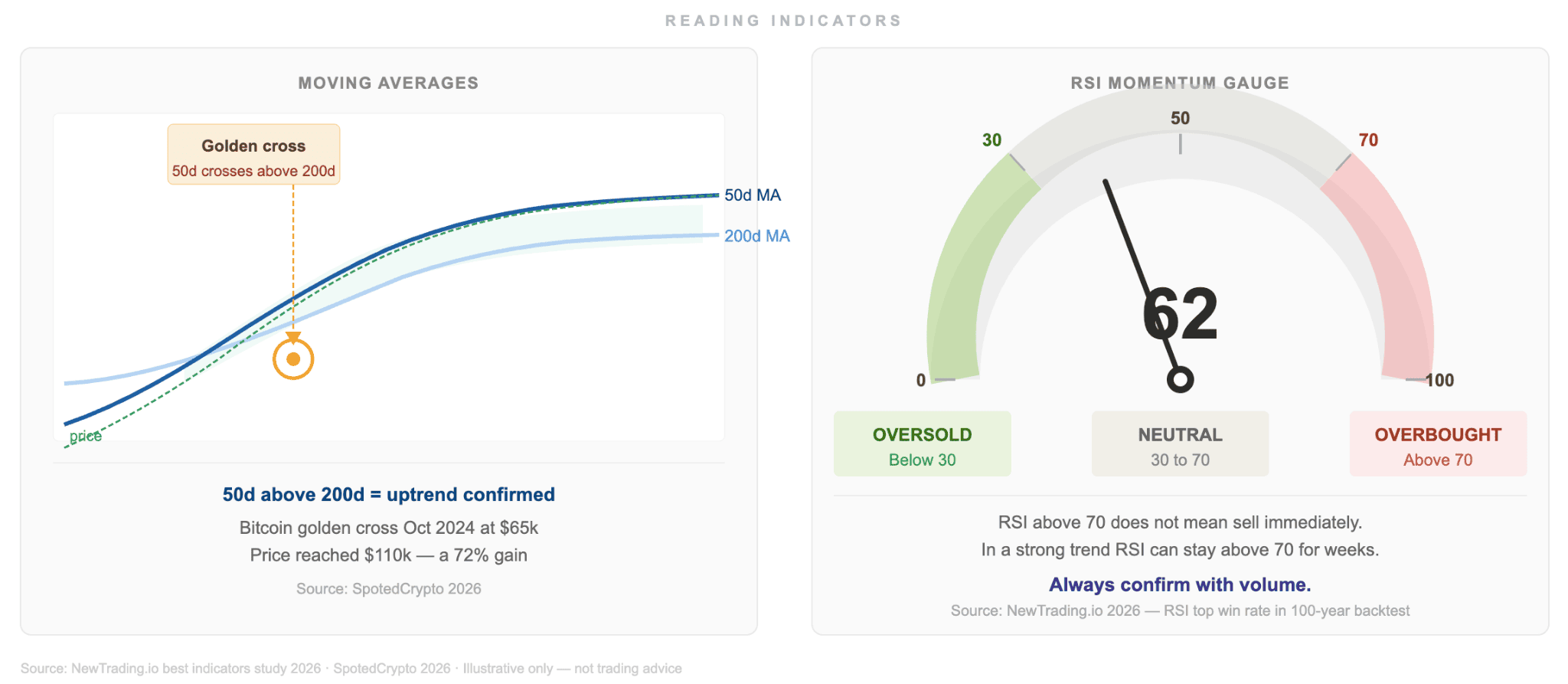
A 50-day simple moving average shows the average closing price across the last 50 trading sessions. It filters short-term price noise and reveals the underlying direction. The 200-day moving average is the most widely watched level in global equity markets.

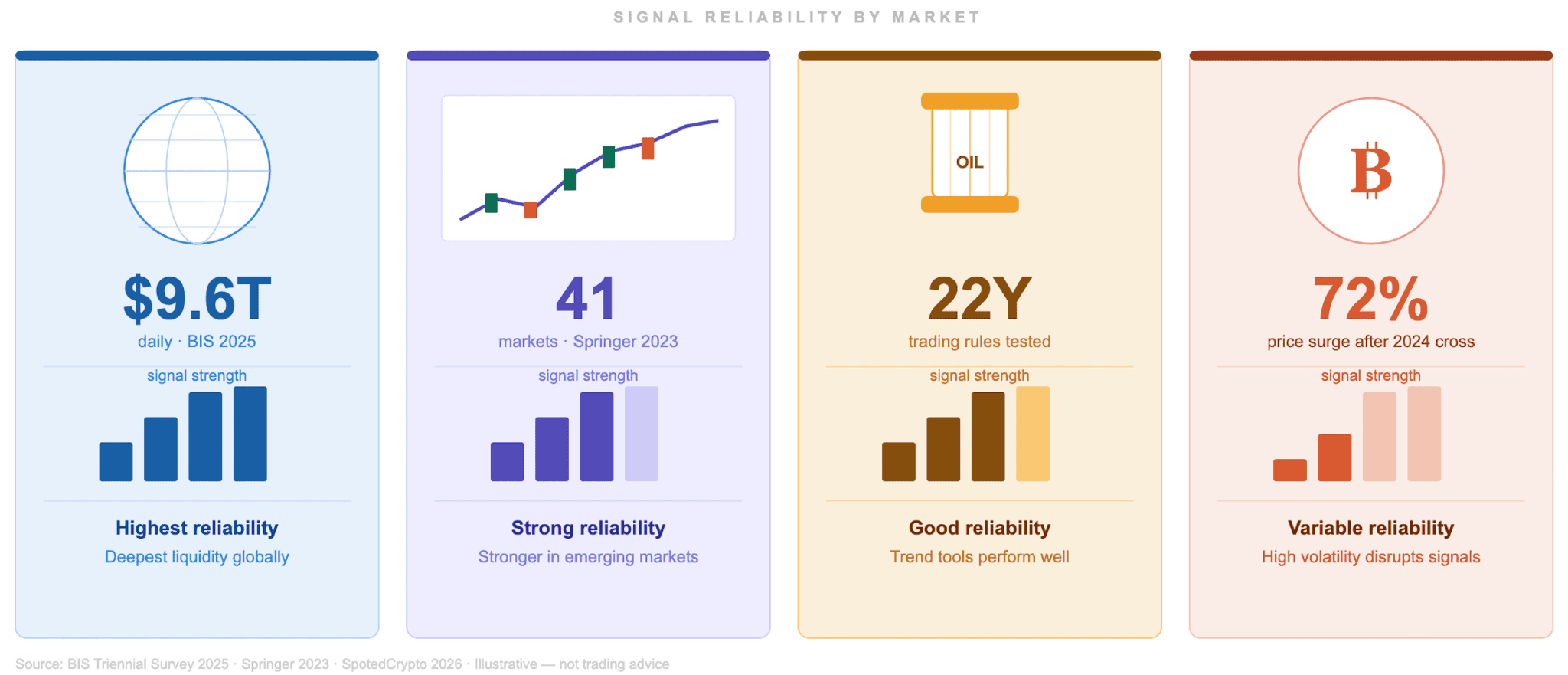
When the 50-day crosses above the 200-day, traders call it a golden cross. In October 2024, Bitcoin printed a golden cross at approximately $65,000. The asset subsequently surged past $110,000, a gain of roughly 72%. When the 50-day crosses below the 200-day, traders call it a death cross, a widely watched bearish signal in technical analysis trading.

Momentum Indicators, Oscillators, and Volume

The RSI measures the speed of price changes on a scale of 0 to 100. Readings above 70 indicate an asset may be overbought. Readings below 30 may indicate oversold conditions. Backtesting across nearly 100 years of market data found that RSI and Bollinger Bands delivered the highest and most consistent win rates among the major indicators tested. 

The MACD tracks the relationship between the 12- and 26-period exponential moving averages. A crossover of the MACD line above its signal line is read as a buy signal. The ADX indicator measures trend strength on a scale of 0 to 100. Readings above 25 indicate a strong trend. Readings below 20 suggest weak or absent trend conditions, a crucial filter before applying trend-following tools.

Volume is not an oscillator. It is a confirmation tool. A price breakout on high volume signals broad market participation. The same breakout on low volume is suspect. Dow himself identified volume as a trend confirmation signal in his 1900 to 1902 Wall Street Journal editorials.

"RSI above 70 does not mean sell. It means a strong trend is running. In trending markets, RSI stays overbought for weeks."

Reading Signals Without Chart Overload

One trend indicator, one momentum indicator, and volume as confirmation. That is a complete system. Adding a fourth and fifth tool rarely improves outcomes and often creates conflicting reads, delaying decisions.

Research across 100 years of Dow Jones data confirms that combining complementary indicator types outperforms using redundant ones. Clean charts produce faster, clearer decisions. Cluttered charts produce hesitation.

Stacking a 50-day MA, a 200-day MA, RSI, and volume on a single chart gives you trend direction, trend confirmation, momentum status, and participation level. That is four distinct data points from four complementary sources. 

IndicatorTypeWhat It MeasuresSignal Threshold
50-day Moving AverageTrendAverage price over 50 sessionsPrice above MA signals an uptrend
200-day Moving AverageTrendLong-term price directionGolden cross above, death cross below
RSI (14-period)MomentumSpeed of price change, 0 to 100Above 70 overbought, below 30 oversold
MACDMomentumGap between 12 and 26-period EMAsSignal line crossover triggers entry
ADXTrend StrengthDirectional movement forceAbove 25 strong trend, below 20 weak
VolumeConfirmationNumber of units traded per periodRising volume confirms price signal

Key takeaway: Moving averages track the trend direction of the trend. RSI and MACD track momentum. ADX measures trend strength. Volume confirms all of them. The ADX signals a strong trend at readings above 25 and weak conditions below 20.

Technical Analysis Across Asset Classes

Technical Analysis Across Asset Classes

Technical analytics apply across markets but do not perform identically in all of them. This is the detail most introductory guides skip. Market structure, liquidity, and participant behavior all affect how reliably price levels and signals hold.

Where Technical Analysis Works Best

The global forex market traded $7.5 trillion per day in 2022, according to the Bank for International Settlements. That liquidity means price levels, trend lines, and moving averages are observed and respected by a far larger pool of participants than in smaller markets.

Research testing 497 technical trading rules across 10 currency pairs over 22 years found that these rules significantly predicted price movements in both developed- and emerging-market currencies. Simple moving averages performed best in emerging-market currencies. Oscillator-based strategies produced stronger results on developed-market currency pairs.

The Springer study of 6,406 trading rules across 41 markets found stronger outperformance in emerging equity markets than in developed ones. The reason is efficiency. More participants in a market mean price levels are tested and arbitaged more quickly, reducing the edge available from any single pattern or signal.

Limitations to Know Before Trading

The same Springer study found that technical rule predictability diminished sharply in the most recent years of the sample. Markets adapt. When enough participants follow an identical signal, the signal loses its statistical edge.

False signals are part of the process. An RSI reading of 72 does not guarantee a reversal. A head-and-shoulders pattern can form and fail. Managing position size and placing stop-loss orders at logical price levels reduces the cost of those failures. 88% of active traders already use stop-loss orders, according to industry data.

“No indicator predicted the March 2020 equity crash before it happened.”

Macro events override chart signals. Market behavior analysis has a clear boundary: it reads what markets have done. It cannot read what central banks, governments, or black swan events will do next.

Key takeaway: TA performs differently depending on market liquidity and structure. The global forex market trades $7.5 trillion daily.  Research across 22 years and 497 trading rules confirms that technical signals predict price movements in both developed and emerging currency markets.

Building a Technical Analysis Strategy

Building a Technical Analysis Strategy

A strategy is a repeatable process with fixed rules for entry, sizing, and exit. Technical analysis basics provide the components. The strategy is how you assemble those components into a system you can test and apply consistently.

70% of active day traders report having an established trading strategy. Those who survive longer than two years are disproportionately the ones who stick to a defined process rather than switching methods after losing trades.

Combining Price Action with Indicators

Price action is raw price movement on a chart with no indicators applied. Reading price action first tells you what the market is doing. Indicators tell you how fast and how far the move is developing.

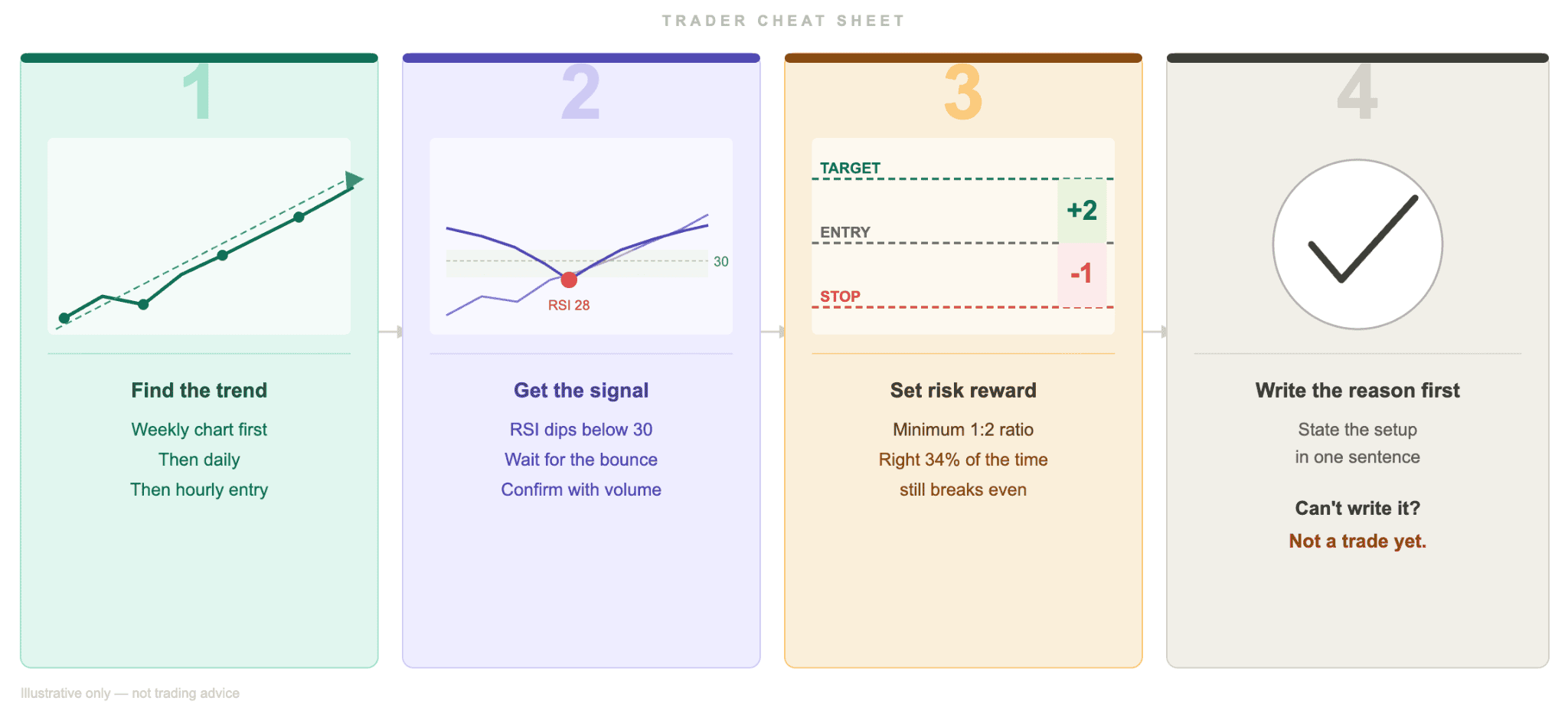
Start by identifying the trend on a higher-timeframe chart, such as weekly or daily. Move to a lower timeframe, hourly or 15-minute, to find the entry. Apply RSI to confirm momentum. Check volume to confirm participation. That four-step process is what the 30% breakout success rate in Tradeciety's trader survey was built on. 

Entry Points, Exit Points, Stop Losses

An entry point is a price level at which your analysis indicates a statistically higher probability of a move in your favor. It is a calculated decision based on pattern, level, and confirmation. It is not a certainty.

A stop-loss should be set at a price that signals the analysis was wrong. Most professional traders target a minimum 1:2 risk-to-reward ratio, meaning the potential gain is at least twice the potential loss. At a 1:2 ratio, a strategy only needs to be right 34% of the time to break even over a large sample of trades.

"A 1:2 risk-reward ratio changes everything. You can be wrong more often than you are right and still come out ahead."

Key takeaway: 70% of active traders operate with a defined trading strategy. A working strategy requires a fixed entry rule, a stop-loss rule, and an exit rule. 

Summary

What is technical analysis in investing at its core? It is a structured way to read market behavior using price and volume data collected over time. The tools have evolved since Charles Dow's 255 Wall Street Journal editorials from 1900 to 1902. 

The underlying logic has not. Technical analysis does not eliminate uncertainty. It gives you a framework for making decisions under uncertainty with rules, data, and defined risk. 89% of active traders use it because charts show things that financial statements cannot.

Frequently Asked Questions

Disclaimer: This article is for informational purposes only and does not constitute financial advice. Trading involves risk and may result in loss of capital.

Related Articles

The First Move Is Yours

Discover how Supertrade can transform your trading career. Explore challenges, access instant funding, and join a growing community of Supertraders.

Stay Ahead of the Game

Sign up to receive exclusive tips, market insights, and the latest updates from Supertrade. Don’t miss out on opportunities to grow your trading success.
how it works

Our Community

Do not skip any beat.

The Ultimate Trading Community. Join our Discord server to get the latest updates, news and more.

2026 Supertrade. All rights reserved
DiscordFacebookInstagramTelegramYouTubeXTikTok
Trading involves significant risk. Past performance is not indicative of future results. This is a simulated trading environment. Supertrade provides educational trading services.
Supertrade
Supertrade Ltd, a company incorporated under the laws of Saint Lucia with registered number 2024-00699, located at Ground Floor, Rodney Court Building, Rodney Bay, Gros Islet, Saint Lucia, LC01 101, operates and owns this website, as well as provides services under the Terms and Conditions posted on the website. Supertrade Prop Ltd, a company incorporated under the laws of England and Wales with registered number 16234284, located at 52-56 Standard Road, London, England, NW10 6EU, acting as a payment agent.