En
En Es
Es

Prop Trading: Key Q&As
| Question | Answer |
|---|---|
| What is proprietary trading? | A firm trades its own capital through selected traders and splits the profits. |
| Who are proprietary traders? | Traders funded by a firm, operating under defined risk rules with firm capital. |
| What is a prop trading account? | A funded account is granted after passing a firm's evaluation challenge. |
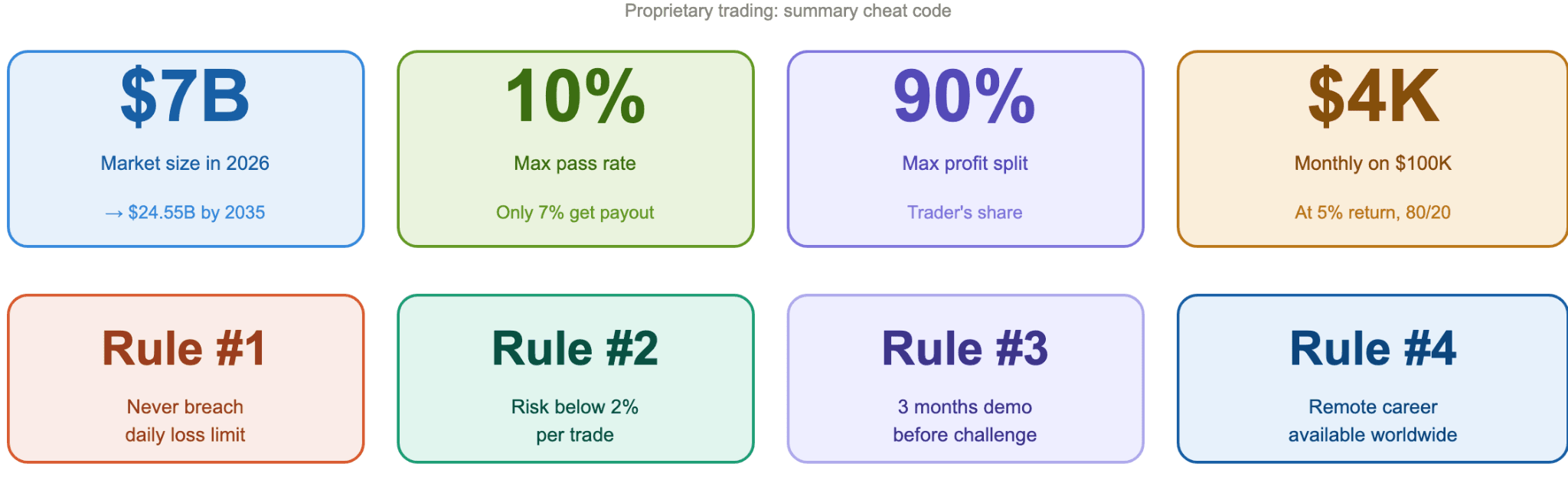
| What is the 2026 challenge pass rate? | Between 5% and 10% of traders pass. Only 7% ever reach a payout. |
| How much can a prop trader earn? | $4,000 per month on a $100K account at 5% return with an 80/20 split. |
| Is prop trading legal? | Yes. Independent prop firms operate legally and fall outside Volcker Rule restrictions. |
What Is Proprietary Trading: Definition and Models
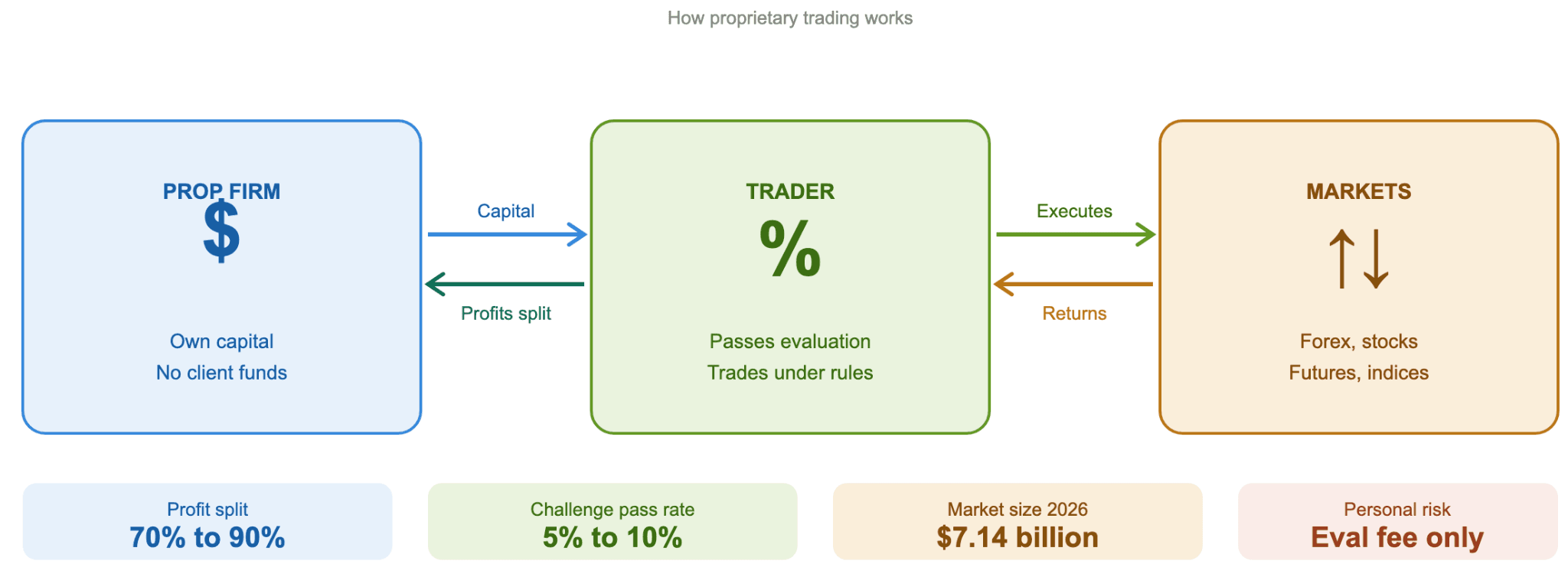
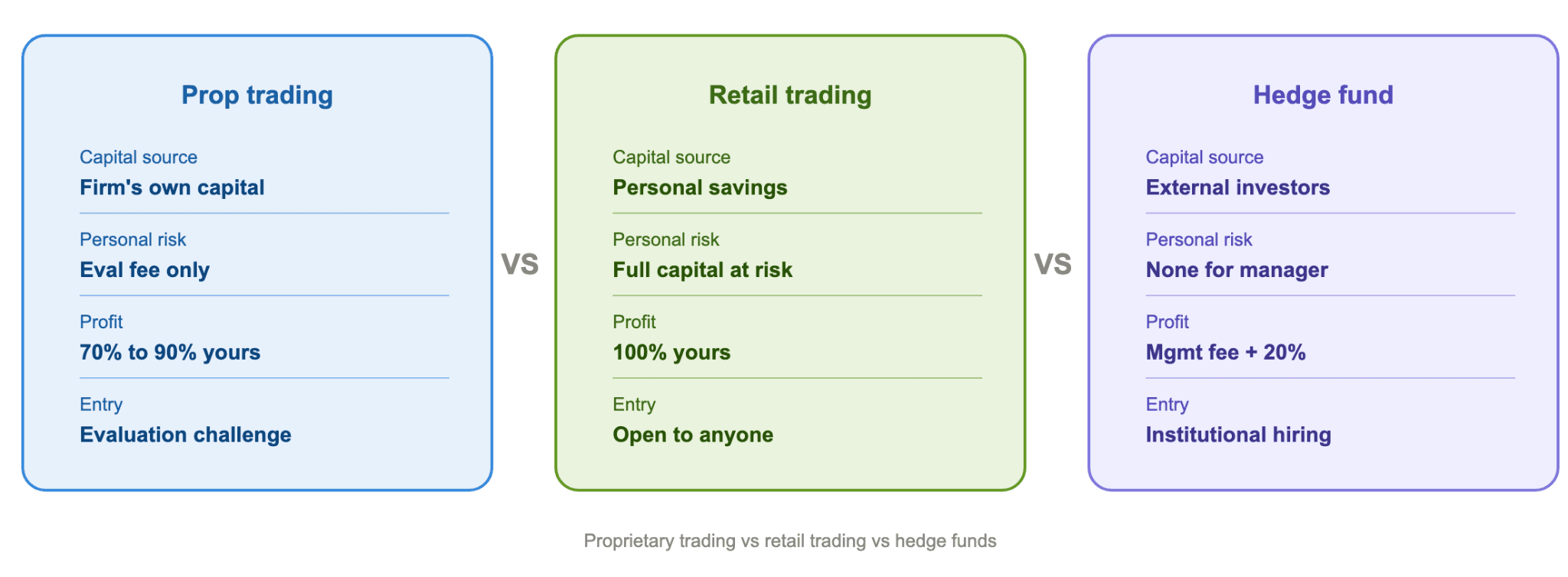
Proprietary trading means a firm trades financial markets with its own capital, not client funds, and keeps the returns it generates. Two distinct models carry this name. In the institutional model, banks and investment firms operate internal trading desks to generate direct balance-sheet returns.
In the independent model, firms fund individual traders through a structured evaluation and share the profits. Both operate on one principle: the firm has direct skin in the game on every position.
The meaning goes beyond the absence of client money. When a firm earns only from its own positions, every risk decision carries a direct financial consequence. That structure drives how firms design drawdown limits, capital allocation rules, and evaluation standards for the traders they fund.
Proprietary Trading Meaning in Simple Terms
A broker earns commissions whether their clients win or lose. A prop firm earns nothing unless its traders generate positive returns. That alignment of incentives is what separates prop trading from every other model in financial markets.
The funded model applies this logic to individual traders. Pass an evaluation, receive a capital allocation, trade under defined rules, and split the profits. The firm carries capital risk. The trader carries performance responsibility. Neither side profits unless the trading works.
Who Are Proprietary Traders Today
Proprietary traders in 2026 range from institutional desk professionals at major financial firms to independent remote traders operating across every time zone. The demographic profile has shifted significantly. By the mid-2020s, younger generations, including Gen Z and Millennials, became the dominant participant group in retail prop trading, driven by the accessibility of remote funding programs.
Geography no longer determines access. A funded trader in Warsaw, Lagos, or Manila operates under the same platform conditions as one in London or Chicago. Discipline and risk management determine outcomes, not location or academic credentials.
How the Volcker Rule Reshaped Proprietary Trading
The 2008 financial crisis showed how speculative prop trading inside deposit-taking banks amplified systemic risk across global markets. The Volcker Rule, introduced under Section 619 of the Dodd-Frank Wall Street Reform and Consumer Protection Act, prohibits banking entities from engaging in short-term proprietary trading of securities, derivatives, commodity futures, and options for their own profit.
Five federal agencies jointly developed the implementing regulations: the Federal Reserve, the CFTC, the FDIC, the OCC, and the SEC. Independent prop firms hold no customer deposits and fall entirely outside the Volcker Rule scope. Prop trading moved from bank balance sheets to independent firms, and the retail-funded model grew directly from that structural shift.
Key takeaway: Proprietary trading funds select traders with firm capital and pay them solely on performance. The Volcker Rule removed banks from speculative prop positions and redirected the model toward independent firms. Today, proprietary traders operate remotely across every major asset class, in a market projected to grow at 10.9% CAGR through 2035.
How a Proprietary Trading Account Works Step by Step
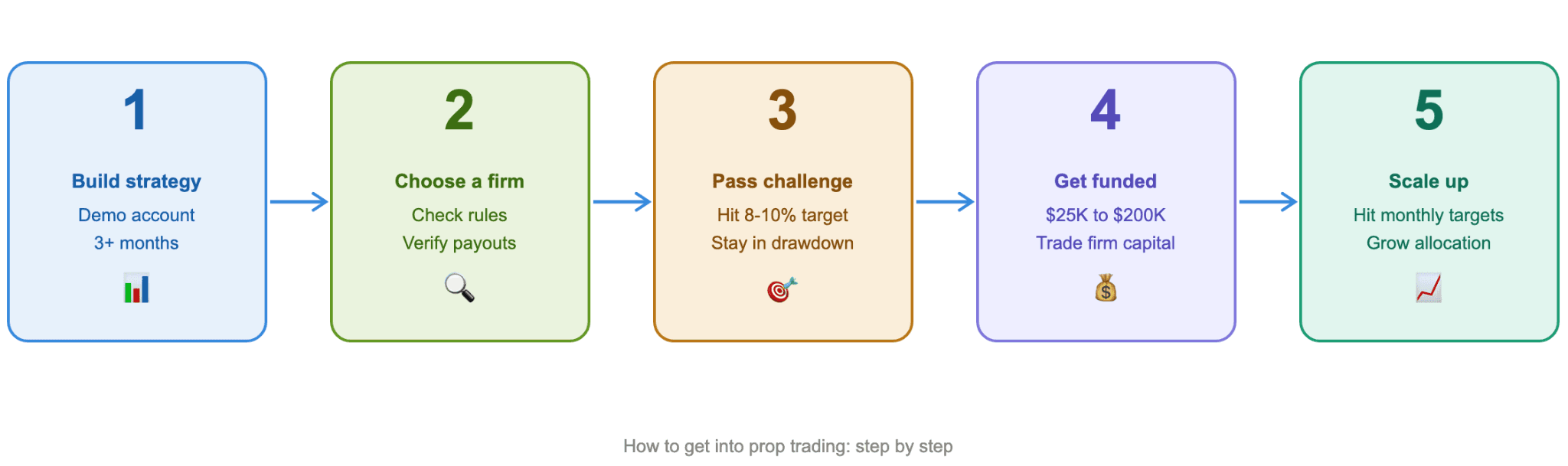
A proprietary trading account requires no personal deposit to open. Traders earn access by passing an evaluation that tests consistent performance within defined risk parameters. The evaluation exists because firms allocate real capital to funded traders. A $100,000 funded account carries real firm risk, and the challenge is the mechanism firms use to identify traders who perform under pressure before that capital goes live.
Most firms run a two-phase model. Single-phase and instant funding options now exist across the industry, but the two-phase structure remains the dominant standard because it tests both profit generation and consistency separately.
The Evaluation and Challenge Phase
The standard evaluation sets a profit target of 8%-10% in phase one, with a maximum drawdown limit of 10% and a daily loss limit of 5%. Phase two reduces the profit target to around 5% while maintaining the same risk limits. Both phases enforce identical rules. Breaking any single limit ends the evaluation immediately, regardless of the overall account profit at that point.
Most firms also set minimum trading-day requirements to prevent traders from meeting targets with one or two large positions. The evaluation tests process and consistency, not the ability to get lucky on a single trade.
Prop Firm Evaluation Phases Compared
| Phase | Profit Target | Max Drawdown | Daily Loss Limit | Duration |
|---|---|---|---|---|
| Phase 1 | 8-10% | 10% | 5% | 30 days |
| Phase 2 | 5% | 10% | 5% | 60 days |
| Funded | None | 10% | 5% | Ongoing |
Rules on overnight positions, weekend holds, and news trading vary by firm. The table above reflects the most common industry standard. Always read the full rules of your specific target firm before purchasing an evaluation.
Rules That Govern Your Funded Status
One rule breach ends a funded account immediately, regardless of cumulative profits to date. The most common termination causes are:
- Daily loss limit exceeded
- Total drawdown breached
- News trading restriction violated
- The overnight position rule is broken