

Forex Trading

May 25, 2026 - 15 min

Beginner

Forex Trading for Beginners: Why 80% Lose and How to Be in the Other 20%

Forex Trading Guide

Forex trading means buying one currency and selling another simultaneously, profiting when the exchange rate moves your way. Forex trading for beginners comes with one hard fact. According to ESMA, 74-89% of retail accounts lose money. This guide covers the mechanics, the real numbers, and the exact steps to start without becoming part of that statistic.

Justin Freeman
Reviewed by:
Share

Forex Trading Key Facts Before You Start

  • $9.6 trillion daily turnover in April 2025, per BIS Triennial Survey
  • 74 to 89 percent of retail CFD accounts lose money, per ESMA
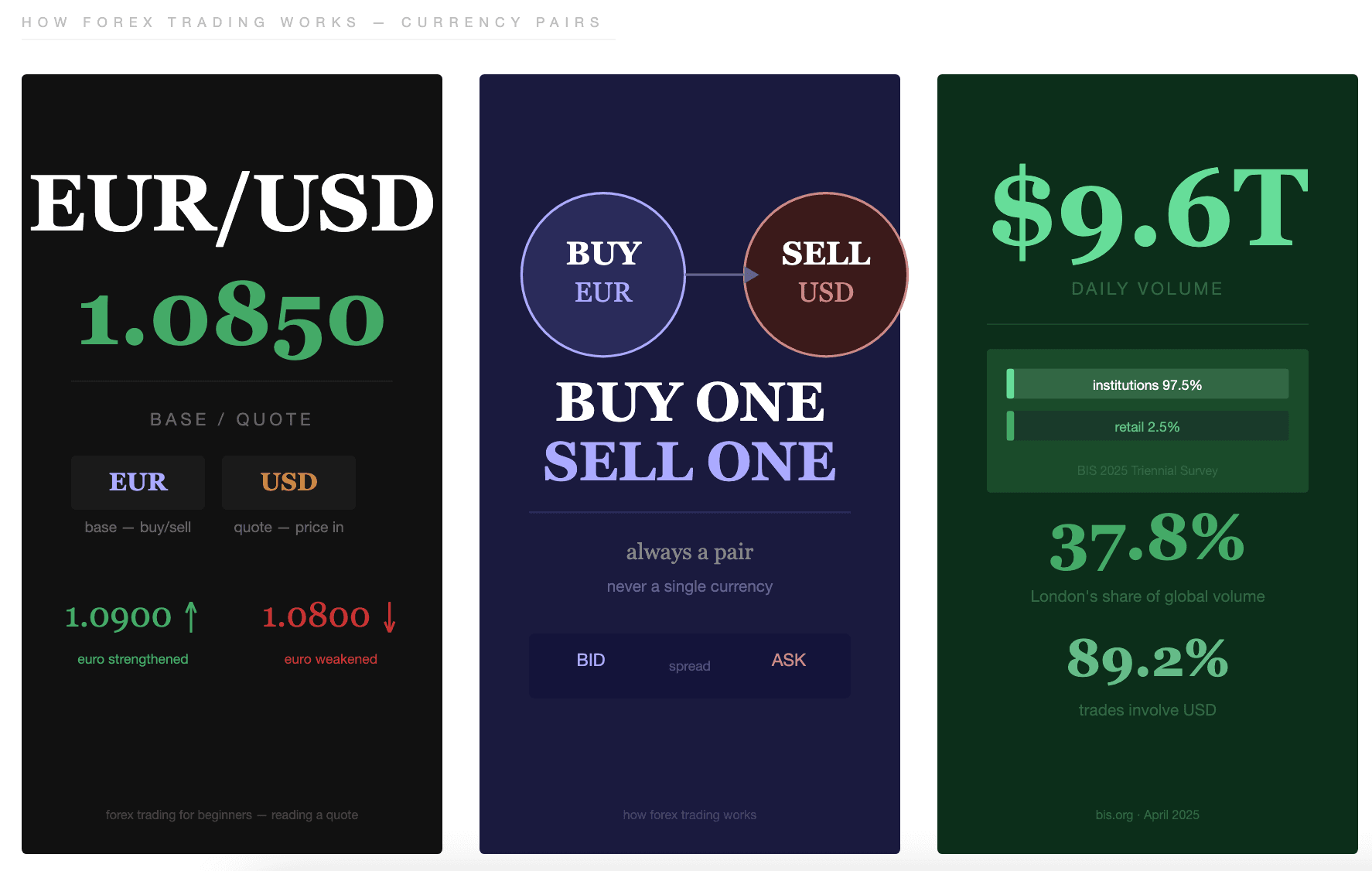
  • The US dollar accounted for 89.2 percent of all trades, per the BIS 2025
  • EUR/USD accounts for 21.2 percent of daily global volume, per BIS 2025
  • Retail traders represent 2.5 percent of total forex volume in 2025
  • London handles 37.8 percent of global forex turnover, the world's largest hub
  • London/New York overlap, 12:00 to 16:00 UTC, produces peak daily liquidity

What Is Forex Trading and How Does It Work
What Is Forex Trading and How Does It Work

Forex means buying one currency and selling another simultaneously. The price shows the exchange rate between the two currencies in the pair. You profit when that rate moves in the direction you predicted. Every trade, at every size, follows this same logic.

"Most beginners overcomplicate forex. One currency goes up relative to another. You either positioned for that move or you did not."

How to Read a Forex Quote: EUR/USD 1.0850 Explained

EUR/USD 1.0850 means one euro costs 1.0850 US dollars right now. EUR is the base currency. USD is the quote currency. The base is what you buy or sell. The quote is what you price it in.

Price moves to 1.0900, and the euro strengthened against the dollar. Price drops to 1.080,0 and the euro weakened. Every quote on every platform follows this exact structure, for every pair you will ever trade.

Two prices appear on the platform. The bid is what the market pays you to sell. The ask is what you pay to buy. The gap between them is the spread, and that spread goes to the broker on every single trade.

How Currency Pairs Work: Majors, Minors, and Exotics

Currency pairs are divided into three categories based on liquidity and volume. Major pairs always include the US dollar. EUR/USD, GBP/USD, USD/JPY, AUD/USD, USD/CAD, USD/CHF, NZD/USD. These carry the tightest spreads and the deepest liquidity. Start here and stay here for at least the first month.

Minor pairs drop the dollar and combine two other major currencies. EUR/GBP, AUD/JPY, GBP/CAD. Wider spreads and less analysis coverage than the majors. Exotic pairs combine a major currency with one from an emerging economy. USD/TRY, USD/HUF, EUR/ZAR. Wide spreads, high volatility, and very little room for error.

The Difference Between Forex and Stock Trading

Forex and stocks both involve buying assets and profiting from price movement. The structure underneath is different. Beginners in stocks often make mistakes by applying stock logic to currency markets.

Stocks trend upward over decades because companies grow and compound earnings. Forex has no such long-term directional bias. EUR/USD can trade in the same range for years. Central bank decisions and macroeconomic data drive currencies far more than any individual company event does.

FeatureForexStocks
Market hours24 hours, 5 daysExchange hours only
What you tradeCurrency pairsCompany shares
Leverage availableUp to 1:30 EU, higher offshoreTypically 1:2 to 1:5
Daily market size$9.6 trillion~$200–400 billion
Primary price driversInterest rates, macro dataEarnings, sector news
Long-term directional biasNoneUpward over time

What Moves Currency Prices

Interest rate differentials drive the most sustained forex trends. When the Fed raises rates while the ECB holds rates steady, money flows to dollar-denominated assets. Dollar demand rises. EUR/USD falls. That mechanism sits behind the majority of major currency moves and behind every sustained trend you will ever trade.

CPI, PPI, NFP, GDP, political events, and central bank forward guidance all contribute. The weight each carries shifts depending on which economic story dominates the market at any given time.

Key takeaway: Forex is the buying and selling of one currency for another. EUR/USD 1.0850 means one euro costs 1.0850 dollars right now. Interest rate decisions drive the majority of sustained currency moves. 

Forex Trading Basics Every Beginner Must Know
Forex Trading Basics Every Beginner Must Know

Three mechanical concepts determine whether your account grows or gets wiped before you learn anything. These are not optional background knowledge. Get them wrong, and no strategy saves you.

Pips, Lots, and Position Size

A pip is the smallest standard price unit in a currency pair. For EUR/USD, one pip equals 0.0001. Move from 1.0850 to 1.0851, and that is one pip, worth a different dollar amount depending on your lot size.

Lot size determines how much each pip costs or earns you in real money. Three options cover every account size:

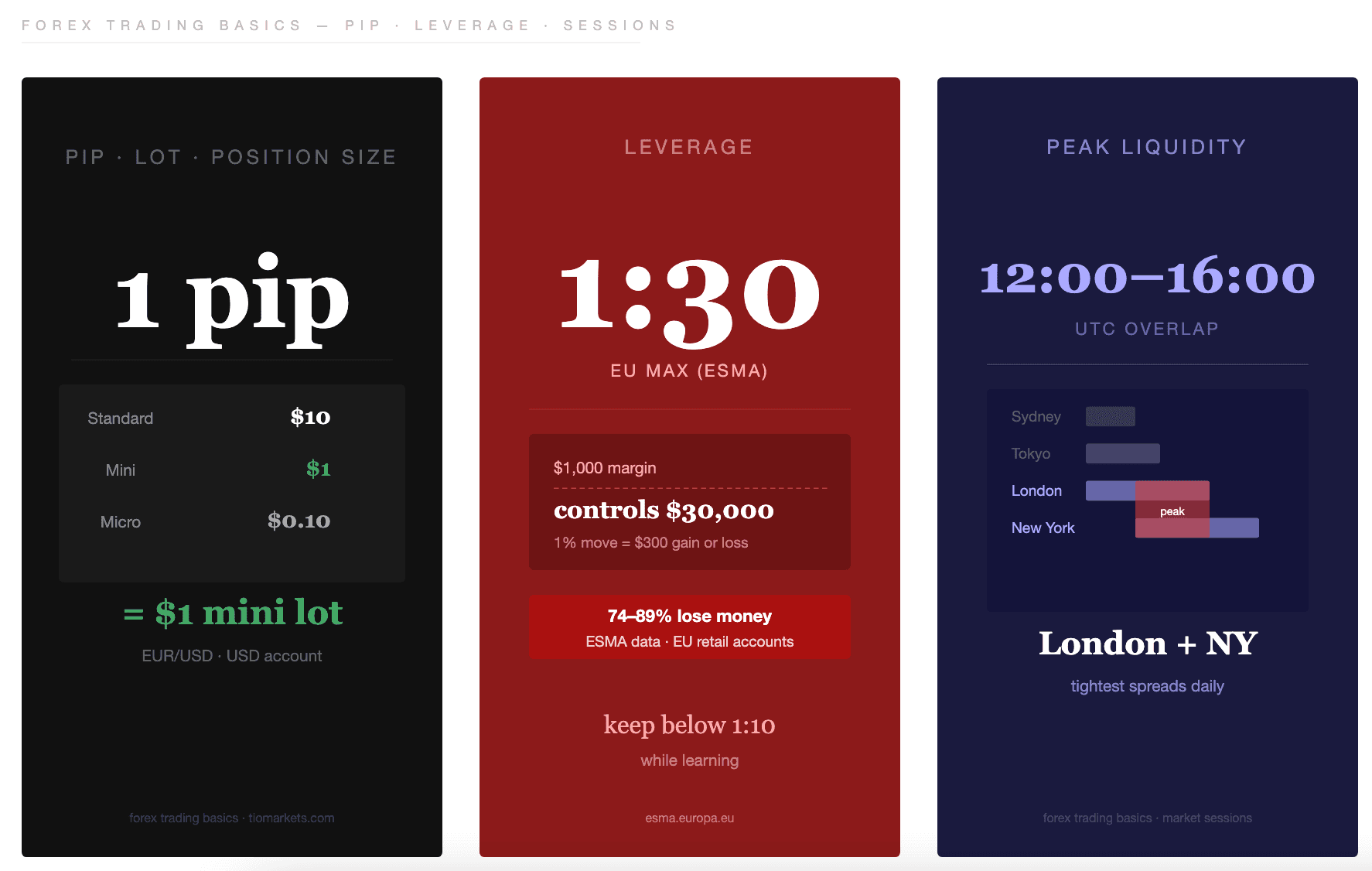
  • Standard lot, 100,000 units: one pip equals $10 on EUR/USD
  • Mini lot, 10,000 units: one pip equals $1
  • Micro lot, 1,000 units: one pip equals $0.10

A 20-pip stop on a mini lot costs $20 if wrong. The same stop on a standard lot costs $200. Same trade, ten times the risk. Position size is not a detail. It is the foundation of every decision you make.

Leverage and Margin: Power and Risk

Leverage lets you control a position larger than your deposited capital. At 1:100 leverage, $1,000 controls $100,000 in currency. One pip on a standard lot equals $10. A 100-pip move against you wipes the account completely.

Margin is the collateral your broker holds while a position stays open. When losses reduce your account balance to below the required margin level, your broker automatically closes the trade without asking. 

“Keep leverage below 1:10 until you demonstrate consistent profitability across at least 100 documented trades.”

The Four Market Sessions and When Liquidity Peaks

The forex market runs continuously because it follows time zones around the globe. Four distinct sessions shape each trading day, each with a different character and different pairs that move most actively.

SessionUTC HoursKey PairsCharacter
Sydney21:00–06:00AUD/USD, NZD/USDLow volume
Tokyo00:00–09:00USD/JPY, AUD/JPYModerate volume
London07:00–16:00EUR/USD, GBP/USDHigh volume
New York12:00–21:00EUR/USD, USD/CADHigh volume
London/NY overlap12:00–16:00All majorsPeak liquidity

From 12:00 to 16:00 UTC, London and New York overlap. This four-hour window produces the tightest spreads and the sharpest directional moves of the entire trading day. Most weekly ranges on EUR/USD and GBP/USD form during this overlap.

Key takeaway: A mini lot on EUR/USD makes each pip worth $1. A 20-pip stop costs $20 if wrong. Keep leverage below 1:10 while learning. The London/New York overlap from 12:00 to 16:00 UTC delivers the day's best conditions for major pairs.

A Real Forex Trade Example With Numbers

Abstract explanations hide what actually happens when you open and close a position. Here is a complete EUR/USD trade, with all costs included. Know what it looks like before your first entry.

  • Setup: EUR/USD at 1.0800. You buy one mini lot. You expect the euro to rise against the dollar.
  • Profit scenario: Price rises to 1.0850. You close. That is 50 pips. At $1 per pip on a mini lot, gross profit is $50 before costs.
  • Loss scenario: Price drops to 1.0750. Your stop fires. That is 50 pips against you. Loss is $50.
  • Spread cost: Broker quotes 1.08003 ask and 1.07997 bid. The spread is 0.6 pips on a mini lot, which costs $0.60 before the market moves. Your 50-pip profit after spread is $49.40. Every trade starts slightly negative because of the spread.
  • Swap cost: Hold overnight, and your broker applies a rate based on the EUR/USD interest rate differential. At current rates, this runs $0.50 to $2 per mini-lot per night, depending on the direction and broker.
  • Margin required: At 1:30 leverage, 10,000 EUR units at 1.0800 require roughly $360 in margin.

Run this calculation for every setup before entry. Know the win. Know the cost. Know the swap if you hold overnight.
Become a Confident Trader

Master trading with our structured course designed for beginners and intermediate traders.

Step-by-step lessons
Real strategies
Risk management training

Join 10,000+ traders improving their skills

Start Course Now

Key takeaway: A 50-pip move on a mini lot results in a a $50 profit or a a $50 loss. The spread costs money before the market moves. Overnight swaps accumulate on held positions. Calculate all three before every trade, not during it.

Learn Forex Trading Step by Step: From Zero to First Trade

Learn Forex Trading Step by Step: From Zero to First Trade

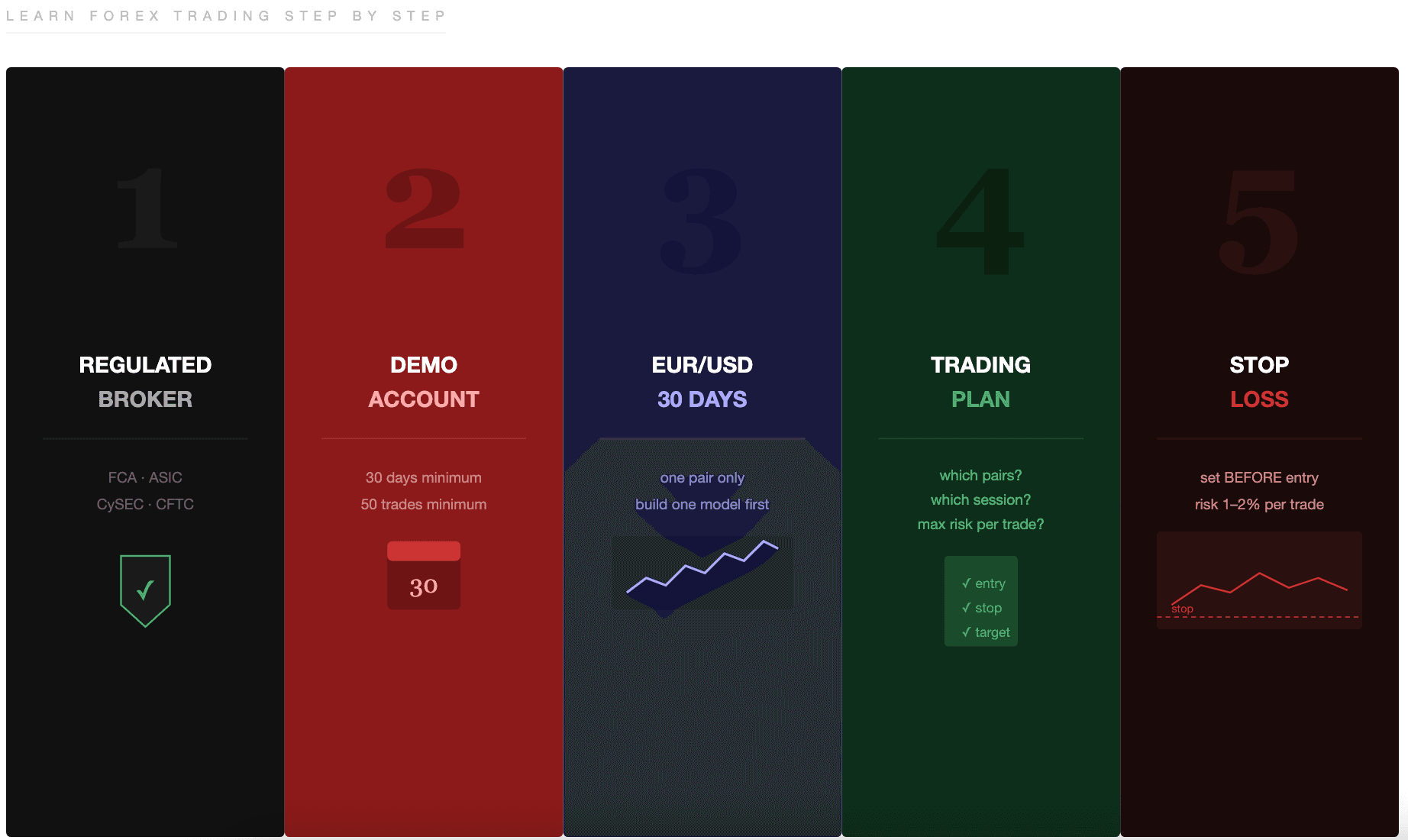
Most beginners blow their first account within weeks because they skip preparation and go straight to live trading—these five steps separate traders who develop an edge from those who burn through their first account. Do not skip steps two and three. They do more work than any strategy.

Step 1 — Choose a Regulated Broker

A regulated broker operates under mandatory rules on leverage limits, client fund segregation, and negative balance protection. Look for regulation from the FCA in the UK, ASIC in Australia, CySEC in the EU, or the CFTC in the US.

Step 2 — Open a Demo Account and Trade It Seriously

A demo account replicates live market conditions using virtual capital. Run the demo for at least 30 days and complete at least 50 trades. Journal every entry price, exit price, stop level, and the reasoning behind each decision. No consistent profitability on demo means adding real money only adds emotional pressure, not edge.

Step 3 — Pick EUR/USD and Study It for 30 Days

EUR/USD carries the deepest liquidity and the most analysis coverage of any pair in the world. Watch how it reacts to US CPI releases. Watch it during ECB rate decisions. Watch the behavior during the London open and the New York overlap. Build one clear mental model of that pair before you add a second.

Step 4 — Build a Trading Plan Before Your First Real Trade

A trading plan answers six questions before you open the platform and look at a chart. Here they are:

  1. Which pairs? 
  2. Which session? 
  3. Maximum risk per trade as a percent of account? 
  4. What triggers an entry? 
  5. Where does your stop loss go? 
  6. What is your profit target?

Without answers to all six, every trade becomes an improvised decision under pressure. Improvised decisions under live market conditions consistently underperform rules-based decisions made in a calm, rational state.

Step 5 — Set Your Stop Loss Before You Enter Any Trade

A stop loss closes your trade automatically if the market moves against you to a pre-defined level. Setting it before entry removes the most dangerous in-trade decision. No more holding a loser and hoping for a reversal.

Risk 1 to 2 percent of your account on any single trade. On a $2,000 account at 1 percent, that is $20. At $1 per pip on a mini lot, your stop sits 20 pips from entry. Calculate this before opening the trade, not after you are already losing.

Key takeaway: Five steps: regulated broker, serious demo for 30-plus days, EUR/USD only for the first month, a written trading plan, and a stop loss set before every entry. Skip any, and you are gambling with structure, not trading.

Forex Trading Strategies for Beginners

Forex Trading Strategies for Beginners

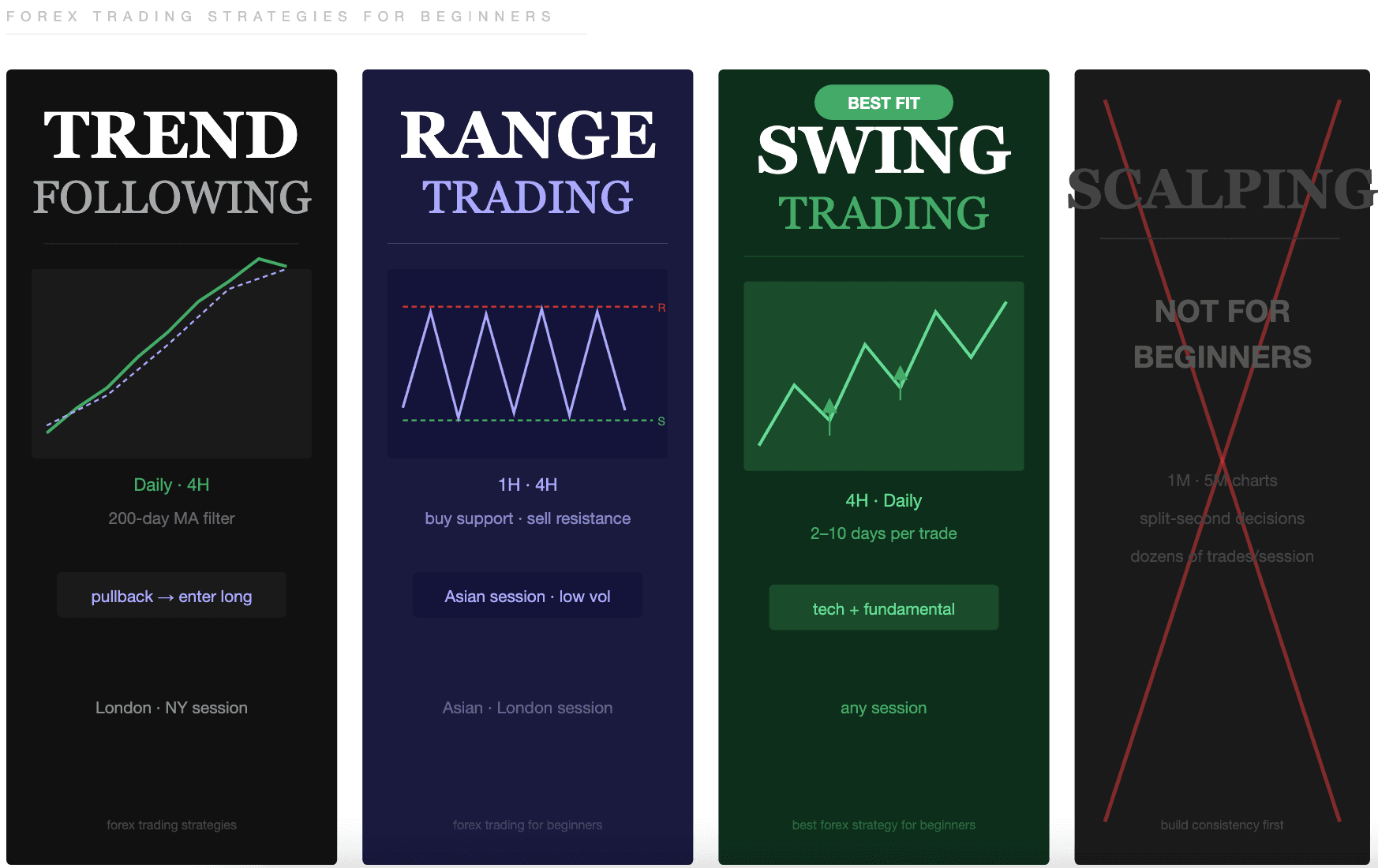
A forex trading strategy defines the exact conditions required before you enter a trade. Without that definition, you react to market noise rather than act on a clear signal. Three strategies suit beginners well because each relies on visible, objective conditions rather than complex indicator combinations.

Trend Following: The Simplest Starting Point

Trend following means identifying the current direction of a pair and trading with it. If EUR/USD makes consistently higher highs and higher lows on the daily chart, the trend is up. Look for pullbacks to the 50-day or 200-day moving average. Enter long when the price shows signs of resuming upward.

Price above the 200-day moving average signals a bullish long-term bias. The price below signals bearish. The core risk is entering near the trend's end. Adding RSI to confirm momentum before entering reduces the frequency of those late, expensive entries.

Range Trading: Buy Support, Sell Resistance

Range trading works when a currency pair bounces between two well-defined price levels without breaking out. Buy near support at the bottom of the range. Sell near resistance at the top. Close when the price approaches the opposite boundary.

Swing Trading: The Best Fit for Most Beginners

Swing trading holds positions for two to ten days. It targets medium-term moves driven by technical setups or fundamental catalysts. It does not require constant chart monitoring. Practical for beginners who cannot dedicate full sessions to screens.

A swing setup on EUR/USD might start with a view that the dollar looks weak after a soft NFP. The four-hour chart then confirms a break of resistance. Enter on that confirmation, stop below the prior swing low, and target the next resistance zone.

StrategyTimeframeAnalysis TypeSessionBeginner-Friendly
Trend followingDaily, 4HTechnicalLondon, NYYes
Range trading1H, 4HTechnicalAsian, LondonYes
Swing trading4H, DailyTechnical + FundamentalAnyYes, best fit
Day trading15M, 1HTechnicalLondon-NY overlapModerate
Scalping1M, 5MTechnicalLondon-NY overlapNot recommended

Key takeaway: Trend following, range trading, and swing trading all suit beginners. Each has clear entry conditions and defined stop placement. Swing trading is the best fit because it does not require a full-time screen presence. Avoid scalping until you have 12 months of consistent results on a slower approach.

Technical and Fundamental Analysis for Beginners

Technical and Fundamental Analysis for Beginners

Forex analysis is divided into two categories that work best together. Technical analysis reads price charts to identify entry and exit points. Fundamental analysis reads economic data to understand the direction of the larger move. Start with three technical tools and one fundamental rule, then build from there.

Moving Averages: Your First Trend Tool

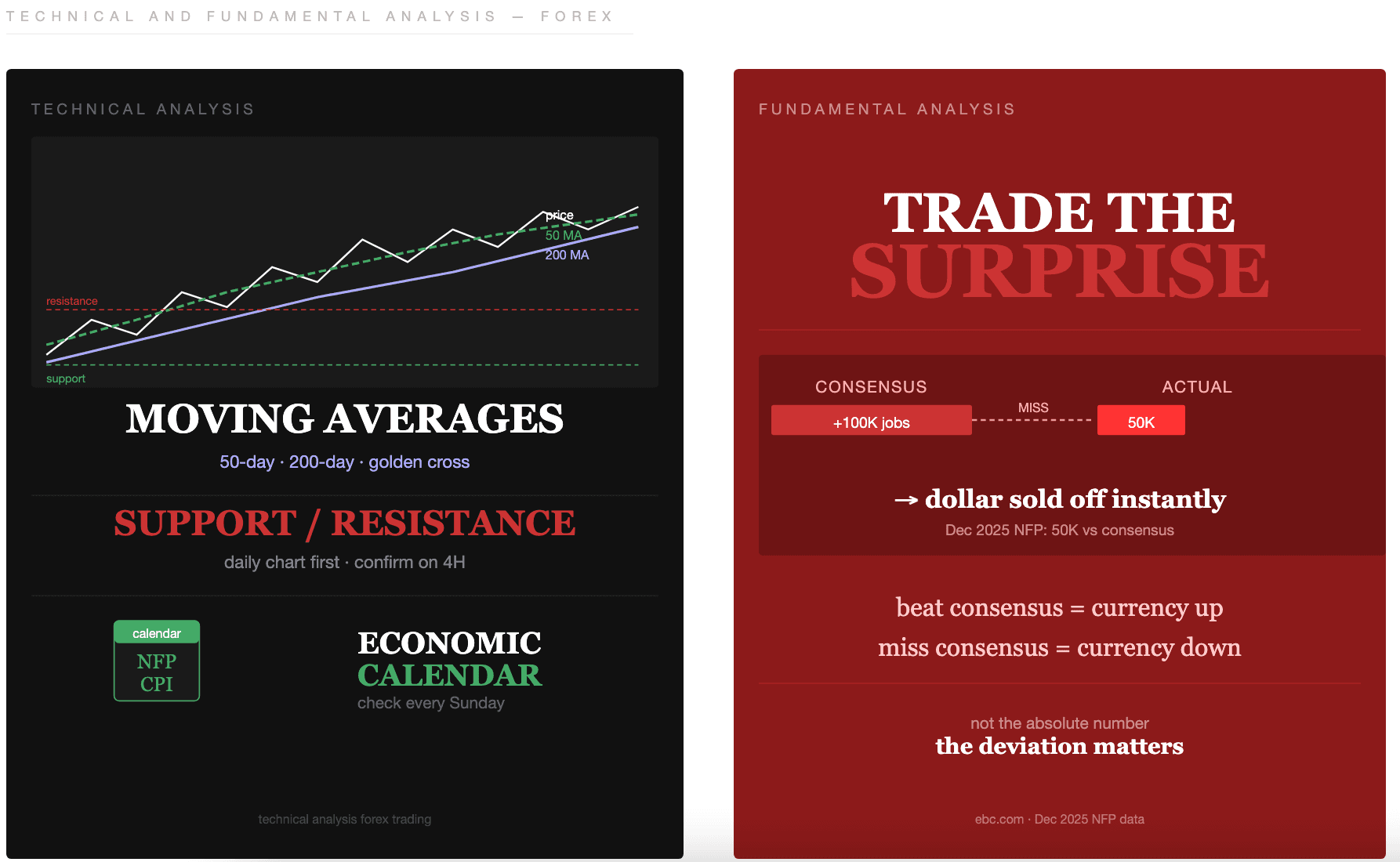
A moving average smooths price data into a single directional line on the chart. The 50-day and 200-day moving averages on the daily chart are the most widely watched levels across professional forex desks.

Price above the 200-day signals a bullish long-term bias. When the 50-day crosses above the 200-day, traders call this a golden cross and treat it as trend confirmation. These signals carry weight because enough participants act on them at once. That creates the reactions that make them self-fulfilling.

Support and Resistance: Where Price Reacts

Support is a price level where buyers have previously stepped in strongly enough to stop a decline. Resistance is a level where sellers previously capped a rally. Both form because traders remember prior reversals. When the price returns to the same area, they act on that memory again.

How to Use an Economic Calendar in Forex Trading

An economic calendar lists every scheduled data release for major economies, alongside the consensus forecast and the previous result. High-impact events that move currency markets consistently include NFP, CPI, central bank rate decisions, and GDP releases.

Here are the steps to read the economic calendar like a pro:

  1. Check the upcoming week's calendar every Sunday
  2. Identify every high-impact event for the pairs you trade and mark the release times
  3. Decide whether you hold existing positions through each event or close before

Most beginners lose money by holding positions into high-impact releases without understanding what the market expects. The market moves on the deviation from consensus, not on the absolute number.

Fundamental Analysis in One Rule: Trade the Surprise

Market prices are based on expectations before data releases. Beat the consensus significantly, and the currency strengthens fast. Miss significantly, and it weakens fast. This one rule covers most of what beginners need from fundamental analysis.

December 2025 NFP came in at 50,000 jobs, below the higher-than-expected consensus. The dollar sold off immediately. A trader tracking the consensus knew why in real time. A trader who ignored it watched the position move with no framework to understand it.

Key takeaway: Moving averages give directional bias. Support and resistance give entry and stop levels. The economic calendar shows when to get positioned or stay out. 

The Biggest Mistakes Beginners Make in Forex Trading

The Biggest Mistakes Beginners Make in Forex Trading

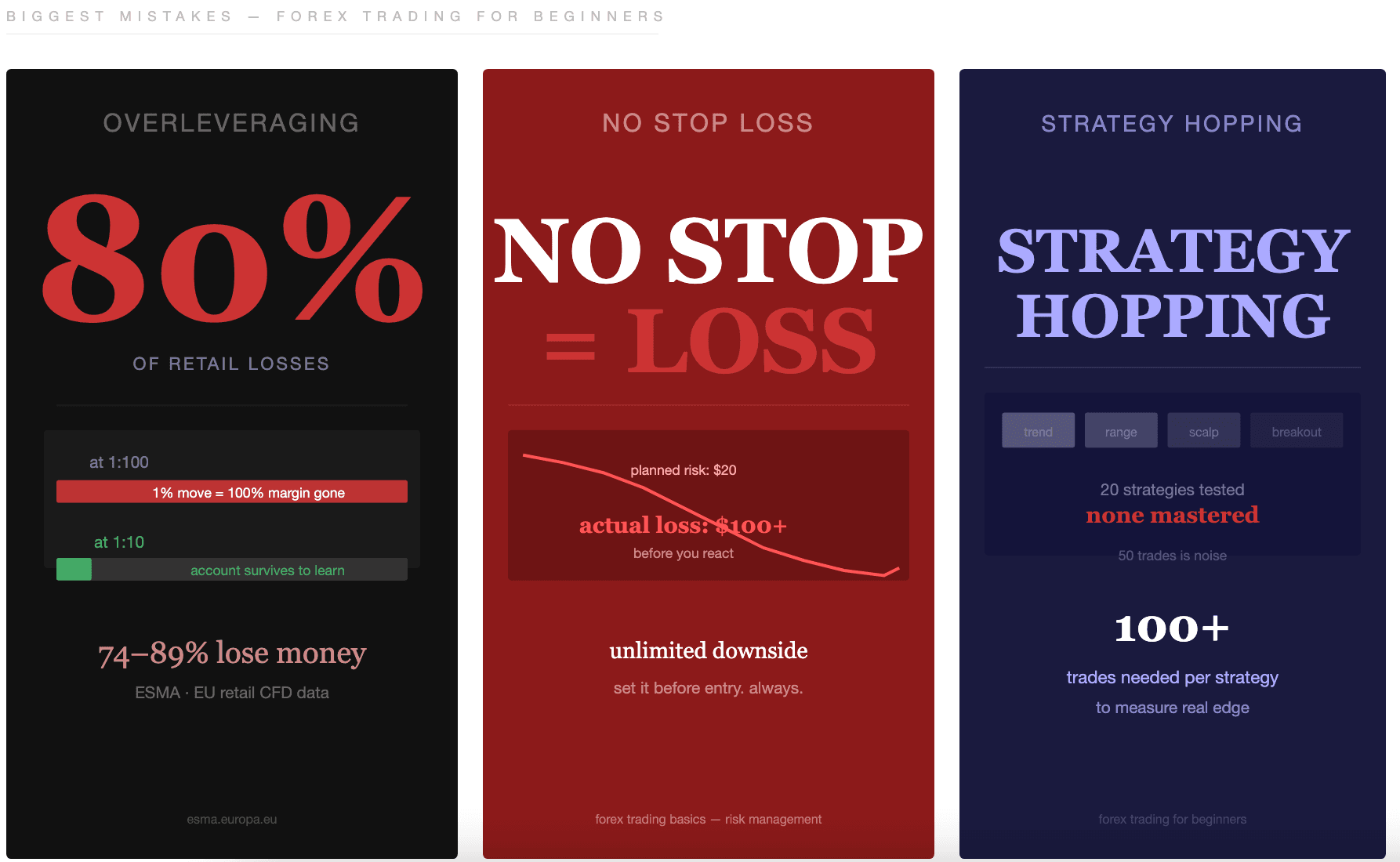
ESMA shows that 74 to 89 percent of retail accounts lose money, with average losses of 1,600 to 29,000 euros per client. The losses are not random. They cluster around three specific, repeatable behaviors.

Overleveraging on the First Account

At 1:100 leverage, a 1 percent adverse move wipes 100 percent of the margin on that position. Most beginners choose high leverage because brokers allow it, and the profit potential looks impressive on paper. 

The same lever works identically in both directions. A 20-pip win produces $200. A 20-pip loss also produces $200 in losses. Losing positions arrive more reliably and faster than winning ones do while you are still learning.

Start at 1:10 or lower. The profit numbers look smaller in the short term. The account lasts long enough for you actually to learn something.

Trading Without a Stop Loss

A trade without a stop-loss order carries theoretically unlimited downside risk. EUR/USD can move 100 pips in a single session during a major news release. Without a stop, a trade planned to risk $20 becomes a $100 loss before you can react.

Strategy Hopping: Why Most Beginners Never Find Their Edge

Every strategy produces losing streaks. A trend-following strategy loses in ranging markets. A range strategy loses on breakouts. That failure rate traces back to three mistakes: high leverage, the absence of stop-losses, and strategy hopping.

Key takeaway: Three mistakes cause most retail failures. High leverage destroys accounts before genuine learning happens. Missing stop losses turn planned small losses into account-ending ones. 

Summary

Forex trading for beginners starts with one mechanism. Buy one currency, sell another, profit when the rate moves your way. The BIS 2025 Triennial Survey confirms $9.6 trillion. ESMA data shows 74 to 89 percent of retail accounts lose money. 

That failure rate traces back to three mistakes: high leverage, the absence of stop-losses, and strategy hopping. Start with one pair, one strategy, and strict risk rules per trade. Add complexity only after demonstrating consistent results over at least 100 documented trades.

Frequently Asked Questions

Disclaimer: This article is for informational purposes only and does not constitute financial advice. Trading involves risk and may result in loss of capital.

The First Move Is Yours

Discover how Supertrade can transform your trading career. Explore challenges, access instant funding, and join a growing community of Supertraders.

Stay Ahead of the Game

Sign up to receive exclusive tips, market insights, and the latest updates from Supertrade. Don’t miss out on opportunities to grow your trading success.
Discord

Our Community

Do not skip any beat.

The Ultimate Trading Community. Join our Discord server to get the latest updates, news and more.

2026 Supertrade. All rights reserved
DiscordInstagramTelegramYouTubeX
Trading involves significant risk. Past performance is not indicative of future results. This is a simulated trading environment. Supertrade provides educational trading services.
Supertrade
Supertrade Ltd, a company incorporated under the laws of Saint Lucia with registered number 2024-00699, located at Ground Floor, Rodney Court Building, Rodney Bay, Gros Islet, Saint Lucia, LC01 101, operates and owns this website, as well as provides services under the Terms and Conditions posted on the website. Supertrade Prop Ltd, a company incorporated under the laws of England and Wales with registered number 16234284, located at 52-56 Standard Road, London, England, NW10 6EU, acting as a payment agent.