
Crypto

May 27, 2026 - 14 min

Beginner

Crypto for Beginners in 2026: Start Here

Crypto Basics Guide

Digital money. No bank controls it. No government issues it. Crypto for beginners starts with one number: 741 million people worldwide hold digital assets, per Crypto.com's 2025 Market Sizing Report. That number grew 12.4 percent in a single year. This 2026 guide covers what cryptocurrency is, how it works, and how to start. No fluff.

Justin Freeman
Reviewed by:
Share

Seven Key Facts Before You Start

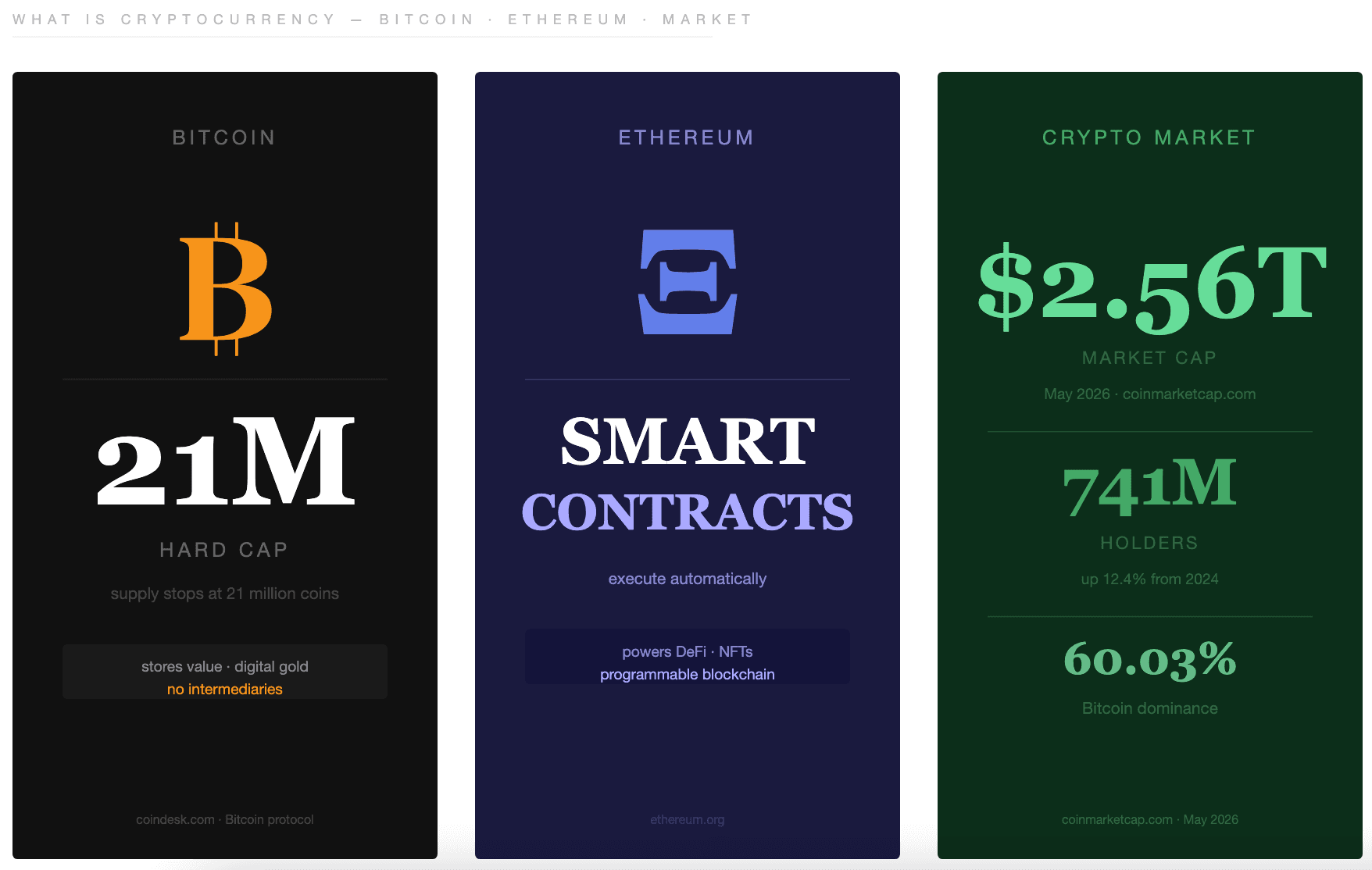
  • Global crypto market cap: $2.56 trillion, May 2026
  • 741M holders worldwide, up 12.4% from 2024 
  • Bitcoin ETF inflows: $58.72B since Jan 2024 
  • Bitcoin dominance: ~60.03% of total market cap 
  • Schwab ($11.9T assets) launched spot BTC/ETH 2026 
  • Stablecoin volume: 104% of daily trading, May 2026
  • BTC hit $80K+ on Senate crypto bill, per Bloomberg 

What Is Cryptocurrency and How Does It Work
What Is Cryptocurrency and How Does It Work

Cryptocurrency, or simply crypto, is digital money running on a decentralized network of computers—no central bank. No government. No single point of failure. Transactions are recorded permanently on a shared ledger that anyone can read, but no one can alter. That is the core of what makes crypto different from every financial system before it.

"Most beginners ask what crypto is worth. The better question is what problem it solves. Decentralized, borderless, 24-hour money is the answer."

How to Read Crypto and What the Difference Actually Is

Bitcoin (BTC) and Ethereum (ETH) are both cryptocurrencies. They do different things. BTC stores and transfers value without intermediaries. Its supply stops at 21 million coins, per the Bitcoin protocol. The code enforces that scarcity permanently. That hard cap is why many investors treat Bitcoin as digital gold.

Ethereum is a programmable blockchain. It does not just move value — it runs code. Smart contracts on Ethereum execute automatically when conditions are met, with no third party required. That programmability powers DeFi, NFTs, and most crypto applications built today. 

On any trading platform, BTC/USDT means you buy BTC with USDT. The price shows how many USDT one Bitcoin costs right now.

Why Crypto Prices Move So Fast

Three things drive crypto volatility.

  • 24/7 trading, no circuit breakers
  • Thinner markets than equities, less liquidity per trade
  • Sentiment shifts on single headlines or announcements

One headline, one institutional announcement, or one liquidation cascade can move prices 10 to 20 percent. In hours. That speed creates trading opportunities. It also destroys undisciplined accounts.

Key takeaway: Crypto is decentralized digital money on immutable blockchains. Bitcoin stores value. Ethereum runs programs. Crypto moves 3 to 5 times faster than traditional markets due to 24-hour trading, thin liquidity, and rapid shifts in sentiment. Understand all three before you put capital in.

Crypto Terms Every Beginner Must Know Before Their First Trade
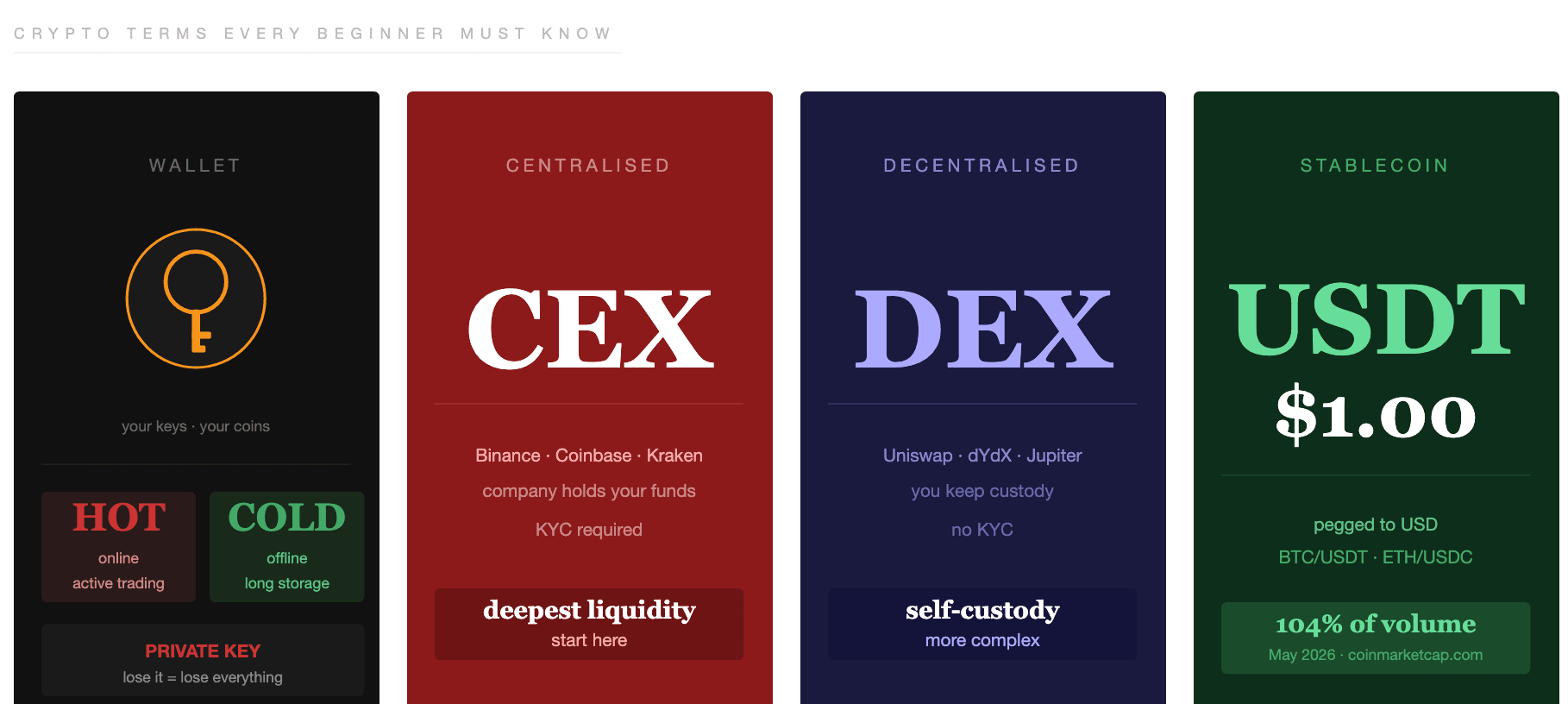
Crypto Terms Every Beginner Must Know Before

You will see the same terms on every platform, every chart, every analysis piece in crypto. Get them wrong, and you misread the market. Get them right, and you'll already be operating at a higher level than most new accounts.

Wallets, Exchanges, and Keys: The Three Things You Set Up First

Three things you need before any trade:

  • Wallet — stores your private keys
  • Exchange — where you trade crypto
  • Private key — proves you own funds

Hot wallets connect to the internet and are good for active trading. Cold wallets sit offline on a hardware device, better for long-term storage and larger amounts.

Your coins live on the blockchain. The wallet gives you access. Share your private key with anyone, and they control your funds. Lose it, and access is gone permanently. No password reset exists. No support call fixes a lost private key.

On a CEX like Binance or Coinbase, the exchange holds your keys. Your coins sit in their custody. That distinction matters when exchanges get hacked.

Stablecoins: What They Are and Why Every Trader Uses Them

Stablecoins are cryptocurrencies pegged to the US dollar. USDT and USDC are the two largest, and their prices stay at $1.00. Every trader uses stablecoins for three reasons:

  • Exit a trade without converting to fiat
  • Avoid withdrawal fees between trades
  • Park capital during volatile conditions

Stablecoin volume now exceeds 104% of total daily crypto trading volume, per CoinMarketCap, May 2026. Every major pair on a CEX uses a stablecoin as the quote currency. BTC/USDT, ETH/USDC, SOL/USDT. Understanding stablecoins is not optional. It is the foundation of how every trade works.

CEX vs DEX: Where You Actually Trade

A CEX is a centralized exchange: Binance, Coinbase, Kraken, etc. A company operates it, holds your funds, verifies your identity through KYC, and matches your orders: deepest liquidity, tightest spreads, simplest execution.

A DEX is a decentralized exchange: Uniswap, dYdX, Jupiter, etc. Smart contracts match trades automatically. You keep custody of your funds with no identity verification required. Access to tokens not listed on CEXes—the trade-off: more complexity, higher gas fees, thinner liquidity. Start on a regulated CEX. Move to a DEX when you understand what you are doing.

Key takeaway: Wallets store keys, not coins. Private keys cannot be recovered if lost. Market cap and liquidity tell you how stable a coin is. Stablecoins let you stay in cash inside the crypto ecosystem. Start on a regulated CEX for better liquidity and simpler execution.

How to Get Started in Crypto: Step by Step
How to Get Started in Crypto

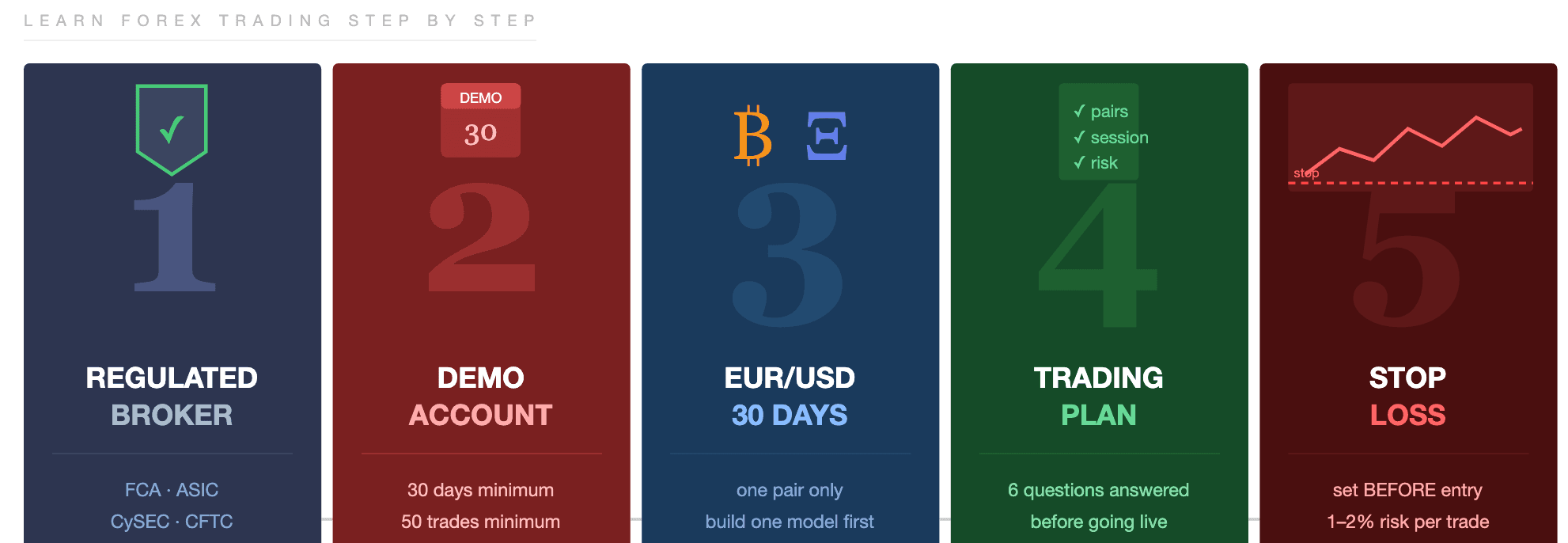
These five steps separate beginners who lose their first deposit from those who build something worth building. Do not compress this into a weekend. Each one builds on the last.

Step 1 — Choose a Regulated Exchange

A regulated exchange operates under mandatory rules:

  • Client fund segregation from company assets
  • Published security standards and audit trails
  • Identity verification protects you from fraud
Become a Confident Trader

Master trading with our structured course designed for beginners and intermediate traders.

Step-by-step lessons
Real strategies
Risk management training

Join 10,000+ traders improving their skills

Start Course Now

Binance, Coinbase, and Kraken hold licenses across multiple jurisdictions. Check the regulatory status for your country before depositing. An unregulated exchange removes every protection you have.

Step 2 — Set Up and Secure Your Wallet

Leaving funds on an exchange means the exchange holds your private keys. Exchange gets hacked, you lose. Exchange freezes withdrawals; you cannot access your funds.

A couple of steps to start:

  1. Get a software wallet, such as MetaMask or Trust Wallet, for active trading. 
  2. Set up a hardware wallet like Ledger for anything you are not actively trading. 
  3. Write your seed phrase on paper and store it offline. 

Never photograph it. Never save it digitally. That seed phrase is the only recovery path if your device fails.

Step 3 — Make Your First Purchase

Start with Bitcoin or Ethereum. Both are:

  • Most liquid crypto assets are available
  • Most researched with the widest analyst coverage
  • Most regulated crypto assets

Bitcoin and Ethereum account for approximately three-quarters of the total crypto market cap, per Schwab's Crypto launch. Buy a small amount. Executing a real purchase and watching the confirmation land teaches more than any explanation does.

Step 4 — Learn One Chart Pattern Before Your First Trade

Support and resistance are the most practical chart concepts for new crypto traders:

  • Support — price where buyers repeatedly stopped declining
  • Resistance — price where sellers repeatedly capped rally

Find two clear support levels on the BTC/USDT daily chart before placing any trade. Mark them. Watch how the price behaves when it approaches them. This single exercise builds more pattern recognition than reading about twenty indicators.

Step 5 — Set Your Stop Loss Before Every Single Trade

A stop-loss closes your position automatically when the price reaches a predefined loss level. Set it before entry. Not after you are already losing.

Risk 1 to 2 percent of your account on any single trade. On a $1,000 account, that is $10 to $20. Place the stop below a meaningful support level rather than at a round number. A stop at $79,500 on a Bitcoin trade is arbitrary. A stop below the prior swing low at $78,200 is logical.

Key takeaway: Five steps. Regulated exchange, secured wallet with offline seed phrase, BTC or ETH first, support and resistance before any strategy, stop loss before every entry. These prevent the losses that end most beginner accounts in month one.

How Cryptocurrency Works in Trading

How Cryptocurrency Works in Trading

Crypto trades 24 hours a day, 365 days a year. That creates opportunities traditional equity traders never see. It also creates traps. The strategies below have clear entry conditions, manageable time requirements, and defined risk per trade.

Investing vs Trading Crypto: Which One Are You Actually Doing

These are two completely different activities. Most beginners get confused by them and pay for it. Investing means buying and holding for months or years on a fundamental view. Check the price monthly, not hourly. Bitcoin ETF inflows reached $47.2 billion in 2025, showing institutions doing exactly this at scale.

Trading means opening and closing positions on shorter timeframes: days, hours, or minutes. It requires active management, stop losses, and a defined strategy for every position. Most beginners think they are investing. Then the price drops 20 percent, and they sell. That is trading badly, not investing. Decide which one you are doing before you open the platform.

Swing Trading Crypto: How It Works and When to Use It

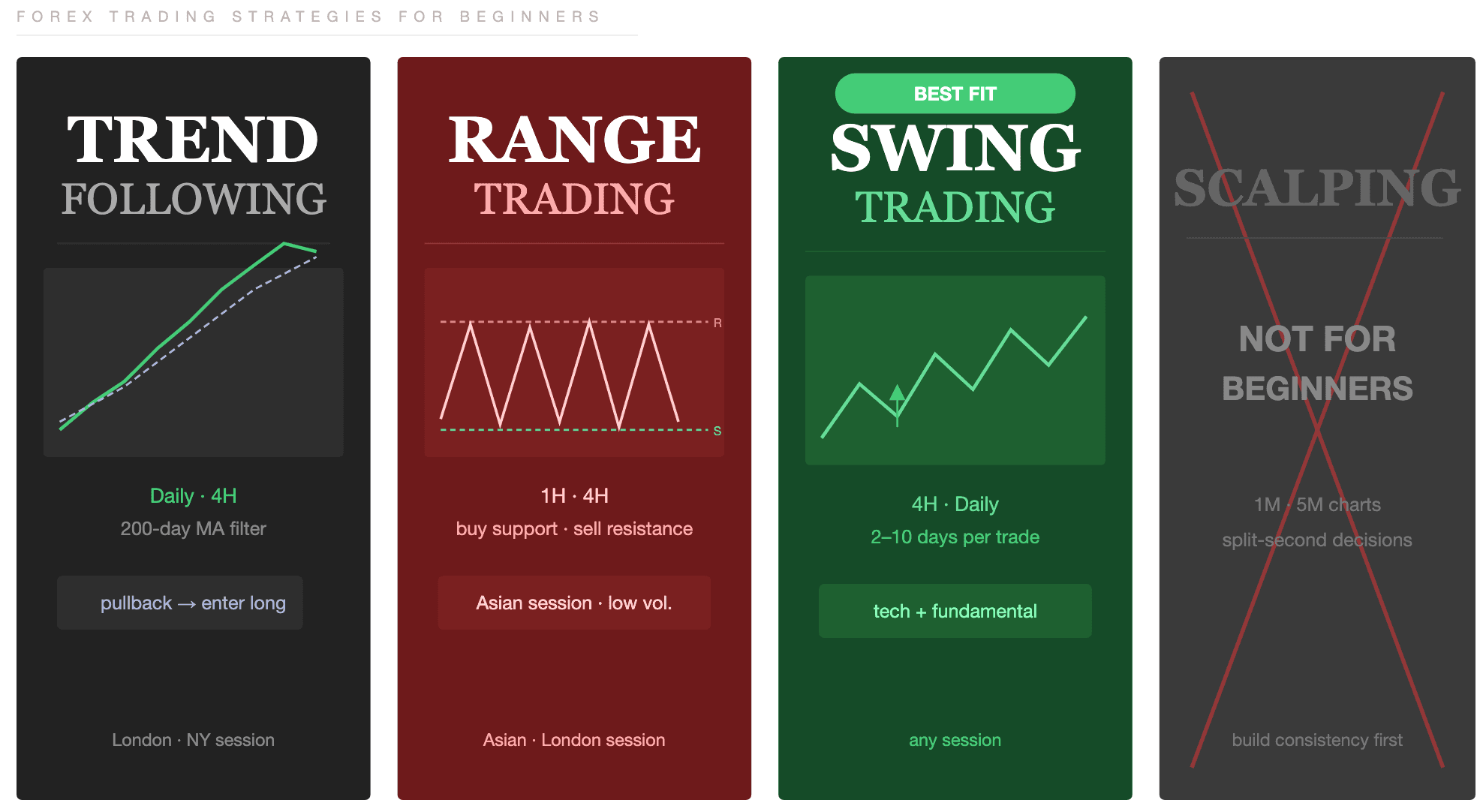
Swing trading holds positions for two to ten days. It targets price moves from technical setups or macro catalysts and does not require watching screens every hour. A swing setup on BTC/USDT looks like this:

  • Bitcoin holds support at $78,000 after a selloff
  • RSI reaches oversold on the daily chart
  • Senate advances a crypto market structure bill
  • Entry at $78,500, stop at $77,800, target at $82,000

Entry, stop, and target are defined before the trade opens. That is swing trading done correctly.

How Crypto Reacts to Macro Events: Trade the Surprise

Crypto reacts to macro events faster than any other asset class. In May 2026, the Senate Banking Committee advanced a digital asset market structure bill. Bitcoin climbed past $80,000 within hours, per Bloomberg.

StrategyTimeframeAnalysisBeginner-Friendly
HODLingMonths to yearsFundamentalYes, lowest stress
Swing trading2–10 daysTechnical + FundamentalYes, best fit
Day tradingHoursTechnicalModerate
ScalpingMinutesTechnicalNot recommended

Key takeaway: Decide whether you are investing or trading before opening the platform. Swing trading suits most beginners. It does not need a full-time screen presence. Crypto reacts faster than any other market to macro events. Know the consensus expectation before every major announcement.

The Biggest Risks in Crypto Trading and How to Manage Them

The Biggest Risks in Crypto Trading and How to Manage Them

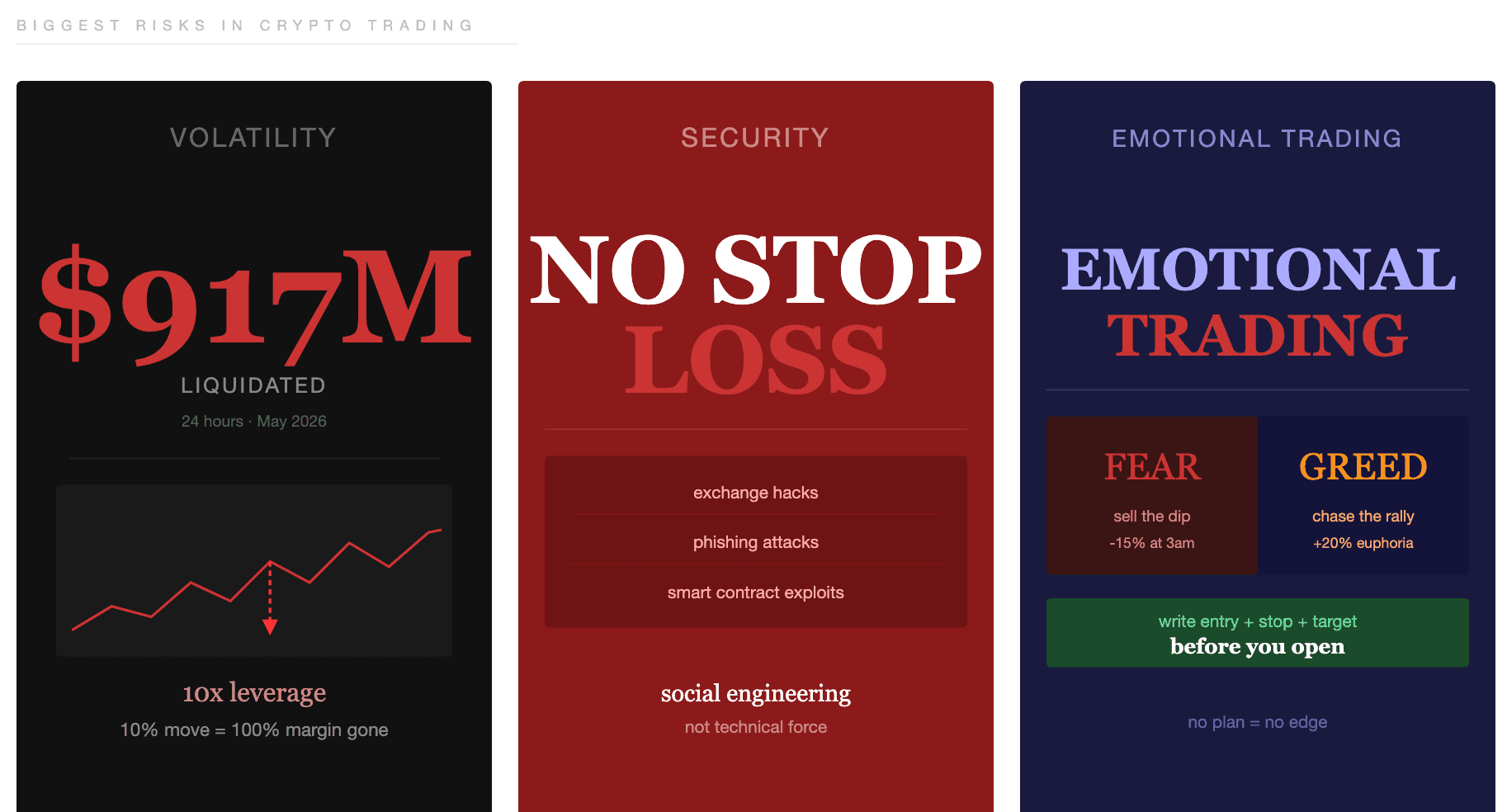
Most beginners lose capital before the market even has a chance to work against them. They over-leverage. They skip stop losses. They make emotional decisions at 3 am during a 20 percent drop. 

“Three specific risks cause the majority of early losses. None of them is about picking the wrong coin. All of them are about behavior before the trade opens.”

Volatility: Cryptxo Moves 3–5x Faster Than Forex or Indices

In a single 24-hour period in May 2026, Bitcoin futures liquidations erased nearly $917 million in positions. How liquidation cascades work:

  • Leveraged longs get force-closed when the price drops
  • Forced selling pushes the price lower
  • More longs hit their liquidation level
  • The loop feeds itself

Without leverage, volatility is manageable with stop losses. At 10x leverage, a 10 percent adverse move means 100 percent of the margin gone. This is not a theoretical risk. It happens daily in crypto markets. Start without leverage. Add it only after 50 documented profitable trades.

Security Risks: Wallets, Exchanges, and Private Keys

In May 2026, Bloomberg reported that hackers were actively using AI tools to target the $130 billion crypto sector. Crypto security threats arrive from three directions. Most beginners never see them coming until funds are gone.

Three main attack vectors:

  • Exchange hacks steal platform funds
  • Phishing steals your private keys
  • Smart contract exploits drain DeFi

Protecting yourself comes down to three rules you apply before any funds move. Each one removes a specific attack surface that criminals rely on.

Three rules that eliminate most risk:

  • Use regulated exchanges only
  • Hardware wallet for idle funds
  • Ignore unsolicited exchange messages

The attack almost always arrives through social engineering, not technical force. The most sophisticated hackers in crypto do not break encryption. They send convincing emails.

Emotional Trading: Why Most Beginners Lose Before the Market Does

Crypto's 24-hour market and extreme volatility create constant emotional pressure. A 15 percent drop at 3 am looks catastrophic. A 20 percent rally creates euphoria. Both states produce the same outcome: decisions made without a plan.

The fix is mechanical:

  1. Write entry, stop, and target before opening
  2. If levels remain valid, hold the trade
  3. If they do not, close at the stop

Never move a stop loss further from entry. That rationalization is what turns a small loss into an account-ending one. It is the single most common mistake in retail crypto trading.

Key takeaway: Crypto moves fast enough to trigger $917 million in liquidations in a single day. Leverage amplifies that speed into account wipes. Emotionally driven decisions amid volatility kill more accounts than bad strategy does. 

Final Things to Remember

The global market is valued at $2.56 trillion as of May 2026, per CoinMarketCap. Charles Schwab's $11.9 trillion platform confirmed that spot BTC and ETH trading will launch this year. That is the strongest institutional signal crypto has received.

Bitcoin and Ethereum represent roughly three-quarters of the total market cap. Start with these two before touching anything else. Set a stop loss before every trade. Risk is 1 to 2 percent per position, nothing more.

Frequently Asked Questions

Disclaimer: This article is for informational purposes only and does not constitute financial advice. Trading involves risk and may result in loss of capital.

Related Articles

The First Move Is Yours

Discover how Supertrade can transform your trading career. Explore challenges, access instant funding, and join a growing community of Supertraders.

Stay Ahead of the Game

Sign up to receive exclusive tips, market insights, and the latest updates from Supertrade. Don’t miss out on opportunities to grow your trading success.
Discord

Our Community

Do not skip any beat.

The Ultimate Trading Community. Join our Discord server to get the latest updates, news and more.

2026 Supertrade. All rights reserved
DiscordInstagramTelegramYouTubeX
Trading involves significant risk. Past performance is not indicative of future results. This is a simulated trading environment. Supertrade provides educational trading services.
Supertrade
Supertrade Ltd, a company incorporated under the laws of Saint Lucia with registered number 2024-00699, located at Ground Floor, Rodney Court Building, Rodney Bay, Gros Islet, Saint Lucia, LC01 101, operates and owns this website, as well as provides services under the Terms and Conditions posted on the website. Supertrade Prop Ltd, a company incorporated under the laws of England and Wales with registered number 16234284, located at 52-56 Standard Road, London, England, NW10 6EU, acting as a payment agent.