

Crypto Trading

Jun 8, 2026 - 16 min

Beginner

How to Trade Cryptocurrency: A Complete Guide for 2026

How to Trade Cryptocurrency: A Complete Guide for 2026

Buying and selling digital assets on exchanges to profit from price movements is how most people enter the crypto market. Cryptocurrency trading now touches over 67 million Americans, roughly 1 in 4 adults, up 12 million from 2025. This crypto trading guide breaks down the mechanics, strategies, charts, and risk management that separate lasting traders from those who quit after one bad month.

Justin Freeman
Reviewed by:
Share

Cryptocurrency Trading at a Glance: Key Facts

QuestionAnswer
What is cryptocurrency trading?Buying and selling digital assets on exchanges to profit from price movements.
How many people own crypto in 2026?Over 67 million in the US alone, roughly 1 in 4 adults (BusinessWire / NCA + Harris Poll).
What is the global crypto market worth?Estimated at $6.16 trillion in 2026 (Mordor Intelligence).
How many cryptocurrencies exist?More than 18,000, with Bitcoin holding roughly 57% market dominance.
Can you trade crypto 24/7?Yes, unlike stock markets, crypto exchanges never close.
What is the biggest risk?Volatility and lack of understanding. 59% of non-owners say they do not understand crypto (Motley Fool, 2026).

What Is Cryptocurrency Trading?

What Is Cryptocurrency Trading

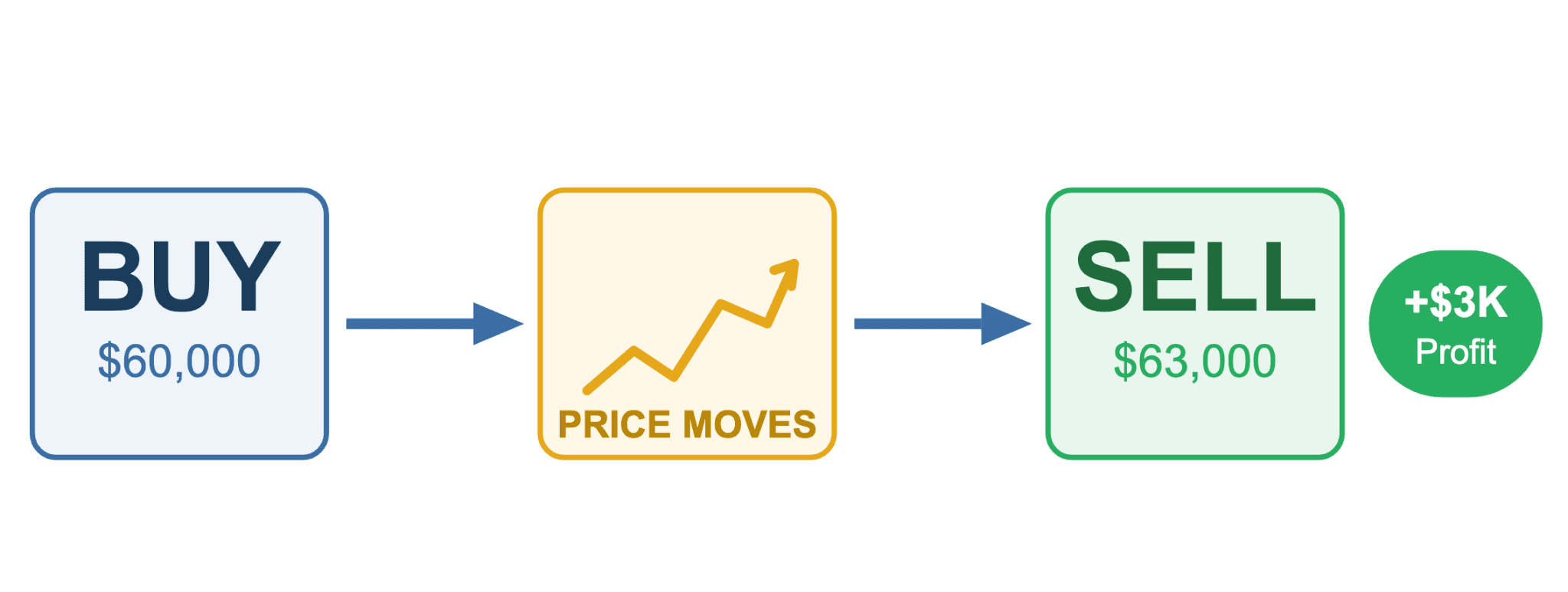
Cryptocurrency trading means buying digital assets at one price and selling them at another to capture the difference. You buy Bitcoin at $60,000, sell at $63,000, and pocket $3,000 minus fees. The concept is simple, but execution requires timing, risk control, and an understanding of what moves prices in a market that never sleeps.

Crypto markets run 24 hours a day, 7 days a week, with no closing bell and no weekends off. That constant activity creates more opportunities for active traders, but it also means prices shift overnight, on holidays, and during every hour you are not watching.

What Is Cryptocurrency?

A cryptocurrency is a digital currency secured by cryptography and recorded on a blockchain. No bank or government issues it. Bitcoin, the first cryptocurrency, launched in 2009 and still holds roughly 57% of the total market. Today, over 18,000 altcoins exist alongside it, from Ethereum to stablecoins pegged to the US dollar.

The blockchain is a shared digital ledger that records every transaction across a network of computers. Once data lands on the chain, nobody can alter it without the network detecting the change. That built-in transparency is what allows the system to function without a central authority managing trust.

How Is Crypto Trading Different from Stock Trading?

Stocks represent ownership in a company. Crypto tokens do not. You own a digital asset on a blockchain, not a share of a business with earnings reports and dividends. That structural difference changes how prices behave and how much they can move in a single day.

QuestionCrypto TradingStock Trading
When can you trade?24/7, no closuresLimited to exchange hours
What do you own?A digital token on a blockchainA share in a company
How volatile is it?High. 10%+ daily swings happen regularlyGenerally lower on major indices
How is it regulated?Evolving, varies by countryMature, standardized frameworks
What is the minimum to start?Often under $10Varies by broker, no legal minimum for most

In 2025, 19 US states considered legislation that would allow public funds to flow into digital assets. The regulatory landscape is catching up fast. Stock markets have had decades of standardized oversight. Crypto is still building those guardrails.

Spot Trading vs. CFD Trading

Spot trading means you buy the actual coin, store it in a wallet, and sell it when you choose. You own what you buy. The risk matches the size of your position.

CFD trading means you speculate on the price of an asset without owning the underlying asset. You bet on direction, often with leverage. The math changes fast when leverage enters the picture.

A concrete example makes the difference clear. You buy $1,000 of Bitcoin on the spot. The price drops 10%. You lose $100. Now imagine you open a $1,000 CFD position with 10x leverage. The same 10% drop wipes out $1,000, your entire position. The price moved the same amount. Leverage turned a manageable loss into a total one.

For beginners in cryptocurrency trading, spot trading is the clearer starting point. Own the asset. Match your risk to the size of your trade. Leave leveraged products for later, once you understand how quickly they can multiply losses.

Key takeaway: Crypto trading runs on 24/7 markets where you trade digital tokens, not company shares. Spot trading lets you own the asset and cap your risk at the amount you invest. CFD leverage can erase your position in the same price move that would cost a spot trader 10%. Start with a spot.

How to Start Trading Crypto: Step by Step
How to Start Trading Crypto: Step by Step

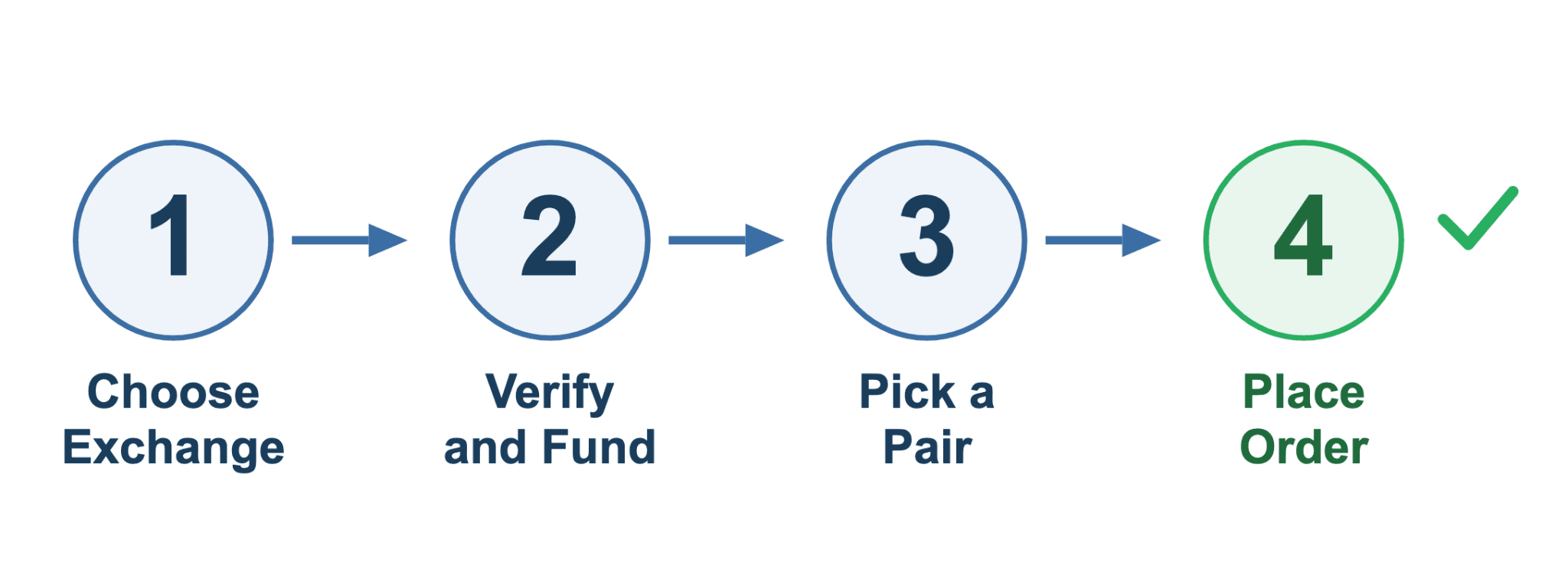
The whole process takes less than a day. Four steps stand between you and your first trade, and none require prior experience. What matters is doing them in order and not rushing past the part where you understand what you are buying.

Choose an Exchange

As of early 2026, over 260 spot crypto exchanges are listed globally, but only 210-230 remain consistently active. The market is fragmented, and not every platform deserves your trust or your funds.

Pick a regulated exchange with licensing in your jurisdiction, insurance on custodial funds, and transparent fee structures. The exchange holds your money. That decision is not a preference. It is your first real risk management choice, and treating it casually is how people lose capital before they even place a trade.

Verify Your Identity and Fund Your Account

Most regulated exchanges require identity verification before trading. You submit a government-issued ID, proof of address, and sometimes a selfie. This process, called KYC (Know Your Customer), exists to comply with anti-money-laundering laws.

Once verified, deposit funds via bank transfer or card payment. If you already hold crypto, you can transfer it directly to your exchange wallet. One warning that matters more than any strategy: always send each coin to the correct network address. Sending Bitcoin to an Ethereum address results in permanent, irreversible loss.

Pick a Trading Pair

Cryptocurrencies trade in pairs. BTC/USDT means you trade Bitcoin against the Tether stablecoin. ETH/BTC means you trade Ethereum against Bitcoin. The first asset is what you buy or sell. The second is what you pay with.
Most beginners start with pairs that include a stablecoin like USDT or USDC. These pairs show the price in dollar-equivalent terms, which makes tracking profit and loss straightforward. As you progress, you can explore altcoin pairs like SOL/ETH, where both sides of the trade are volatile, and price dynamics become more complex.

Become a Confident Trader

Master trading with our structured course designed for beginners and intermediate traders.

Step-by-step lessons
Real strategies
Risk management training

Join 10,000+ traders improving their skills

Start Course Now

Place Your First Order

Two basic order types exist. A market order fills instantly at the best available price. A limit order lets you set the exact price you want, and the trade only fills if the market reaches that level.

Market orders give you speed. Limit orders give you precision. For your first trade, a small market order on Bitcoin or Ethereum removes unnecessary complexity and gets you into the market within seconds. Explore limit orders once you understand how prices move during a session.

Key takeaway: Over 260 exchanges exist, but fewer than 230 run reliably. Choose one that is regulated and transparent. Verify your identity, fund your account, and start with a stablecoin pair on a major coin. A small market order on your first trade teaches you more than a week of reading.

Common Crypto Trading Strategies Compared

Common Crypto Trading Strategies Compared

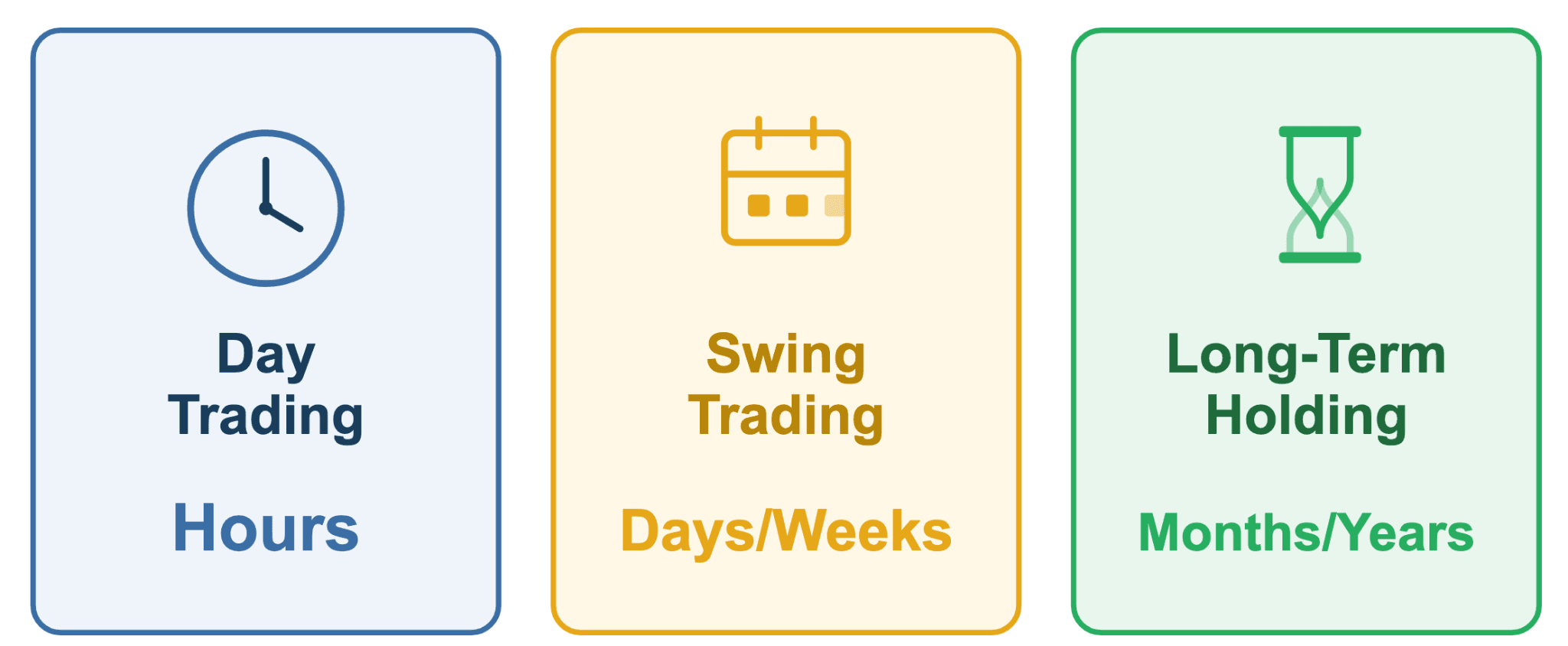
The strategy you pick determines how much time you spend watching screens, how much stress you absorb, and what kind of returns you realistically target. Three approaches dominate the space, and each one demands a different personality as well as a different skill set.

Day Trading

Day traders open and close all positions within the same session. Nothing carries overnight. This approach demands constant attention, fast execution, and a deep understanding of short-term price patterns. It suits people who can commit multiple hours daily and absorb rapid losses without letting emotions steer the next trade.

Swing Trading

Swing traders hold positions for days to weeks, aiming to capture medium-term moves driven by both technical signals and broader market shifts. Screen time drops significantly compared to day trading. This approach fits traders who want active participation but cannot monitor charts every hour.

Long-Term Holding

Holding, often called HODLing in crypto culture, means buying an asset and keeping it for months or years. No daily targets. No stop-loss adjustments. The strategy bets on long-term appreciation and filters out daily price noise. It carries less emotional pressure but exposes you to the same market risk for a much longer stretch. Past performance of any coin does not predict future results.

FeatureDay TradingSwing TradingLong-Term Holding
Holding timeHoursDays to weeksMonths to years
Daily time commitmentVery high (2 to 8 hours)Moderate (30 to 60 minutes)Low (periodic review)
Stress levelHighModerateLower
Skill requiredAdvanced chart readingIntermediate analysisBasic research
Best forFull-time active tradersPart-time active tradersPatient, hands-off holders

This is not a crypto trading tutorial that tells you one strategy is better than the rest. Each one works for different people with varying schedules, temperaments, and levels of capital. The worst choice is to pick a strategy that does not fit your life and then blame the market when it fails.

Key takeaway: Day trading demands your full day. Swing trading works in under an hour. Long-term holding removes daily decisions but not long-term risk. Your available time, emotional tolerance, and financial goals should pick the strategy for you, not excitement or imitation of someone else's results.

How to Read Cryptocurrency Charts: A Beginner's Guide

Every trading decision starts with a chart. If you cannot read one, you are not trading. You are gambling with a nice interface. You do not need a decade of technical analysis experience. You need enough fluency to know what you are looking at before real money is on the line.

What Candlestick Charts Show You

A candlestick displays four data points for a time period: open, close, high, and low. The thick body shows the range between the open and close prices. The thin wicks above and below mark the session's highest and lowest prices.

A green candle means the price closed higher than it opened. Buyers controlled that window. A red candle means sellers won. The size of the body tells you how strong the move was. A tall green body signals aggressive buying, while a tiny body with long wicks on both sides means the market could not decide.

Reading these patterns across multiple candles reveals trends, reversals, and battle zones where buyers and sellers fight for control. Candlestick charting originated in 18th-century Japan, where rice traders tracked market prices with this method. Three centuries later, it remains the default chart type across all financial markets, including crypto.

Support, Resistance, and Volume

Support is a price level at which buying pressure has historically halted a decline. Resistance is a level where selling pressure has historically capped a rise. These are not guarantees. They are zones where price has reacted before, and where many traders place their orders.

When the price approaches a known support level, buyers step in. When it hits resistance, sellers take profit. These crowd behaviors create patterns that repeat until the level breaks.

Volume tells you how many units were traded during a given period. A price move on high volume carries real conviction. The same move on thin volume deserves skepticism. If Bitcoin breaks above resistance on triple its average daily volume, that breakout is more likely to stick than one on a quiet Sunday afternoon.

Before placing any trade, check the candlestick direction on the daily chart, identify the nearest support and resistance levels, and confirm that volume supports the move. That three-step check takes under a minute and filters out many low-quality setups.

Key takeaway: Candlesticks show you who won a given session, buyers or sellers. Support and resistance mark zones where price has reacted before. Volume confirms whether a move has weight behind it. Check all three before every trade. One minute of chart reading prevents hours of regret.

Risk Management and Common Mistakes in Crypto Trading

Risk Management and Common Mistakes in Crypto Trading

The crypto market lost traders $3.4 billion through hacks in 2025, and $17 billion when scams are included. Volatility adds a separate, constant layer of risk on top of that. Managing your downside is the part of crypto trading for beginners that determines whether you survive long enough to develop a real edge.

Position Sizing and Stop-Loss Orders

Position sizing means deciding how much capital to allocate to a single trade. A widely used rule caps risk at 1% to 2% of your total account per position. On a $5,000 account, that means accepting a maximum loss of $50 to $100 on any single trade, regardless of how confident you feel.

A stop-loss order automatically closes your position if the price moves against you by a set amount. You set the exit level before you enter the trade. If the market hits it, the position closes without second-guessing or emotional override. Together, position sizing and stop-loss orders form the foundation of every durable trading approach. Some cap how much you risk. The other enforces the cap automatically.

Mistakes That Cost Beginners the Most

According to Motley Fool's 2026 survey, 59% of people who have never owned crypto say they do not understand how it works. Trading an asset you do not understand is the most expensive mistake a beginner can make. Everything else, like bad entries, panic exits, oversized positions – flows from that single gap.

The errors that drain accounts fastest:

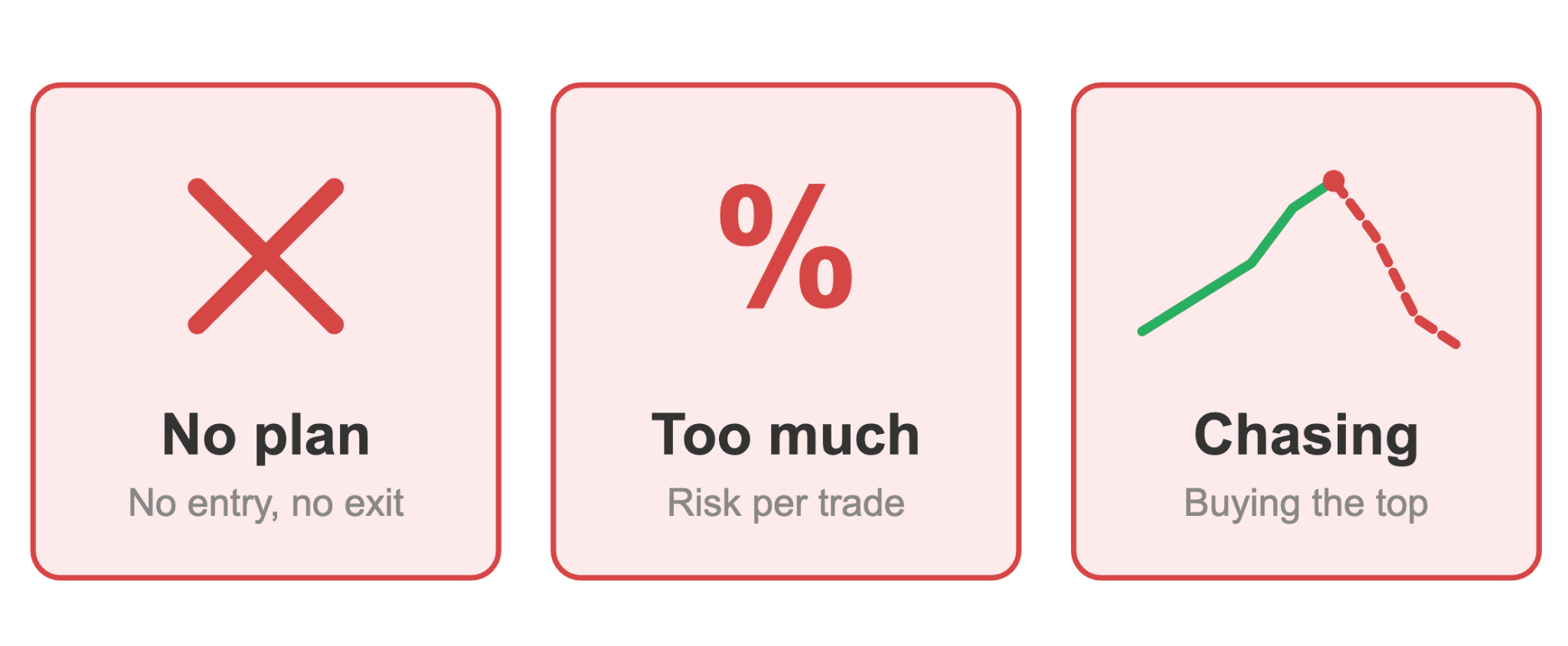
  • Trading without a written plan
  • Risking more than 2% on one trade
  • Chasing price after a big green candle
  • Skipping stop-loss orders entirely
  • Treating a lucky streak as proof of skill

A peer-reviewed study in the Journal of Behavioral and Experimental Finance found that higher crypto literacy reduces the odds of financial loss by 19%. The relationship is direct and measurable. The more you understand before your first trade, the less you stand to lose when you place it.

No indicator, no chart pattern, and no strategy fixes a knowledge gap. Spend the time to learn crypto trading mechanics before you spend money on live positions. That sequence shapes everything that follows.

Key takeaway: Cap each trade at 1-2% of your account and use stop-loss orders to enforce the limit. The most common and most expensive mistake is trading an asset you have not taken the time to understand. 

Wrapping It Up

Crypto trading means buying and selling digital assets on exchanges that run around the clock, every day of the year. Over 67 million Americans own some form of crypto in 2026, and the global market has reached $6.16 trillion. Starting takes four steps: choose a regulated exchange, verify your identity, pick a trading pair, and place a small first order. 

Frequently Asked Questions

Disclaimer: This article is for informational purposes only and does not constitute financial advice. Trading involves risk and may result in loss of capital.

Related Articles

The First Move Is Yours

Discover how Supertrade can transform your trading career. Explore challenges, access instant funding, and join a growing community of Supertraders.

Stay Ahead of the Game

Sign up to receive exclusive tips, market insights, and the latest updates from Supertrade. Don’t miss out on opportunities to grow your trading success.
Discord

Our Community

Do not skip any beat.

The Ultimate Trading Community. Join our Discord server to get the latest updates, news and more.

2026 Supertrade. All rights reserved
DiscordInstagramTelegramYouTubeX
Trading involves significant risk. Past performance is not indicative of future results. This is a simulated trading environment. Supertrade provides educational trading services.
Supertrade
Supertrade Ltd, a company incorporated under the laws of Saint Lucia with registered number 2024-00699, located at Ground Floor, Rodney Court Building, Rodney Bay, Gros Islet, Saint Lucia, LC01 101, operates and owns this website, as well as provides services under the Terms and Conditions posted on the website. Supertrade Prop Ltd, a company incorporated under the laws of England and Wales with registered number 16234284, located at 52-56 Standard Road, London, England, NW10 6EU, acting as a payment agent.