En
En Es
Es

Trading Psychology at a Glance: Key Facts
Every number below comes from a named regulator, academic institution, or independent research body.
- 74–89% retail CFD accounts lose (ESMA)
- Avg. loss: €1,600–€29,000 (ESMA)
- 8.48% underperformed S&P 500, 2024 (DALBAR)
- Emotions drove every 2024 quarter gap (DALBAR)
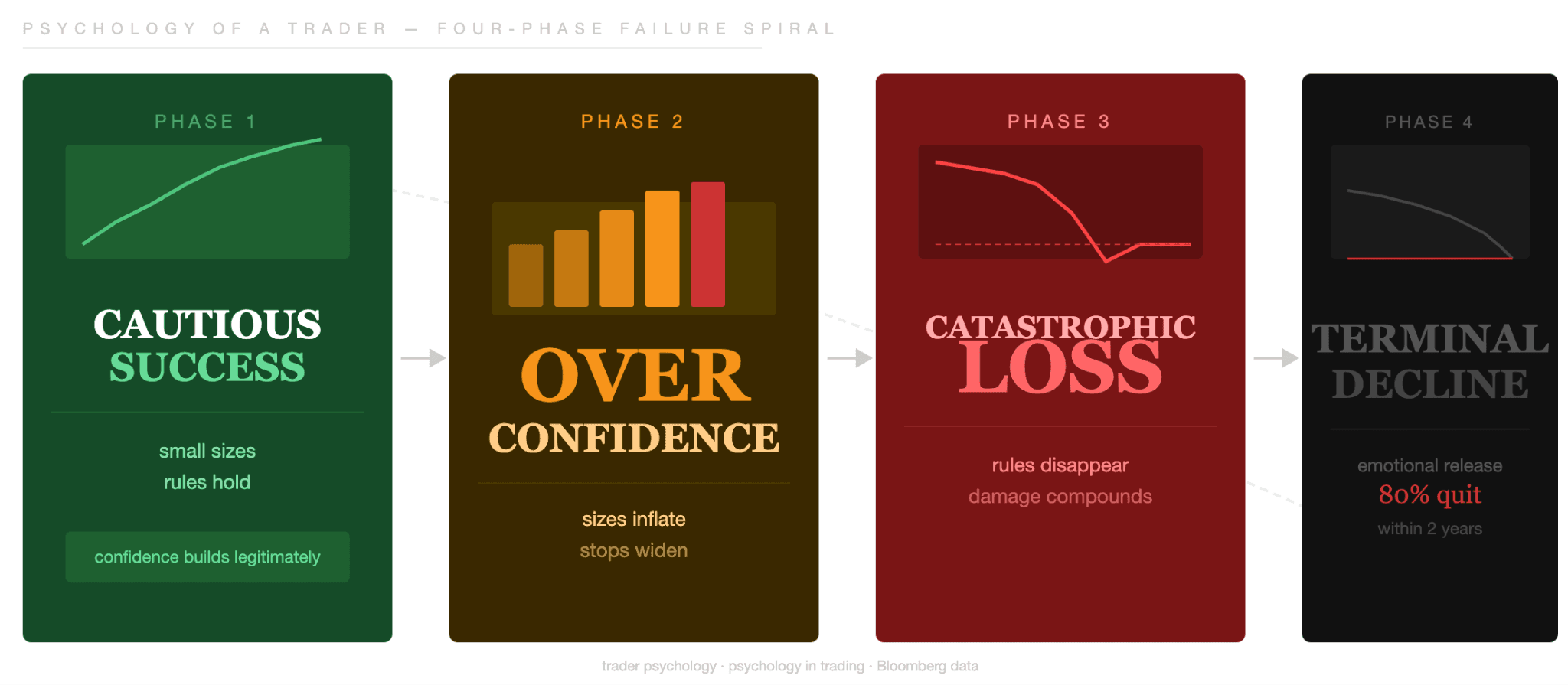
- 80% day traders quit within 2 years (Bloomberg)
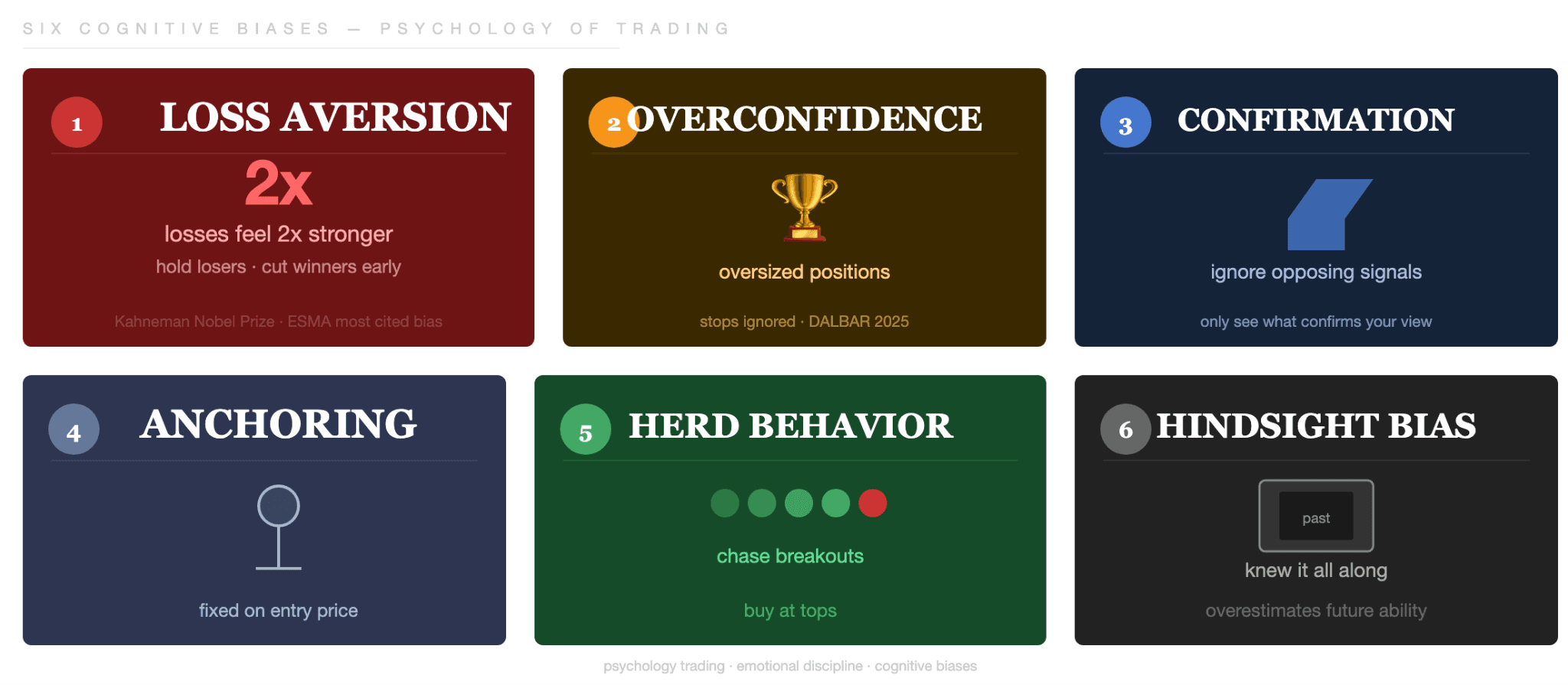
- Loss pain: 2x stronger than gain (Kahneman Nobel)
- 90% global replication (Columbia 2022)
The pattern across every dataset points to the same conclusion. The market did not destroy these accounts. Psychology did.
What Is Trading Psychology
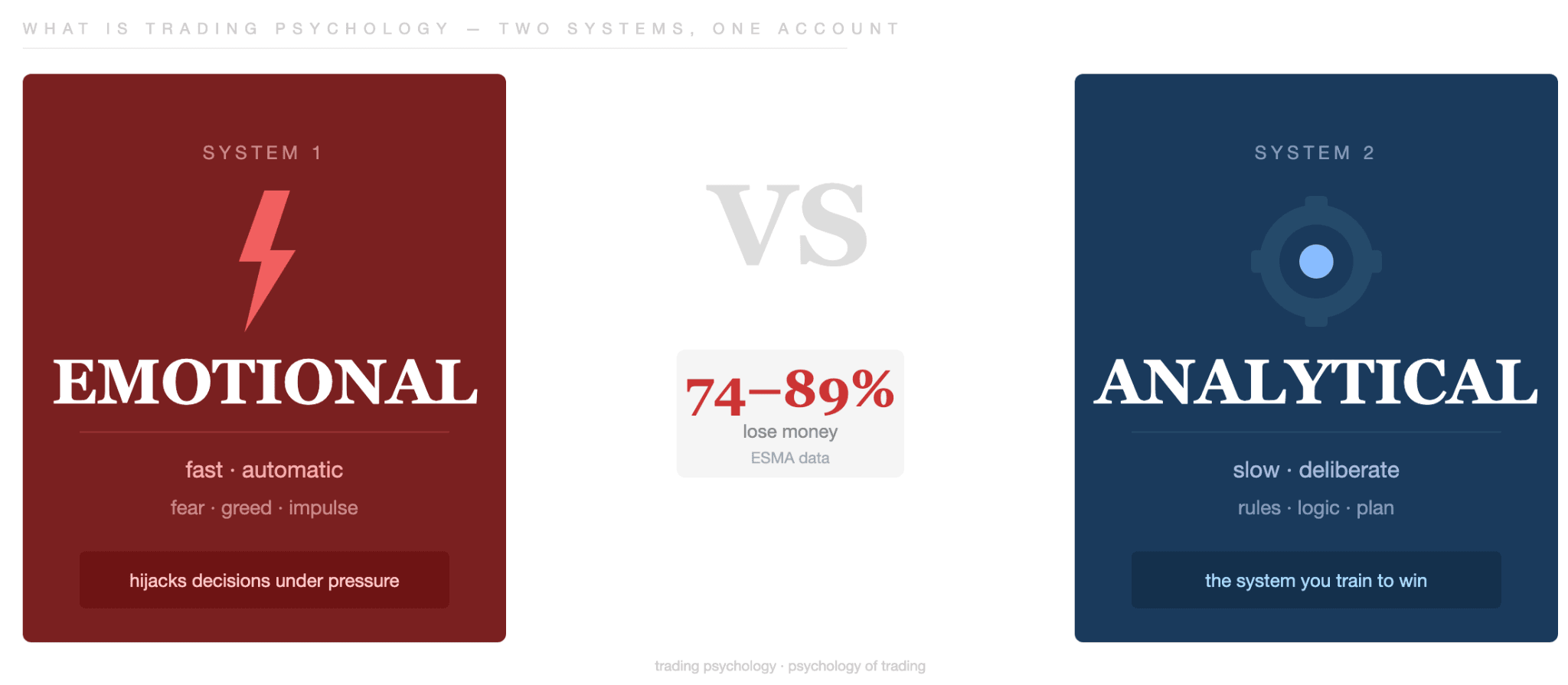
Trading psychology covers the mental and emotional factors that determine whether you execute your strategy when the market tests it. The strategy is not the problem. Execution under pressure is. That gap between knowing and doing, when money moves against you, is where most accounts bleed out.
The Difference Between Trading Psychology and Trading Strategy
Your strategy defines when to enter and exit. Your psychology determines whether you follow those rules when a trade goes red. These are two separate skills. Almost every trader develops one and ignores the other entirely.
Trading psychologist Brett Steenbarger has spent two decades working with professional traders. His observation: "In volatile markets, it's never the strategy that fails first. It's the trader's ability to follow it." Traders who blow accounts do not fail because their entry rules are wrong. Executing rules under pressure requires different training than building them. Most traders only do one.
Why the Brain Treats Losses as Physical Threats
Your brain did not evolve for financial markets. It evolved to survive predators. When a trade turns red, the amygdala triggers the same threat response it produces in response to physical danger. This is why you hold losing positions past your stop, panic-exit winning trades early, and feel urgency when none exists. The response is not irrational. It is evolutionary programming applied to the wrong environment.
Kahneman and Tversky established this in 1979 through Prospect Theory. Kahneman received the Nobel Prize in Economic Sciences in 2002 for this work. Their finding: loss pain registers approximately twice as intensely as equivalent gain. Columbia University's Mailman School of Public Health confirmed 90 percent global replication of this finding across 19 countries in 2022.
The Two Systems Every Trader Fights Daily
Kahneman described two operating systems running in every human brain. System 1 is fast, automatic, and emotional. System 2 is slow, deliberate, and analytical. Traders write plans using System 2. When a trade moves sharply against them, System 1 hijacks the decision before System 2 can respond.
The profitable trader is not smarter than the rest. They trained System 2 to intervene at the moments when System 1 wants to act on impulse. That training does not happen passively. It requires deliberate structure before and during every session.
Key takeaway: Trading psychology is the gap between your written plan and your live execution. Loss aversion and System 1 dominance explain why that gap exists. Both respond to structured training.
The Four Emotions That Destroy Trading Accounts
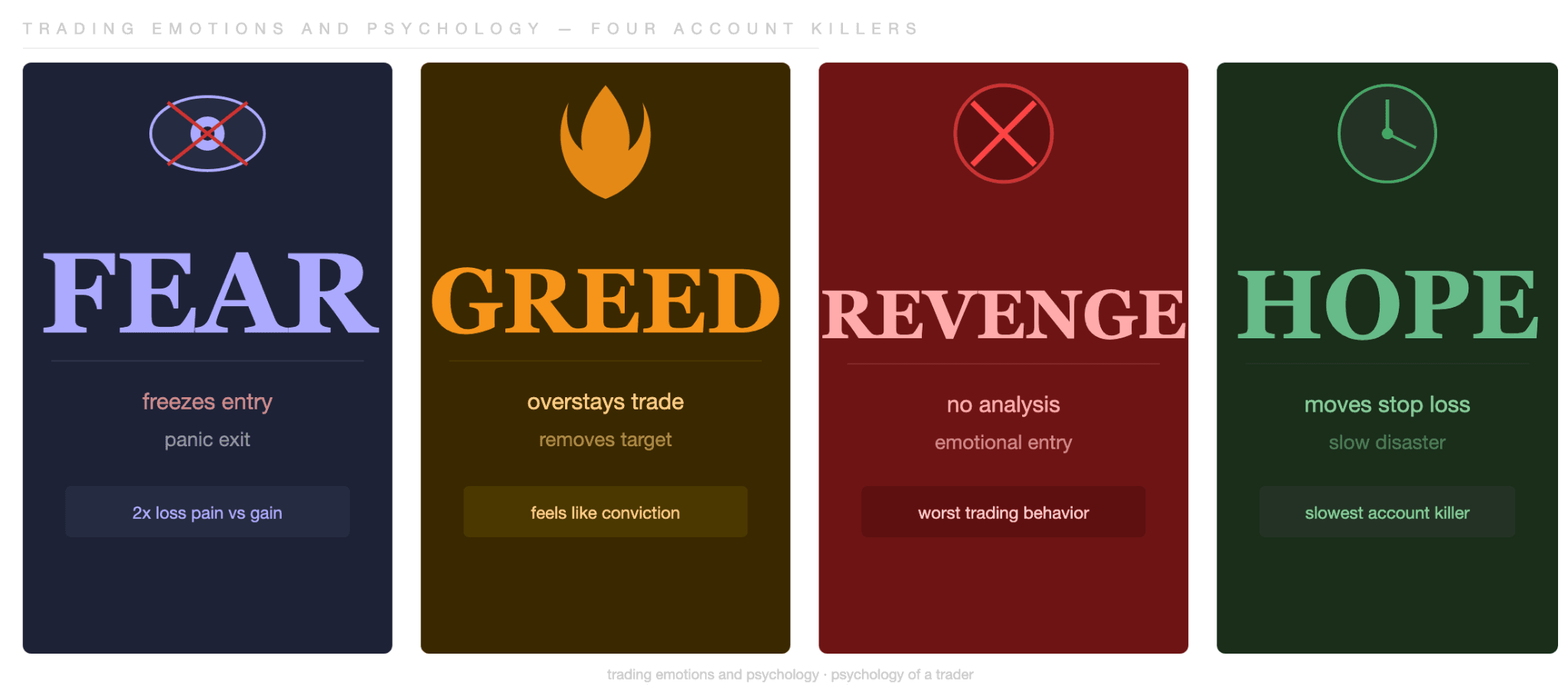
Four emotions generate the majority of account losses in retail trading. Each operates through a different mechanism. Most traders experience all four within a single bad week and rarely identify which one drove each decision. Naming the emotion before acting on it is one of the most powerful interventions available.
Fear: How It Freezes Entries and Triggers Panic Exits
Fear shows up in two distinct patterns. First, it stops valid entries: a setup forms and fear of being wrong prevents the trade from opening. Second, it triggers premature exits from winning trades. Positions close for a fraction of the planned target.
DALBAR's 2025 research found equity investors withdrew money in every quarter of 2024. Largest outflows hit just before a major rally. Investors who sold on fear missed the exact rebounds that would have covered their losses. Fear without structural containment costs more than most strategies can recover.
Greed: The Emotion That Turns Winning Trades Into Losing Ones
Greed keeps traders in positions past their planned profit target. It removes take-profit orders because the momentum looks strong. It reframes discipline as a missed opportunity. Then the reversal arrives, and the position unwinds.
DALBAR data showed that the average equity investor earned 16.54 percent in 2024, compared with the S&P 500's 25.05 percent return. Part of that gap comes from overconfidence during strong rallies — the behavioral signature of greed at scale. In the moment, greed feels like conviction. Catching it requires comparing current behavior against the written plan.
Revenge: The Most Expensive Trade You Will Ever Make
A losing trade triggers a specific urge in most traders: recover what was just lost, immediately. A new position opens with no analysis, no setup criteria, no checklist. The only justification is emotional recovery. This is revenge trading, and it produces the worst results of any trading behavior.
ESMA data confirms 74 to 89 percent of retail CFD accounts lose money. Average client losses range from €1,600 to €29,000. Revenge trades accelerate the damage significantly in any account where the pattern takes hold. One rule stops it: a mandatory minimum wait of one hour between any losing trade and the next position.
Hope: The Emotion That Turns Small Losses Into Account-Ending Ones
Hope is the slowest killer of the four. Fear and greed produce fast decisions. Hope produces a slow, passive disaster. It keeps traders in losing positions for days, waiting for a recovery bounce that may never come. The stop-loss moves farther away each time the price approaches it.
The mechanism matches DALBAR's consistent finding: investors sell during downturns and miss rebounds. They wait for a recovery that never arrives. Accepting the loss and redeploying capital would capture the actual rebound. A stop-loss set before entry, left untouched permanently, removes hope as a trading variable.
Key takeaway: Fear, greed, revenge, and hope each destroy accounts through distinct mechanisms and at different rates. Name the emotion before touching the keyboard.