En
En Fr
Fr Es
Es Prt
Prt
OTC Trading: Quick Summary
| Question | Answer |
| What is the OTC market? | A decentralized network where securities trade outside formal exchanges. |
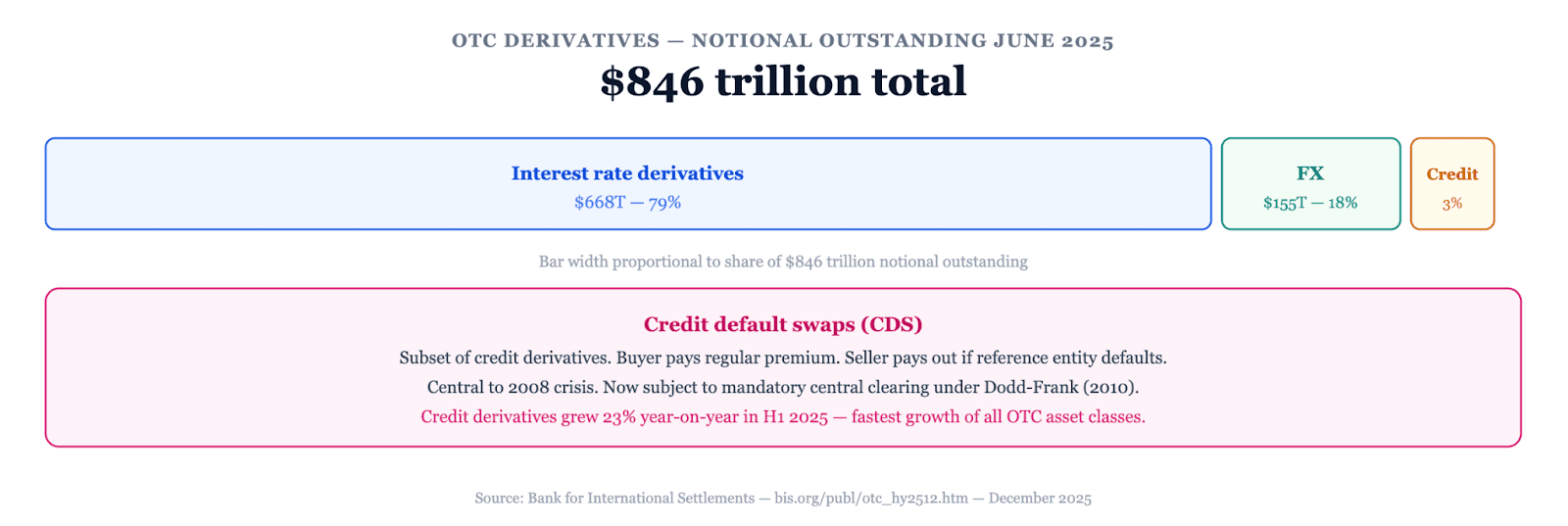
| What instruments trade OTC? | Stocks, bonds, currencies, derivatives, and credit default swaps |
| U.S. OTC regulators | SEC, FINRA, and CFTC |
| Main OTC equity tiers | OTCQX, OTCQB, OTCID Basic, Pink Limited |
| Is OTC riskier than exchange trading? | Yes. Lower liquidity, wider spreads, and less transparency |
What Is the Over the Counter Market
The over-the-counter market is not one place. It is a network of dealers, banks, and brokers who trade securities directly among themselves. No central exchange sits in the middle. No public order book shows every price.
That structure makes OTC the largest financial marketplace on earth by notional value. It covers a vast range of instruments, from micro-cap stocks to custom derivative contracts worth hundreds of millions.
How OTC Trading Differs from Exchange Trading
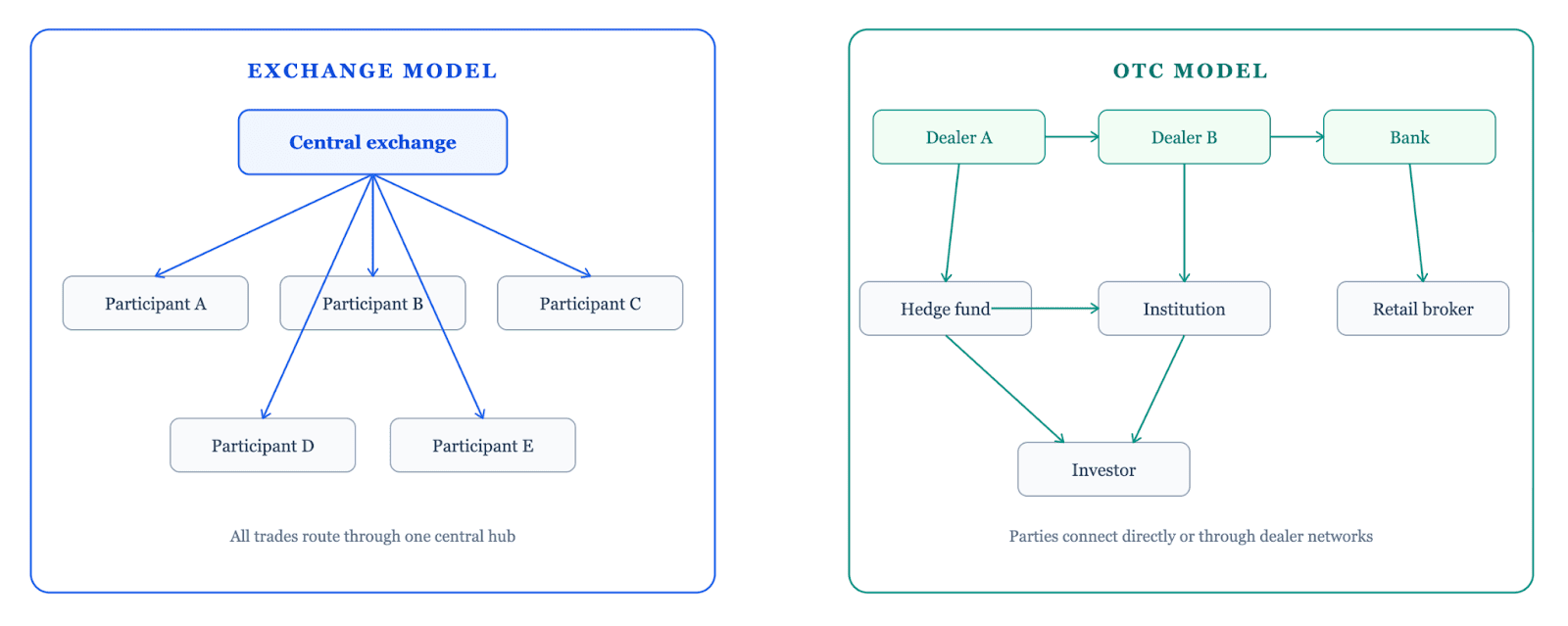
Exchange trading runs through a public order book. Every bid and ask is visible to all participants. An independent clearinghouse guarantees settlement between buyer and seller.
OTC trading removes that infrastructure entirely. Two parties agree on price, terms, and settlement directly or through a dealer. That flexibility allows customized contracts and private execution that exchanges cannot offer.
| Feature | Exchange Trading | OTC Trading |
| Location | Centralized exchange | Decentralized dealer network |
| Price transparency | Full public order book | Dealer-quoted, limited visibility |
| Contract terms | Standardized | Fully negotiable |
| Regulation | Strict listing requirements | Varies by instrument and tier |
| Liquidity | High, continuous | Variable, often lower |
| Counterparty risk | Clearinghouse absorbs it | Buyer and seller bear it directly |
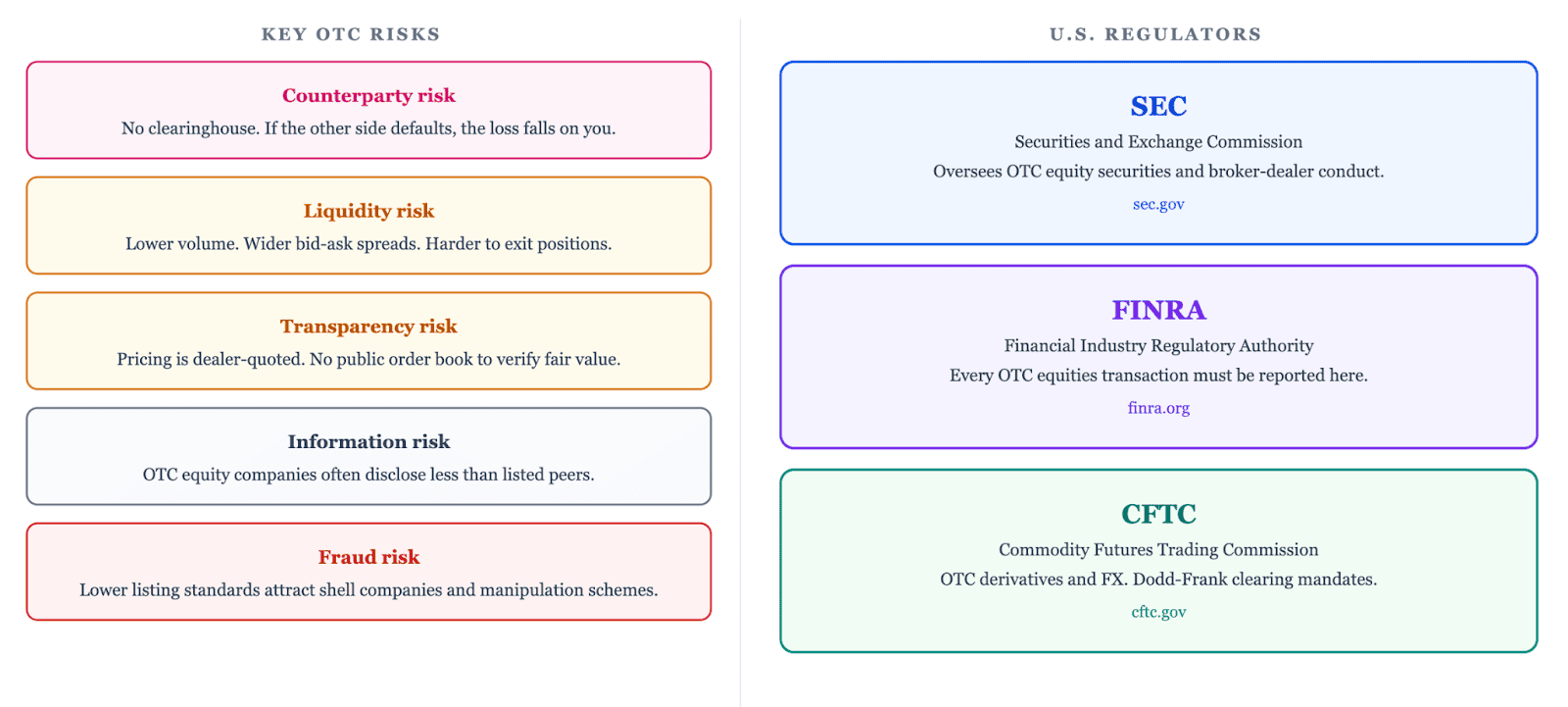
The absence of a clearinghouse is the key structural difference. In OTC trading, each party carries counterparty risk directly. If the other side defaults, the loss falls on you.
Key takeaway: OTC trading is not a lesser version of exchange trading. It is a different model built for flexibility and customization. That flexibility comes with real counterparty and transparency risk that exchange infrastructure removes.
Who Trades in OTC Markets
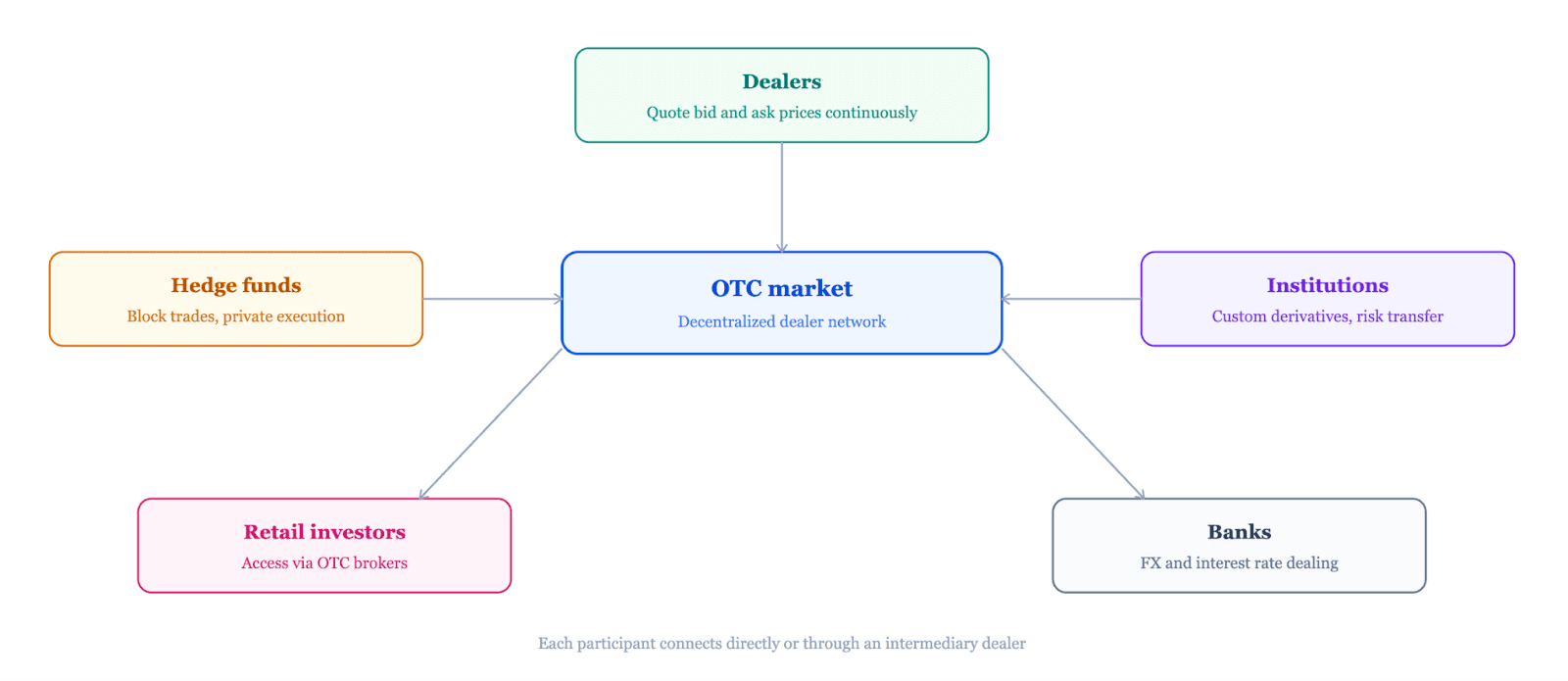
The OTC market serves a wide range of participants. Each group uses it for different reasons. Understanding who is on the other side of an OTC trade helps you assess risk and pricing.
Large institutions dominate OTC volume. Retail participants access a smaller but still significant segment through OTC brokers and online platforms.
Dealers and Market Makers
Dealers are the backbone of OTC markets. They quote bid and ask prices continuously for specific securities. They profit from the spread between those two prices.
Major global banks act as primary dealers in OTC currency and derivatives markets. In equity OTC markets, registered broker-dealers fill this role. Their presence creates liquidity where no exchange mechanism exists.
Institutional Investors and Hedge Funds
Hedge funds use OTC markets to execute large block trades without moving the market. A fund buying 500,000 shares on an exchange would push the price against itself. OTC execution keeps the transaction private.
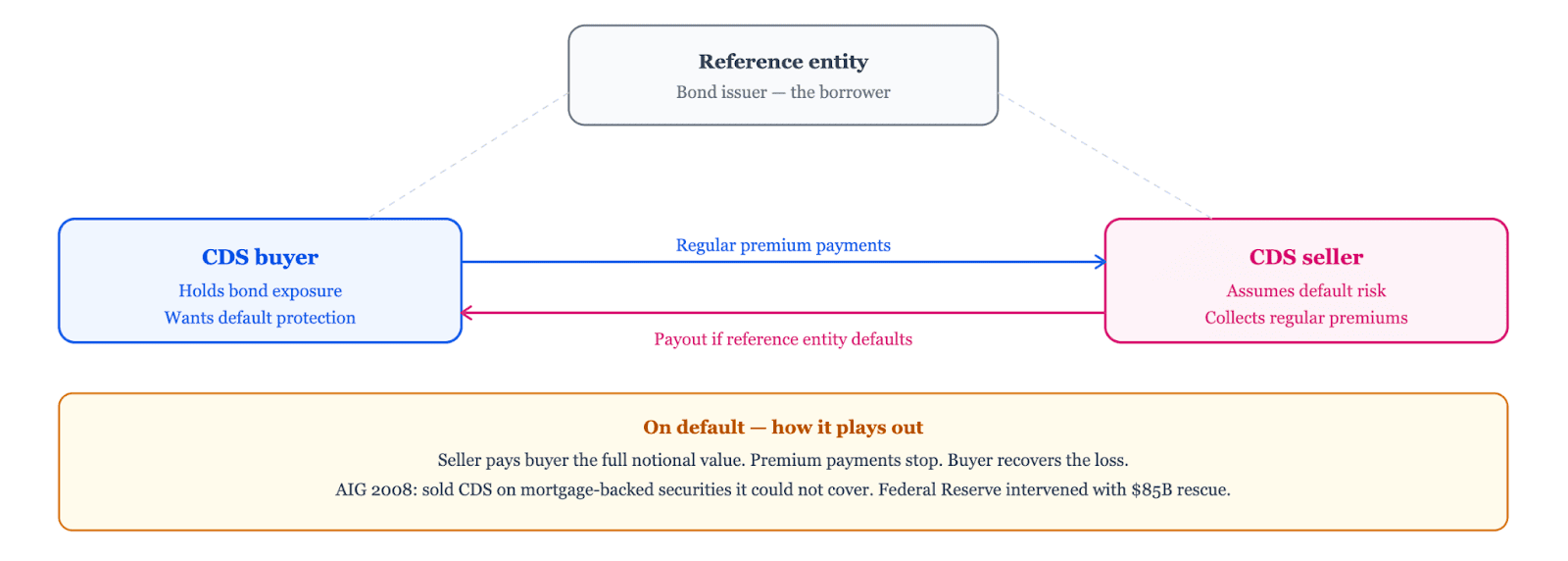
Institutions also use OTC derivatives to hedge exposure. A fund holding a large bond portfolio buys credit default swaps OTC to protect against issuer default. That trade cannot happen on a standard exchange.
Retail Investors and OTC Brokers
Retail investors access the stock market OTC securities through brokers that provide OTC market connectivity. Platforms like Charles Schwab and Fidelity offer access to OTC equity tiers.
Retail participation is concentrated in OTC equities, particularly in OTCQX and OTCQB-listed stocks. The derivatives and currency segments of OTC markets remain largely institutional.
Key takeaway: OTC markets are not built for retail investors first. Dealers and institutions drive the majority of volume. Retail access exists, but requires careful broker selection and a clear understanding of the risks involved.
How the OTC Equity Market Is Structured
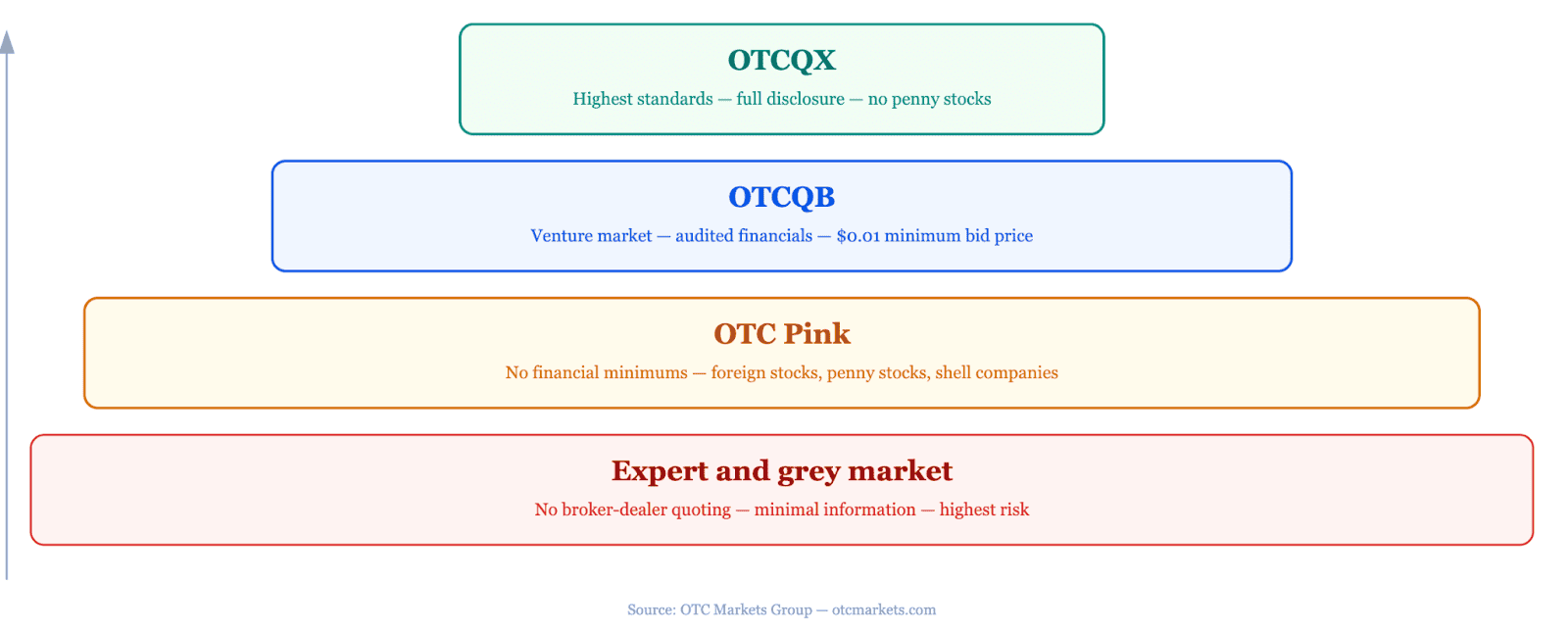
The OTC market for equities operates through a tiered system managed by OTC Markets Group. Each tier sets different disclosure and reporting standards. The tier a company sits in tells you how much public information is available about it.
OTC Markets Group covers more than 12,000 U.S. and international securities across all tiers. Knowing which tier a stock occupies is the first step in assessing its risk.