En
En Es
Es

AI Day Trading at a Glance: Key Facts
| Question | Answer |
|---|---|
| What is AI day trading? | Using AI to support or automate any part of an intraday workflow. |
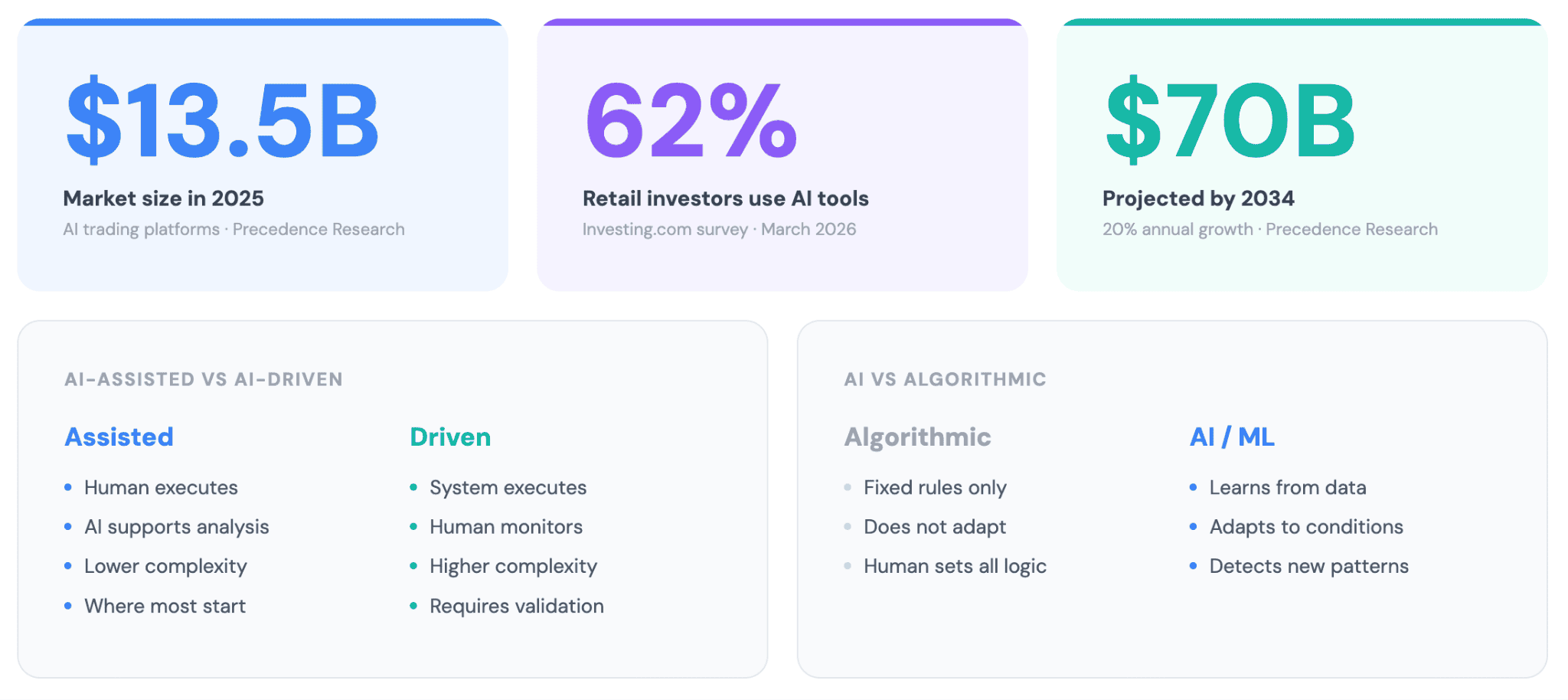
| AI trading platform market size (2025) | $13.52 billion (Precedence Research). |
| Projected market size by 2034 | $69.95 billion at 20% CAGR (Precedence Research). |
| Retail investors using AI tools | 62% (Investing.com survey, March 2026, n=938). |
| Four main use modes | Research, signal scanning, automated execution, and sentiment analysis. |
| Biggest risk | Overfitting to historical data that does not reflect live conditions. |
What Is AI Day Trading?
AI day trading means using artificial intelligence to assist with any part of an intraday trading process. Most retail traders apply it to one or two workflow stages, such as scanning for setups or processing news, while keeping execution under their own control.
A March 2026 survey of 938 US investors found that 62% already use AI tools, with the majority applying them to research rather than automated execution.
"There is a real difference between a tool that helps you think and a tool that thinks for you. Most traders who get burned by AI day trading skipped that distinction entirely."
How AI Differs from Standard Algorithmic Trading
Algorithmic trading follows fixed rules that do not change unless a human changes them. Artificial intelligence trading goes further. Machine learning models update based on new data, identify patterns that the programmer did not specify, and adapt their behavior as market conditions change. The two are not mutually exclusive.
Key takeaway: AI day trading covers tools from simple research assistants to fully automated systems. Before evaluating any product, establish what kind of intelligence it uses, what it was trained on, and what it was built to do.
The Four Ways Traders Use AI in Their Workflow
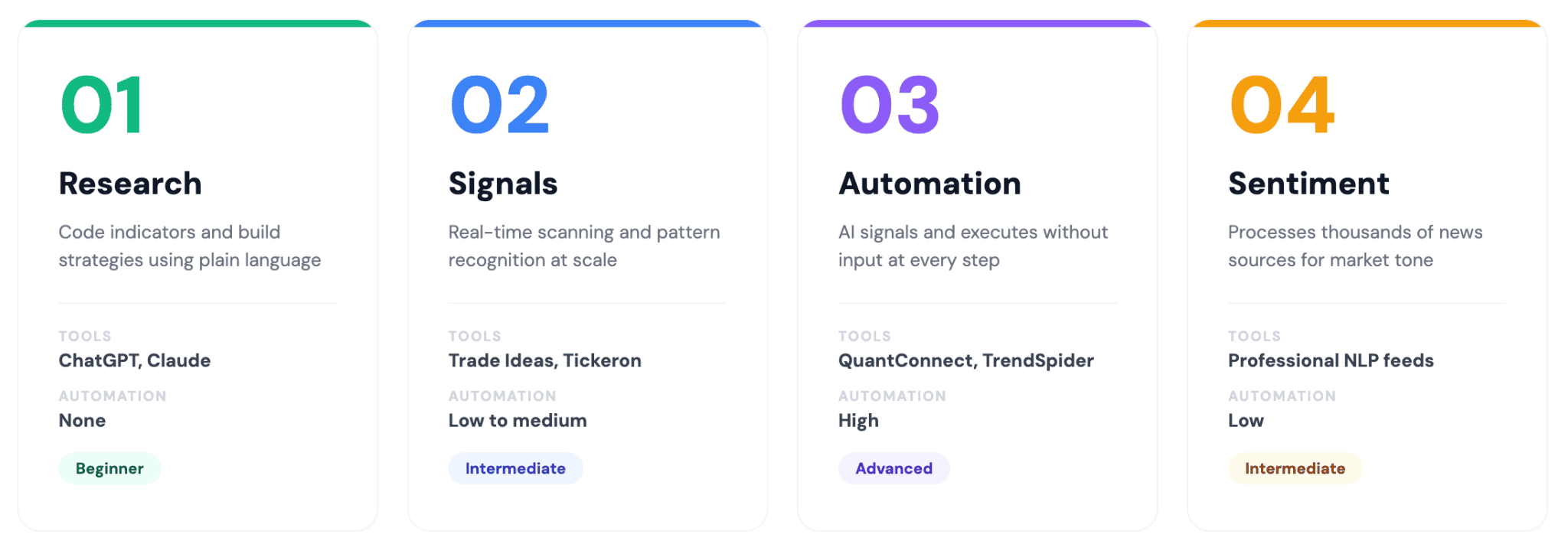
Not every trader needs the same AI capability. The mistake most people make is choosing a tool before deciding what problem they are solving. The four modes below cover how day-trading AI is used in practice, and your workflow stage should determine your tool choice, not the other way around.
"Start with the part of your process that costs you the most time or the most money, then find the AI that addresses it."
AI as a Research and Coding Assistant
Large language models like ChatGPT make strategy research and indicator coding accessible to traders with no programming background. You describe a trading idea in plain language and receive a working Pine Script for TradingView or MQL for MetaTrader in seconds. The limitation is that the model will generate code confidently even when the logic contains errors.
AI for Pattern Recognition and Signal Generation
Tools in this category scan markets in real time and flag setups matching learned criteria. Manually scanning 200 stocks for a specific candlestick formation and volume threshold is not feasible during market hours. These algorithms handle it in seconds, with a confidence score attached to each result, giving traders a filtered list rather than an ocean of raw data.
Automated Day Trading with Bots and Execution Tools
Automated day trading moves AI from the analysis layer into the execution layer. The system generates a signal and places the trade without human input. This is the most technically demanding and highest-risk mode. A wrong model can be wrong at speed and at scale before you have time to intervene, which is why paper trading validation is non-negotiable before any live deployment.
Sentiment Analysis and News Processing
Artificial intelligence trading systems that process news and social media scan thousands of sources simultaneously and score them for market tone. For most retail traders, consumer-facing large language models do not deliver real-time feeds.
| Mode | Skill Level | Best Use Case | Example Tools | Automation Level |
|---|---|---|---|---|
| Research and Coding | Beginner | Strategy building, indicator coding | ChatGPT, Claude | None |
| Pattern Recognition | Intermediate | Real-time scanning, setup identification | Trade Ideas Holly, Tickeron | Low to Medium |
| Automated Execution | Advanced | Hands-free strategy deployment | QuantConnect, TrendSpider bots | High |
| Sentiment Analysis | Intermediate | Pre-market context, news processing | Professional NLP feeds | Low |
The table above is a decision tool, not a ranking. A beginner who jumps straight to automated execution without passing through the earlier stages is taking on a level of technical and financial risk that the tool itself will not flag.
How to Start Using AI for Day Trading: A Step-by-Step Guide
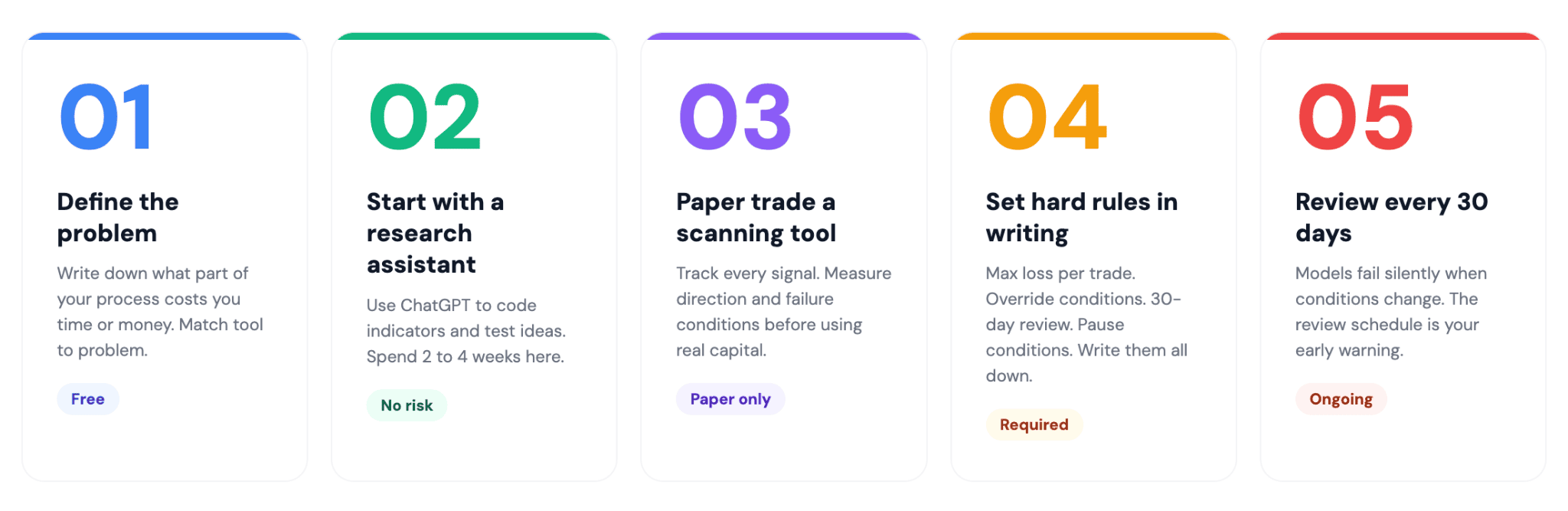
Getting started with AI for day trading does not require a technical background or a large budget. The steps below follow a logical progression from understanding to live application. Skipping the testing phases is where most traders go wrong, and the cost of that shortcut tends to show up quickly in live markets.