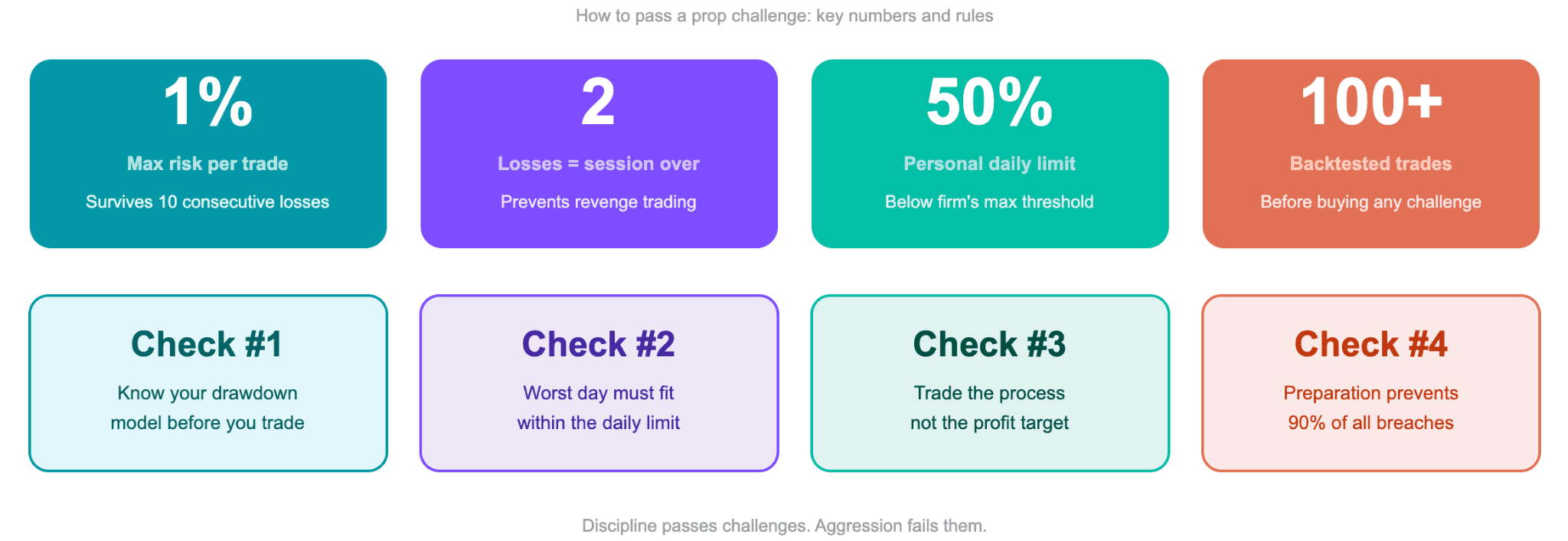


Prop Trading

Jul 10, 2026 - 16 min

●●Intermediate

Why Traders Fail: Prop Challenges and the Mistakes That End 90% of Accounts

Why Traders Fail: Prop Challenges and the Mistakes That End 90% of Accounts

Nine out of ten traders who attempt prop firm evaluations never reach a funded account. Understanding why traders fail prop challenges reveals that strategy quality is rarely the cause. Most evaluations result from rule breaches, emotional decisions, and poor position sizing. This guide covers the five core reasons, the math behind every failure, and how to prepare before spending a dollar.

Evgenij Pakhomov
Reviewed by:
Share

Prop Challenge Failure at a Glance

  • Only 5% to 10% of traders pass prop firm evaluations on the first attempt. 
  • Just 7% of all challenge participants ever reach a payout. 
  • Kahneman's prospect theory proves that traders take irrational risks to avoid locking in losses.
  • Loss aversion makes traders hold losers longer and cut winners earlier than planned. 
  • FINRA warns that day trading can lead to losses for traders without adequate preparation and risk controls.

Five Reasons Traders Fail Prop Firm Challenges
Five Reasons Traders Fail Prop Firm Challenges

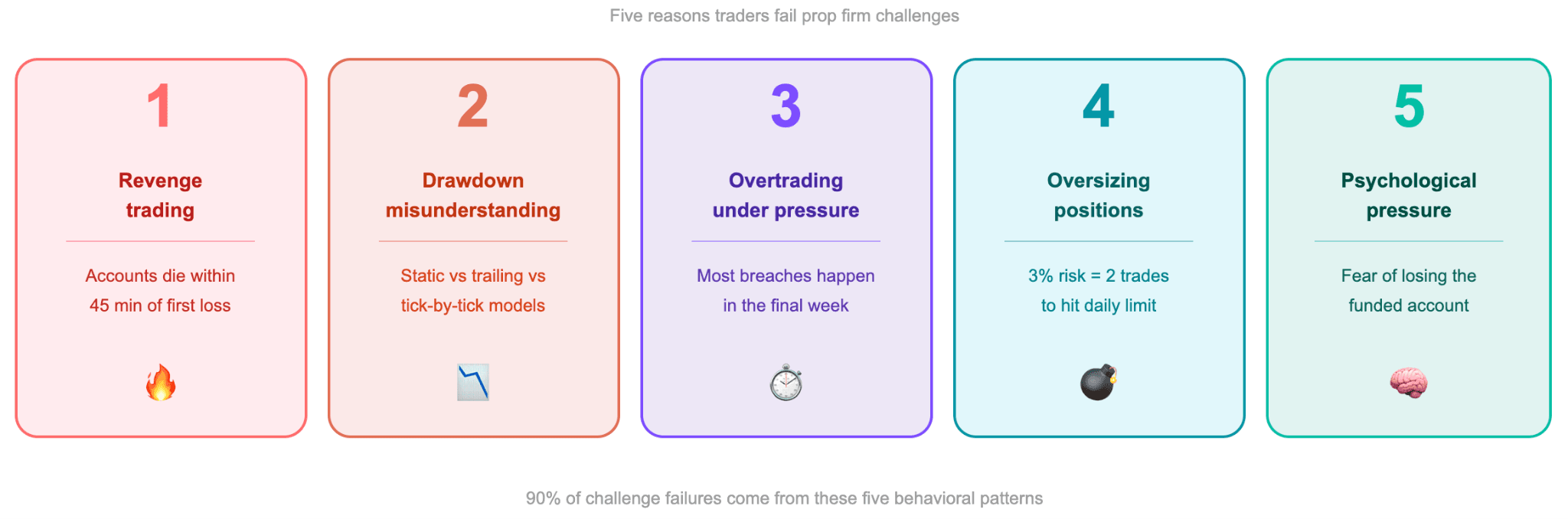
Traders fail prop firm challenges through predictable, measurable patterns rather than random bad luck. The same five mistakes appear across every firm, every market, and every account size. Each one has a concrete fix that removes the decision from the emotional moment. Recognizing these patterns before your evaluation starts gives you a structural advantage over 90% of participants.

Revenge Trading After Hitting Loss Limits

This is the fastest account killer in funded evaluations. A trader loses on the first trade of the session. Instead of stopping, they enter a second trade to immediately recover the loss. The second trade also fails. They enter a third, larger in size. Within 45 minutes, one bad trade has become three.

Revenge trading is not a character flaw. It is a normal human response to loss that becomes fatal in a rule-enforced environment. On a personal account, the damage is gradual. During a challenge, the daily loss limit is triggered, and the evaluation ends.

The fix is a mechanical rule, not willpower. Two consecutive losses in a session mean no more trading that day. Write this into your pre-session checklist. The cost of sitting out is zero. The cost of a third revenge trade is usually the account.

Misunderstanding Drawdown Rules

Most traders who breach drawdown limits do not intend to. They did not know their exact floor before entering the trade that ended their evaluation.

Drawdown rules come in two main forms. Static drawdown is calculated from the initial balance and never moves. Trailing drawdown moves upward as the account reaches new equity highs. The difference changes everything about how you manage risk.

With trailing drawdown, a winning trade reduces your future risk room. Your floor moves up. If you make $2,000 on Monday, your floor has shifted. On Tuesday, you have less absolute drawdown room than on Monday, even though you are profitable.

Read the exact drawdown model of your target firm before buying any evaluation. Knowing whether your firm uses static, trailing, or tick-by-tick trailing determines your entire position sizing approach.

Overtrading Under Time Pressure

Many challenges include 30 to 60 day time limits. These limits prevent traders from waiting indefinitely for perfect setups. In practice, they create deadline pressure that damages decision quality.

As the deadline approaches and the profit target is not reached, three things happen. Traders lower their entry criteria and take marginal setups. Trade frequency increases from 3 per week to 3 per day. Risk per trade increases to close the gap faster.

All three responses accelerate drawdown precisely when drawdown room is most constrained. Challenges fail most often in the final week, not the first. The fix is treating the profit target as the result of the correct process. If your strategy needs 6 weeks to reach the target, it will not reach it in 3 weeks through aggressive trading. It will just breach faster.

Oversizing Positions to Pass Faster

Traders who want to pass quickly trade larger than their risk framework supports. This is backward logic. A larger position does not increase the probability of reaching the profit target. It increases the probability of breaching the drawdown limit first.

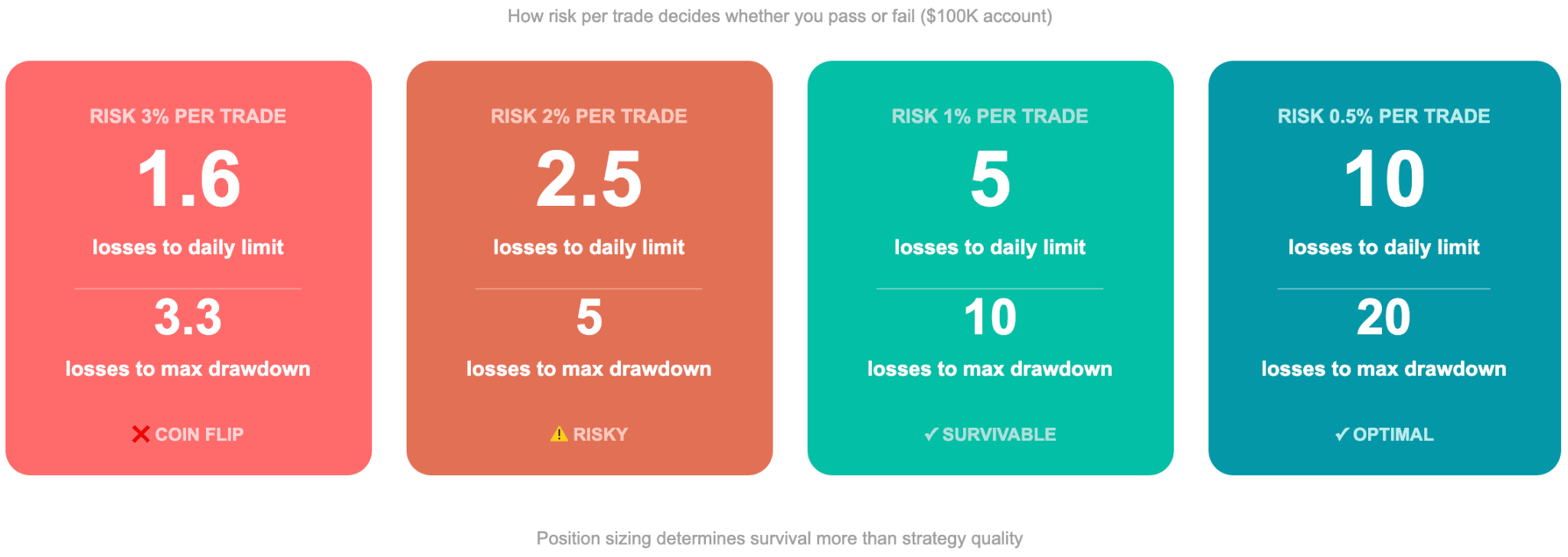
The math is direct. On a $100,000 account with a 5% daily loss limit, risking 3% per trade means two losing trades end your day. Three bad sessions consume most of your total drawdown room.

At 1% risk per trade, you need five losing trades in one session to hit the daily limit. Across the full evaluation, you survive ten consecutive losses before max drawdown triggers. The difference between 1% and 3% risk changes the evaluation from a coin flip to a survivable process.

Position sizing is the single most controllable variable in challenge survival—traders who understand this pass. Traders who ignore it lose evaluations they should have passed.

Ignoring the Psychological Pressure of Funded Capital

Personal account trading and challenge trading create completely different psychological environments. Many traders underestimate that gap until they experience it live.

On a personal account, a losing streak stings but does not end your ability to trade. On a challenge, each loss feels like ticking toward a failure label. Stress hormones narrow focus and disrupt decision-making under this kind of pressure.

Common first-challenge experiences include reducing position sizes out of fear, closing winners early because the profit feels fragile, freezing on valid setups due to outcome anxiety, and carrying emotional states from one session into the next.

None of these signals a bad trader. They signal a trader who has not adapted to rule-constrained pressure. That adaptation requires repetition and structured preparation, not talent.

Key takeaway: Why traders fail prop challenges comes down to five predictable mistakes. Revenge trading, drawdown misunderstanding, overtrading under time pressure, oversizing, and psychological pressure cause the vast majority of breaches. Each mistake has a mechanical fix. Write the fix as a rule before the evaluation starts, not as a reaction after the damage occurs.

How Risk Per Trade Decides Whether You Pass or Fail
How Risk Per Trade Decides Whether You Pass or Fail
Become a Confident Trader

Master trading with our structured course designed for beginners and intermediate traders.

Step-by-step lessons
Real strategies
Risk management training

Join 10,000+ traders improving their skills

Start Course Now

The relationship between risk per trade and challenge survival is mathematical, not theoretical. Most traders set risk based on how fast they want to pass. Professionals set risk based on how many losses they can absorb before the account dies. These two approaches produce opposite outcomes.

Position Sizing and Survival Math

The table below shows how risk per trade affects survival in a $100,000 challenge account with a 5% daily loss limit and a 10% maximum drawdown.

Risk Per TradeLosses to Daily LimitLosses to Max Drawdown
3% ($3,000)1.6 trades3.3 trades
2% ($2,000)2.5 trades5 trades
1% ($1,000)5 trades10 trades
0.5% ($500)10 trades20 trades

At 3% risk, two losing trades in one session end your day. Three bad sessions across the entire evaluation consume your entire drawdown. Normal variance alone can produce three consecutive losing sessions with a 60% win rate strategy.

At 1% risk, you survive five losses in a single session and ten across the full evaluation. That margin absorbs normal losing streaks without threatening the account. The tradeoff is slower progress toward the profit target. But slower progress beats no progress because the account died.

The Gap Between Profit Target and Drawdown Limit

Most challenges require 8% to 10% profit with a 10% maximum drawdown. Traders see the 10% drawdown and feel they have room to move. In reality, the margin is razor thin.

You need to gain 8% before losing 10%. That gap is only 2% of the absolute difference. At 2% risk per trade, four consecutive losses consume 80% of your max drawdown before you have earned anything toward the target.

This is why position sizing at 1% or lower is not conservative. It is the only approach that gives your strategy enough room to express its edge. Anything above 1% turns the evaluation into a race between your profit and your drawdown, and drawdown always moves faster during losing streaks.

Key takeaway: Risk per trade determines challenge survival more than strategy quality does. At 3% risk, two bad trades end a session, and three bad sessions end an evaluation. At 1% risk, the account survives ten consecutive losses. The gap between the profit target and the drawdown limit is smaller than most traders realize. Size is small enough to survive normal variance.

Why Profitable Traders Still Fail Challenges

A significant number of challenge failures come from traders with proven track records on personal accounts. This is one of the most counterintuitive aspects of prop challenge psychology. Profitability over 200 trades does not guarantee profitability within the first 30 trades of an evaluation. The reasons go deeper than discipline alone.

Variance vs Edge in Short Evaluation Windows

A strategy with a 60% win rate and a 1.5-to-1 reward ratio is profitable over 200 trades. Over 30 trades, that same strategy can produce five consecutive losses through normal statistical variance alone.

On a personal account, five consecutive losses are unremarkable. You absorb the drawdown and continue trading. On a challenge with 10% max drawdown and 1% risk per trade, five losses consume half your drawdown room before the edge has time to appear.

The shorter the evaluation window, the more variance dominates over edge. A trader who needs 50 or more trades to demonstrate their edge is structurally disadvantaged in a 30-day challenge with a 10% profit target.

This does not mean the strategy is bad. It means the evaluation format does not match the strategy's statistical profile. Understanding this distinction prevents traders from abandoning profitable systems after challenge failures caused by variance rather than by flawed execution.

Five Strategy Types That Fail Challenges Despite Being Profitable

Some strategies produce strong annual returns but cannot survive challenging constraints. The table below maps five common problems to specific strategy types.

Strategy TypeWhy It Fails Challenges
High drawdown, high expectancyAverage drawdown exceeds the daily limit before profit appears
Martingale or scale-in recoveryAveraging into losses accelerates the breach beyond any limit
News scalping without stopsSpike risk during releases hits daily limit in one candle
Low frequency, high convictionRequires waiting, creates pressure to force trades near the deadline
Correlated multi-positionCorrelated losses hit the daily limit simultaneously

The question before any challenge is not "has this strategy made money over 12 months?" The question is "what is the worst single-day loss this strategy has ever produced, and does that fit within the daily limit?" If the answer is no, the strategy needs to be adjusted before the evaluation begins.

Key takeaway: Profitable traders fail challenges because short evaluation windows amplify variance relative to their edge. A 60% win-rate strategy can produce five consecutive losses under normal statistics. Five strategy types are structurally incompatible with challenge rules, even when they produce strong long-term returns. Match your strategy's drawdown profile to the challenge constraints before starting.

How to Know Your Challenge Is About to Fail

How to Know Your Challenge Is About to Fail

Most evaluation breaches do not come as surprises. They follow recognizable behavioral patterns that appear days before the actual breach. Spotting these warning signals early gives you time to intervene before the account dies.

Warning Signals That Appear Before Every Breach

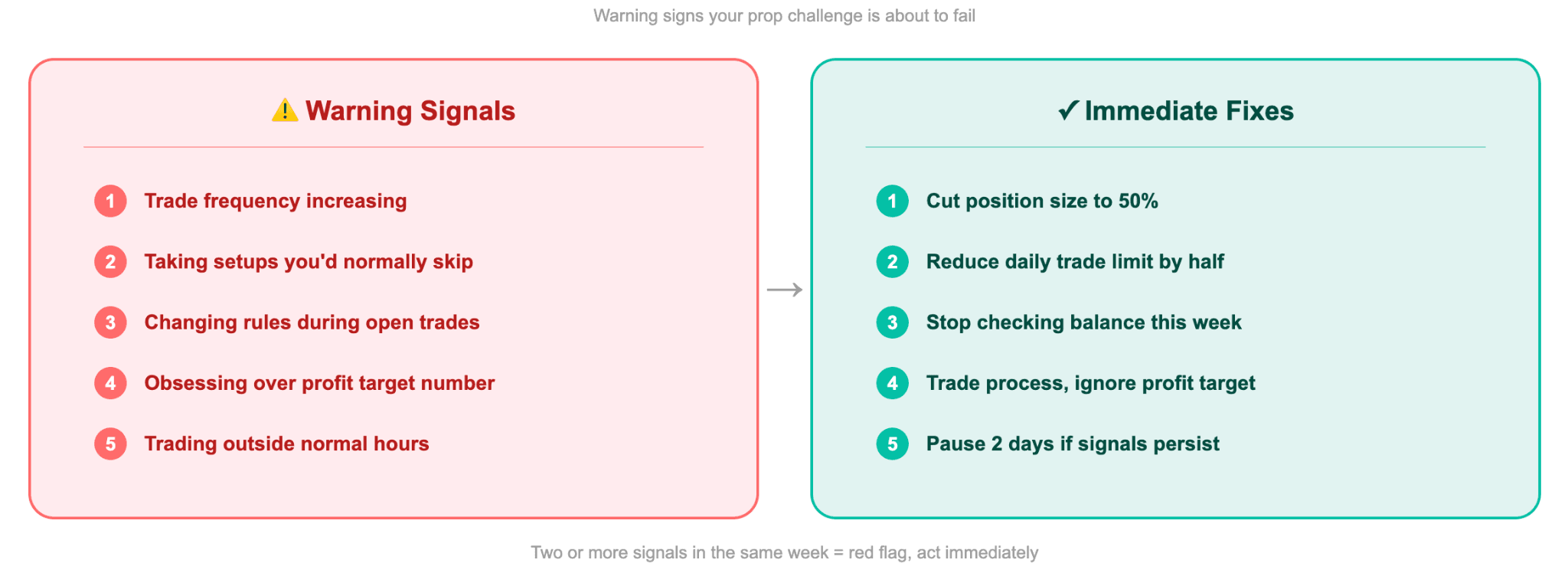
Five measurable signals predict most challenge failures. Track these in your journal daily.

  1. Trade frequency is increasing without better setups
  2. Taking entries you would normally skip
  3. Adjusting stop losses or changing rules during open trades
  4. Focusing on the profit target number instead of your process
  5. Trading outside your normal hours or market conditions

Any single signal is a yellow flag. Two or more appearing in the same week are a red flag that demands immediate action. The account is not dead yet, but your behavior has shifted into the pattern that kills accounts.

What to Do When You Spot the Pattern

The correct response is not motivation or mental toughness. The correct response is mechanical and immediate.

Reduce position size to 50% of your normal risk for the next five trading days. This buys time and reduces the emotional weight of each trade. Cut your daily trade limit by half. If you normally take four trades per day, take no more than that.

Stop checking your account balance or profit target for the rest of the week. Balance obsession is the fuel that drives impulsive decisions near the end of failing evaluations. Trade your process for one that lets the numbers take care of themselves.

If the warning signals persist for more than three sessions despite these adjustments, pause the evaluation entirely. Take two full days off the screen. Review your journal from a neutral state. Decide whether to continue or reset with a clear head.

Key takeaway: Challenge breaches follow predictable warning patterns in the days leading up to the actual failure. Increasing trade frequency, taking marginal setups, and changing rules mid-trade are the strongest signals. The fix is mechanical size reduction and balance blindness, not willpower or motivation.

What to Check Before You Buy a Prop Challenge

Most failed challenges were lost before the first trade opened. The trader bought an evaluation without verifying that their strategy, risk profile, and psychological readiness matched the challenge's requirements. Ten minutes of honest self-assessment prevents weeks of wasted time and money.

Pre-Challenge Readiness Assessment

Run these ten questions before purchasing any evaluation. If any answer is "no," the challenge is a poor fit right now.

  1. Does the worst single-day loss fit within the daily limit?
  2. Strategy backtested over 100 trades?
  3. Does the maximum drawdown from backtesting fit within challenge limits?
  4. Risk per trade set at 1% or lower?
  5. Can you stay in cash for 5 or more days when no setup appears?
  6. Know the exact drawdown model of the target firm?
  7. Understand whether drawdown is static or trailing?
  8. Have a written rule for maximum losses per session?
  9. Have you traded the strategy live for 30 or more days?
  10. Prepared to lose the challenge fee without emotional impact?

Print this checklist and answer every question honestly before entering payment information. The evaluation fee is the lowest cost associated with a failed challenge. The real cost is the weeks of trading time, the psychological damage from preventable failure, and the bad habits formed under stress that carry into future attempts.

Most challenge trading mistakes happen because traders skip this preparation step entirely. They see the profit target, imagine the funded account, and buy the evaluation on optimism alone. Preparation is not glamorous. It is the highest-return activity in funded trading.

Key takeaway: Check the ten readiness questions before buying any prop challenge. If your worst day exceeds the daily limit, the challenge is wrong for your strategy right now. Preparation costs nothing but prevents the most expensive mistakes in funded trading. The evaluation fee is cheap compared to weeks of wasted time on a challenge your strategy cannot survive.

Wrapping It Up

Why traders fail prop firm challenges

Why traders fail prop firm challenges comes down to behavioral errors, not bad strategy. Five mistakes cause 90% of breaches: revenge trading, drawdown misunderstanding, overtrading, oversizing, and psychological pressure. Risk per trade of 1% or lower is the minimum threshold for challenge survival. 

Profitable traders fail when their strategy's variance profile does not match the evaluation window. Warning signals appear days before every breach and respond to mechanical intervention. Ten minutes of honest readiness assessment before buying a challenge prevents the most common and most expensive failures.

Frequently Asked Questions

Disclaimer: This article is for informational purposes only and does not constitute financial advice. Trading involves risk and may result in loss of capital.

Related Articles

The First Move Is Yours

Discover how Supertrade can transform your trading career. Explore challenges, access instant funding, and join a growing community of Supertraders.

Stay Ahead of the Game

Sign up to receive exclusive tips, market insights, and the latest updates from Supertrade. Don’t miss out on opportunities to grow your trading success.
Discord

Our Community

Do not skip any beat.

The Ultimate Trading Community. Join our Discord server to get the latest updates, news and more.

2026 Supertrade. All rights reserved
DiscordInstagramTelegramYouTubeX
Trading involves significant risk. Past performance is not indicative of future results. This is a simulated trading environment. Supertrade provides educational trading services.
Supertrade
Supertrade Ltd, a company incorporated under the laws of Saint Lucia with registered number 2024-00699, located at Ground Floor, Rodney Court Building, Rodney Bay, Gros Islet, Saint Lucia, LC01 101, operates and owns this website, as well as provides services under the Terms and Conditions posted on the website. Supertrade Prop Ltd, a company incorporated under the laws of England and Wales with registered number 16234284, located at 52-56 Standard Road, London, England, NW10 6EU, acting as a payment agent.