
Trading Psychology

Jul 24, 2026 - 10 min

●●●Advanced

Fear and Greed Factors in Trading and How to Trade Against Them

Fear and Greed Factors in Trading and How to Trade Against Them

Losses hurt about twice as much as equivalent gains, according to research by Kahneman and Tversky. That imbalance sits behind the fear and greed factors in trading that push accounts into avoidable losses every week. This guide breaks down the four factors that cause most damage. You also get a framework, a checklist, and guidance on reading the CNN Fear and Greed Index.

Evgenij Pakhomov
Reviewed by:
Share

Fear and Greed Factors: Core Facts

QuestionAnswer
What are fear and greed factors in trading?Emotional patterns that override strategy and cause impulsive entries or exits.
Which factors matter most?Panic selling, FOMO, revenge trading, and complacency.
What is the Fear and Greed Index?A 0 to 100 sentiment gauge built from seven market indicators.
What score signals extreme fear?Any reading below 25 on the CNN scale.
Which emotion causes more losses?Greed, because it removes stops and inflates position size.
How can traders reduce emotional trading?Emotional scans, pretrade checklists, and fixed position sizing.

What Are Fear and Greed Factors in Trading
What Are Fear and Greed Factors in Trading

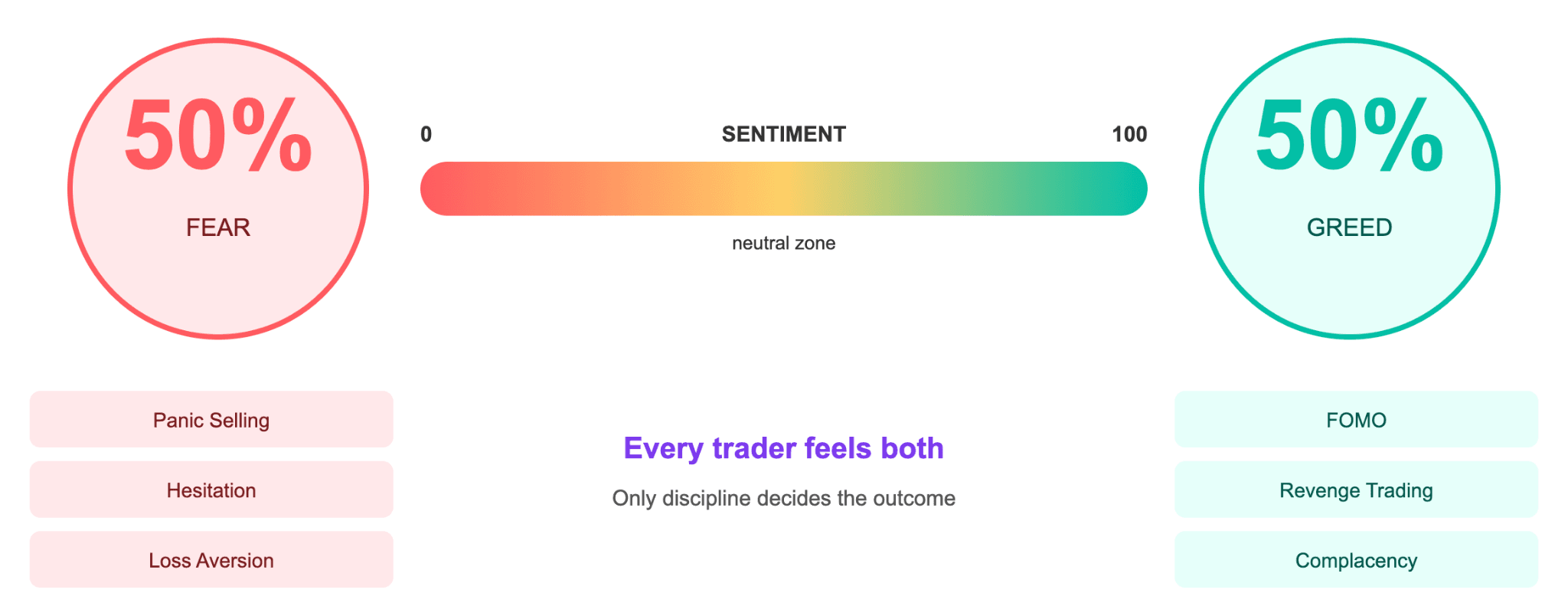
Fear and greed factors in trading are emotional patterns that override strategy and cause impulsive decisions. The four main factors are panic selling, FOMO, revenge trading, and complacency. Every trader feels them. The gap between amateurs and professionals is how much control they keep when these patterns surge.

Fear in Trading and Its Behavioral Signals

Fear in trading shows up as hesitation, tight stops, and skipped setups. A trader feels it after losses, during high volatility, and when news breaks unexpectedly. The brain treats a losing trade like a physical threat and pushes you to exit fast. Traders often close winners too early because holding feels like risking a gain they already own.

Greed in Trading and Its Behavioral Signals

Greed in trading pushes traders to add size, ignore stops, and chase trends late. It disguises itself as confidence, especially after a winning streak. You start believing the current setup cannot fail. Position size grows, checklists shrink, and one bad trade wipes weeks of progress.

Why Fear and Greed Move Markets in Cycles

Every market moves through cycles of fear and greed because human behavior repeats. When enough traders panic together, prices fall harder than fundamentals justify. When enough traders chase, prices rally beyond fair value. The CNN Fear and Greed Index tracked this pattern through 2026. It flipped from extreme fear in March to greed by mid-July.

SituationFear responseGreed responseDisciplined response
Position moves against youClose immediatelyAdd to loserHonor original stop
Position hits profit targetExit half too earlyRemove targetTake planned profit
Big news eventSkip the setupTrade the spikeWait for confirmation
After three winsReduce size in fearDouble sizeKeep size constant
After three lossesStop tradingRevenge tradeReview journal first

Key takeaway. Fear and greed factors in trading create predictable patterns that appear before and during every trade. Fear closes winners early and blocks valid setups. Greed removes stops and inflates size after wins. Naming which emotion runs you is the first act of discipline.

The Main Fear and Greed Factors That Hurt Traders
The Main Fear and Greed Factors That Hurt Traders

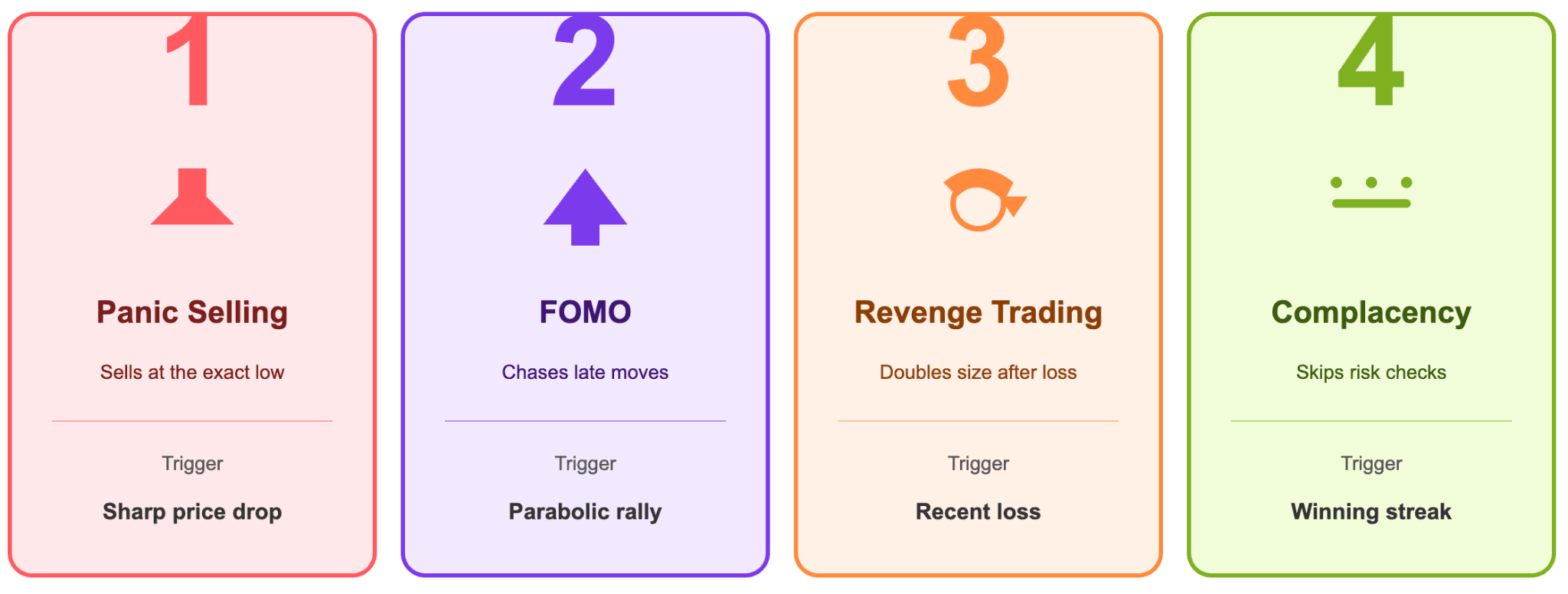
Four factors cause most emotional damage in trading accounts. Each shows up in a specific market condition and produces a specific mistake. Naming them helps you spot the pattern before you act on it.

Panic Selling and Loss Aversion

Panic selling happens when a fast price drop overrides your plan. Behavioral research by Kahneman and Tversky shows traders feel losses about twice as strongly as equivalent gains. That imbalance makes exits feel urgent even when the setup still works. Panic sellers often lock in the exact low of a move.

FOMO and Late Entries

FOMO drives traders to chase a move already in motion. You watch a stock or a crypto pair rally 15 percent, then buy near the top. The setup is late, the risk is worse, and the reversal usually arrives within hours. FOMO combines greed with the fear that others are winning without you.

Revenge Trading After a Loss

Revenge trading occurs when a trader tries to recoup a loss immediately. Size grows, stops shrink, and analysis disappears. The brain wants closure, not profit. Most revenge trades end in a second larger loss that compounds the emotional damage.

Complacency After Winning Streaks

Complacency slips in when confidence outgrows risk control. You skip pretrade checks, add size on weak setups, and trust feel over process. A calm market makes it worse because nothing punishes sloppiness for weeks. When volatility returns, complacency turns weeks of gains into a single drawdown.

Key takeaway. Panic selling, FOMO, revenge trading, and complacency cause most emotional losses in retail accounts. Each pattern maps to a specific market condition and a specific mental state. Traders who catch the trigger early can pause and follow their plan rather than their emotions.
Become a Confident Trader

Master trading with our structured course designed for beginners and intermediate traders.

Step-by-step lessons
Real strategies
Risk management training

Join 10,000+ traders improving their skills

Start Course Now

How the Fear and Greed Index Measures Market Sentiment

How the fear and greed index works starts with turning market emotion into a single number between 0 and 100. The CNN version updates during every US trading day and combines seven weighted indicators. Traders use it as a filter, not a signal.

The Seven Components of the CNN Fear and Greed Index

The fear-and-greed indicator built by CNN combines seven equal-weighted inputs into a single score.

  1. Market momentum vs average
  2. Stock price strength at highs
  3. Stock price breadth and volume
  4. Put and call options ratio
  5. Market volatility from VIX
  6. Haven demand from bonds
  7. Junk bond demand and spreads

Each component carries equal weight in the final score. The index calculates how far each value sits from its long-term average. Reading them together gives a fuller picture than any single indicator.

How to Read the 0 to 100 Scale

The scale splits into five sentiment zones that guide interpretation. Extreme readings on either end often mark short-term turning points in the market.

ScoreZoneWhat it signals
0 to 24Extreme FearPossible bottom, buyer opportunity
25 to 44FearCautious sentiment, wait for confirmation
45 to 55NeutralMarket has no strong bias
56 to 75GreedMomentum favors bulls, watch for exhaustion
76 to 100Extreme GreedOverheated conditions, risk of correction

The CNN index sat at 43 in late July 2026, showing mild fear across US equities. That reading gave contrarian buyers a small edge without confirming a strong reversal signal.

CNN Index vs Crypto Fear and Greed vs VIX

Three sentiment tools dominate trader dashboards, and each measures a different market with different inputs.

ToolMarketScaleBest for
CNN Fear and GreedUS equities0 to 100Stock traders and macro filters
Crypto Fear and GreedCrypto0 to 100Bitcoin and altcoin sentiment
CBOE VIXS&P 500 options0 to 80+Volatility hedgers and options traders

The Chicago Board Options Exchange Volatility Index (VIX) measures expected 30-day volatility from S&P 500 options. A VIX above 30 usually maps to extreme fear on the CNN index. Traders combining these tools get sentiment confirmation across three data sources.

How to Use a Fear and Greed Index in Real Trades

Use the index as a context filter, never as an entry trigger. Buy setups gain confidence when the index reads extreme fear and price action stabilizes. Sell setups gain confidence when the index hits extreme greed and momentum starts to slow. 

In April 2026, the S&P 500 rallied roughly 6 percent. The CNN index flipped from fear to greed inside four weeks. Trend followers who tracked both got early confirmation of the move. Traders who ignored the shift often stayed short too long.

Key takeaway. The Fear and Greed Index turns messy market emotion into a single number backed by seven components. Extreme readings mark short-term turning points but rarely predict exact timing. Combine the index with your technical setup and the VIX for cleaner sentiment reads.

Balancing Fear and Greed Through Discipline

Balancing Fear and Greed Through Discipline

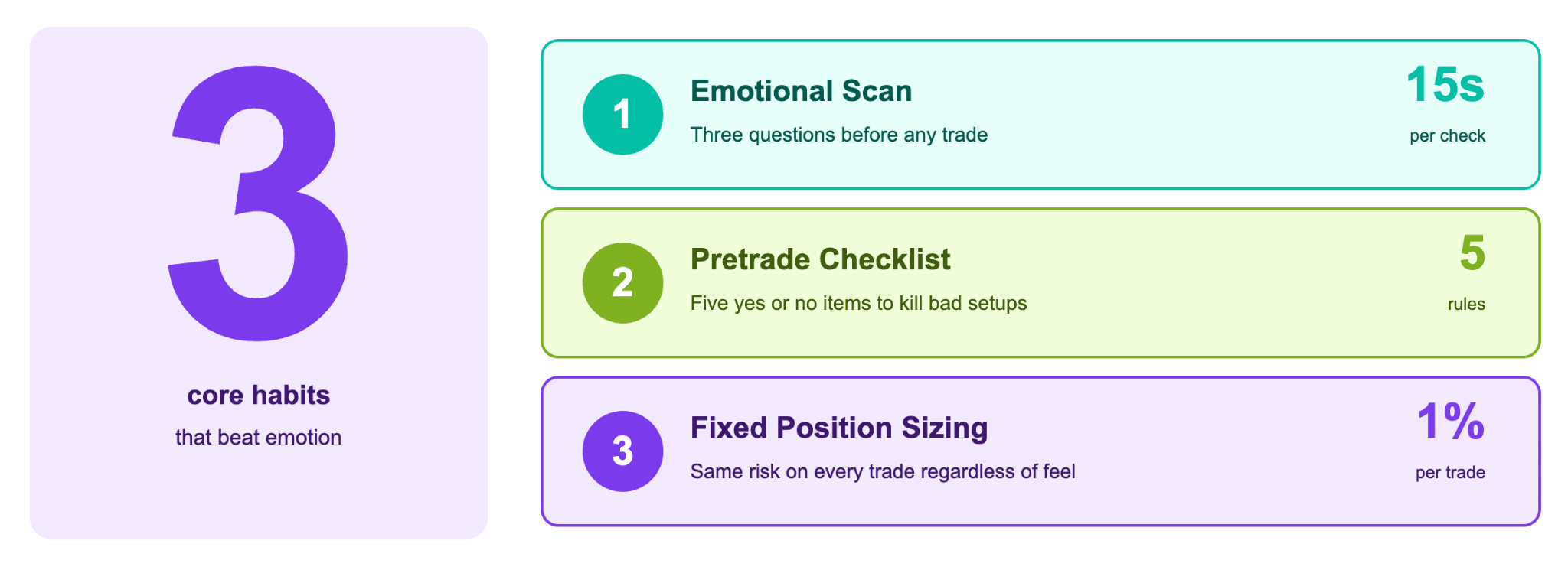
Managing fear and greed and balancing fear and greed both come from process, not willpower. Discipline is not about killing emotion. It is about building a mindset and a routine that run whether you feel calm or scared. Three habits do most of the work.

Quick Emotional State Check Before Any Trade

Before touching any setup, run a 3 question emotional scan on yourself. This step is separate from your setup checklist and takes 15 seconds.

  • Am I chasing a missed move?
  • Am I trying to recover a loss
  • Am I feeling untouchable after wins

Any yes answer means you pause for 10 minutes before touching a chart. This filter catches revenge trades and FOMO entries at the source.

Pretrade Checklist That Stops Emotional Entries

A short checklist forces logic before every trade. Read each item aloud and answer yes or no.

  • Setup matches my written plan
  • Risk is under two percent
  • Stop level defined and firm
  • Market context supports direction
  • Not chasing a missed move

Any no answer kills the trade. This one habit removes most FOMO and revenge entries before they happen.

Position Sizing Rules That Neutralize Greed

Fixed-position sizing removes the biggest lever that greed uses to hurt you. Risk the same percentage per trade whether you feel confident or scared. A trader risking 1 percent per trade can lose ten trades in a row. That trader still keeps 90 percent of the account. Greed hates this rule because it caps upside, but it protects you when you are wrong.

Journaling and Screen Time Habits That Reduce Fear

Journaling every trade catches emotional patterns before they compound. Write what you saw, what you felt, and what you did. Review the journal weekly and count how many trades followed the plan. Limit screen time in the same session. Staring at price makes fear grow faster than logic can catch up.

Key takeaway. Discipline turns fear and greed factors in trading into manageable variables instead of hidden drivers. Emotional scans stop revenge trades, checklists block FOMO entries, and fixed sizing neutralizes greed. These habits do more for your account than any new indicator.

Key Points on Fear and Greed Factors in Trading

Fear and greed factors in trading show up in every account, every week, and every timeframe. The CNN Fear and Greed Index gives you an outside view of market emotion using seven weighted components. Extreme readings often mark turning points but never guarantee them. Discipline built on emotional scans, checklists, and fixed sizing turns emotion from a threat into a signal.

Frequently Asked Questions

Disclaimer: This article is for informational purposes only and does not constitute financial advice. Trading involves risk and may result in loss of capital.

Related Articles

The First Move Is Yours

Discover how Supertrade can transform your trading career. Explore challenges, access instant funding, and join a growing community of Supertraders.

Stay Ahead of the Game

Sign up to receive exclusive tips, market insights, and the latest updates from Supertrade. Don’t miss out on opportunities to grow your trading success.
Discord

Our Community

Do not skip any beat.

The Ultimate Trading Community. Join our Discord server to get the latest updates, news and more.

2026 Supertrade. All rights reserved
DiscordInstagramTelegramYouTubeX
Trading involves significant risk. Past performance is not indicative of future results. This is a simulated trading environment. Supertrade provides educational trading services.
Supertrade
Supertrade Ltd, a company incorporated under the laws of Saint Lucia with registered number 2024-00699, located at Ground Floor, Rodney Court Building, Rodney Bay, Gros Islet, Saint Lucia, LC01 101, operates and owns this website, as well as provides services under the Terms and Conditions posted on the website. Supertrade Prop Ltd, a company incorporated under the laws of England and Wales with registered number 16234284, located at 52-56 Standard Road, London, England, NW10 6EU, acting as a payment agent.