En
En Es
Es

Funded Trading and Leverage Trading at a Glance
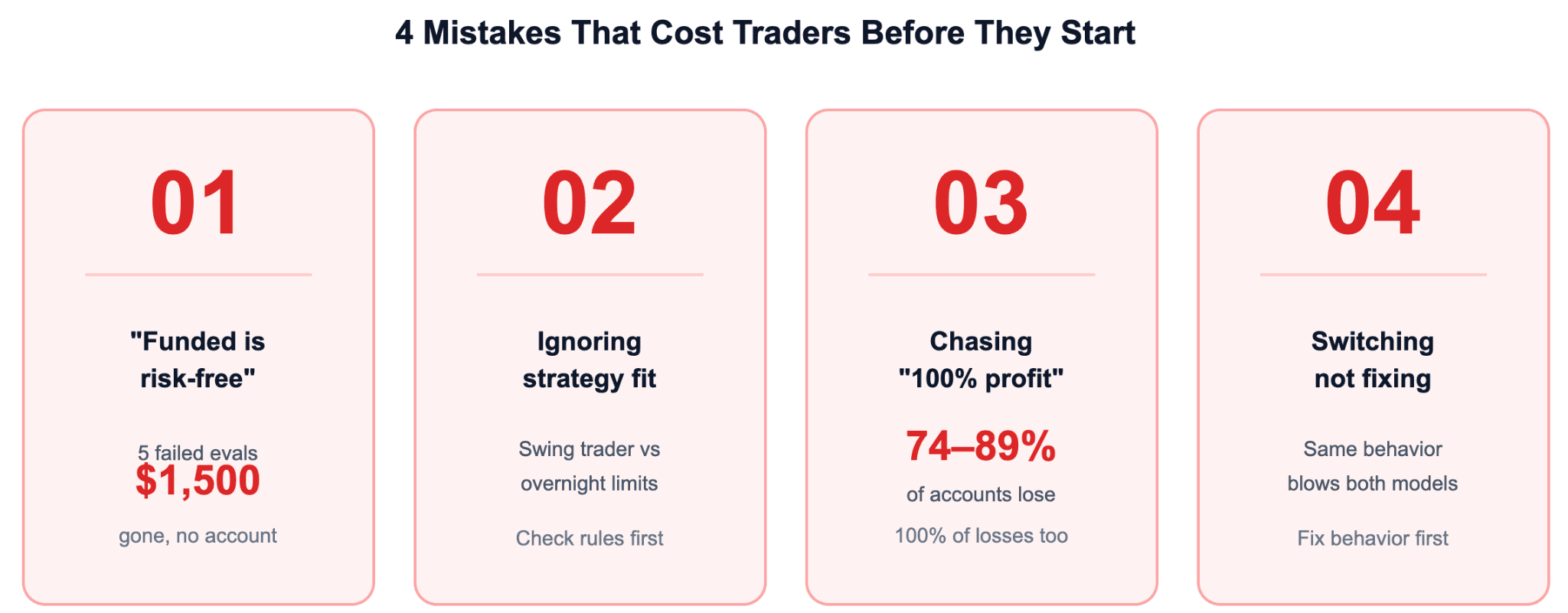
- ESMA reports that 74% to 89% of retail CFD accounts lose money with leverage.
- Average retail leverage losses range from €1,600 to €29,000 per client across EU countries.
- Only 5% to 10% of traders pass prop firm evaluations on the first attempt.
- FINRA warns that leveraged trading can produce losses exceeding the original investment.
- Peer-reviewed research shows that leverage constraints improve retail trading performance.
What Is Funded Trading and What Is Leverage Trading
These two models solve the same problem through opposite structures. Both allow traders to control positions larger than their personal savings. The differences start with who owns the capital and who sets the rules. They extend to who bears losses when positions move the wrong way.
How Funded Trading Works
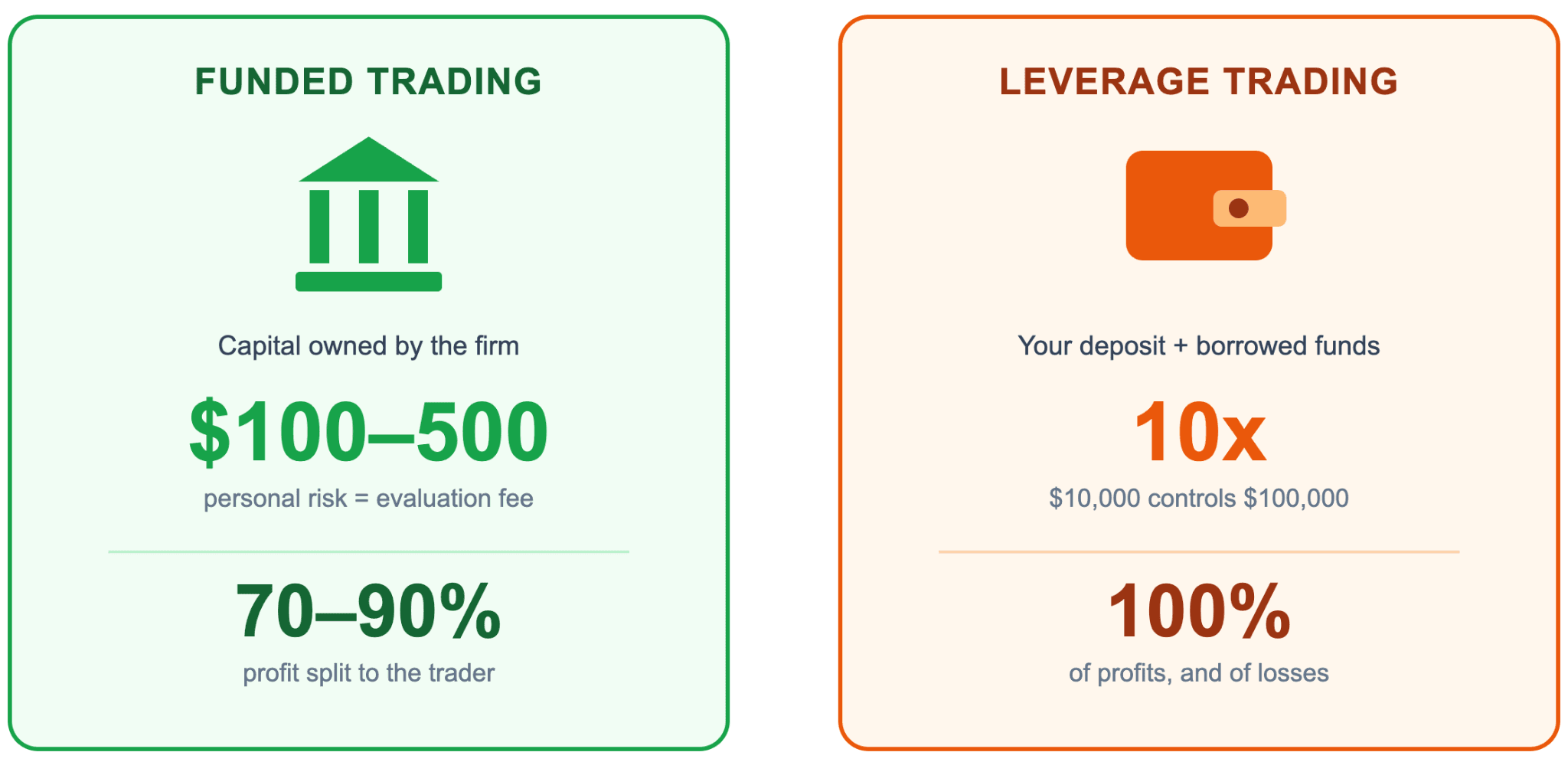
Funded trading means trading with capital provided by a prop firm after passing an evaluation. The firm owns the money. The trader earns access by meeting profit targets within defined risk limits. Profits are split between the trader and firm, typically 70% to 90% in the trader's favor.
The evaluation fee caps personal financial risk. That fee ranges from $100 to $500, depending on account size. If the trader breaches any risk rule, the account closes automatically—no margin calls. No debt. The evaluation fee is the maximum possible loss.
The tradeoff is autonomy. The firm controls position size limits, daily loss caps, and drawdown floors. The trader executes within those boundaries or loses the account.
How Leverage Trading Works
Leverage trading means trading your own deposited funds with borrowed exposure from a broker. You deposit collateral,l and the broker multiplies your position size. A $10,000 deposit at 10x leverage controls $100,000 in market exposure.
You keep 100% of all profits. You also absorb 100% of all losses. If losses exceed your margin, the broker automatically liquidates your position. During extreme volatility, liquidation can occur at prices worse than your stop-loss.
The advantage is complete autonomy. No external rules limit your strategy, position sizing, or trading hours. The disadvantage is full personal financial exposure to every outcome.
Key takeaway: Funded trading limits personal risk to the evaluation fee and provides access to the firm's capital under strict rules. Leverage trading gives full autonomy and full profit retention but exposes the entire deposit to potential total loss. Both models provide larger position sizes. The risk structure is the opposite.
Core Differences Between Funded Trading and Leverage Trading
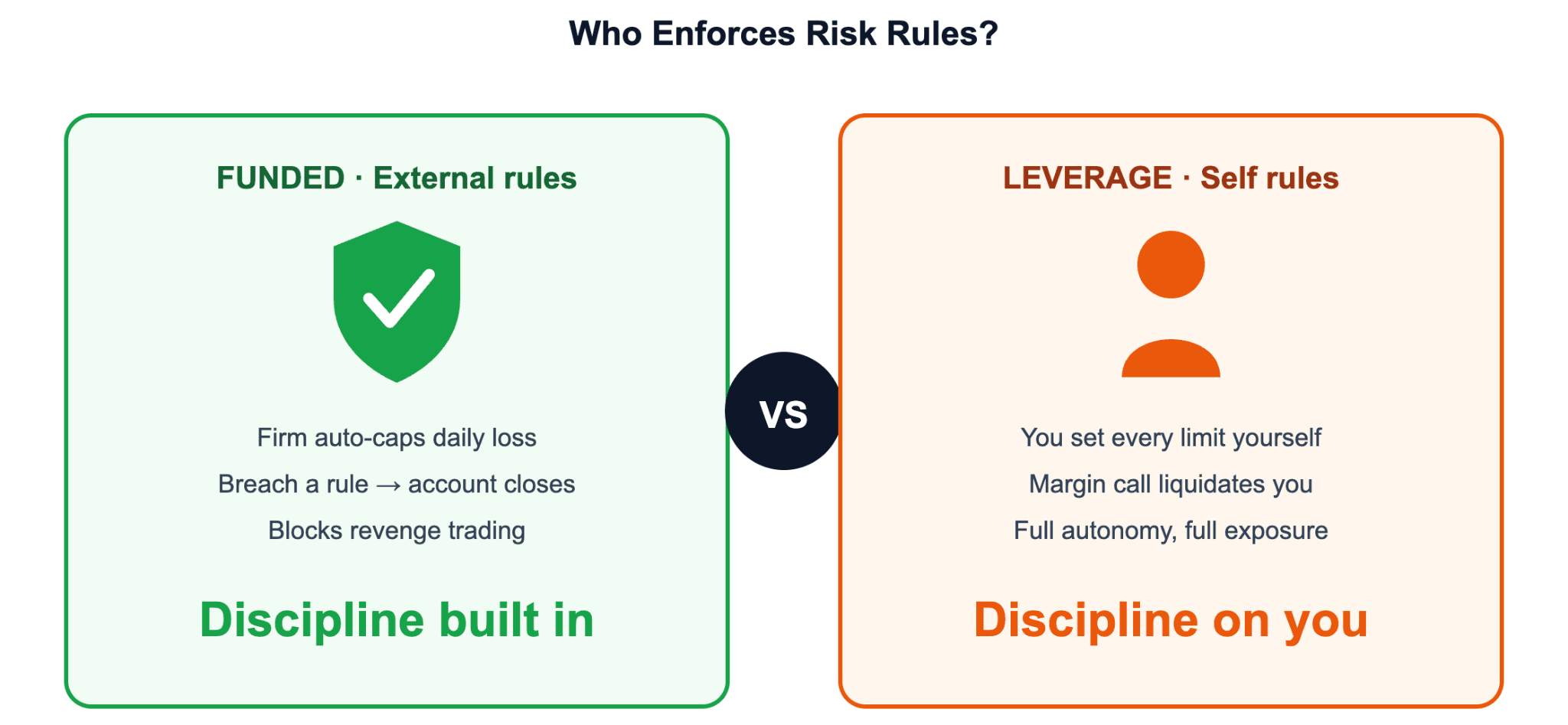
The surface similarity between these models hides fundamental structural differences. Capital sources, risk exposures, profit retention, and rule enforcement all operate differently. Understanding each feature determines which model fits your situation.
Risk, Capital, and Control Compared
Seven features define the structural gap between these two models. The table below compares each one.
| Feature | Funded Trading | Leverage Trading |
|---|---|---|
| Capital source | The firm's own capital | Deposit plus borrowed funds |
| Personal risk | Eval fee ($100 to $500) | Full deposited balance |
| Profit retention | 70% to 90% (split) | 100% |
| Risk rules | The firm enforces automatically | Trader defines alone |
| Account termination | A rule breach ends the account | Margin call liquidation |
| Autonomy | Limited by firm rules | Full trader control |
| Entry requirement | Pass the evaluation challenge | Deposit funds with a broker |
The most important row is "risk rules." In funded trading, the firm decides the maximum daily loss, total drawdown, and position limits. In leverage trading, you set those limits yourself. Most retail traders set limits they never follow. ESMA data confirm this with a loss rate of 74% to 89%.
External rule enforcement is both a constraint and an advantage. It prevents oversizing, revenge trading, and averaging into losers. It also prevents the flexible execution of strategies that some approaches require.
How Each Model Changes Trader Behavior
Funded trading exposes behavioral weaknesses fast. Every emotional response to a loss triggers immediate consequences. Widen a stop-loss beyond the daily limit, and the account closes. Enter a revenge trade, and the daily cap triggers.
Leverage trading masks behavioral problems for longer. A trader who revenge trades loses more money, but the account persists. Without external enforcement, the correction loop runs slower and costs more personal capital.
Research published in the Journal of Banking and Finance confirms this pattern. ESMA's leverage constraints improved retail trading performance measurably. External structure helped traders outperform those with full autonomy.
Traders with strong self-management and proven discipline may not need external rules. Traders who struggle with emotional decisions under pressure benefit from the funded model.
Key takeaway: The core differences center on who controls risk decisions. Funded trading enforces rules externally. Leverage trading leaves enforcement to the trader. ESMA data and academic research both show external constraints improve outcomes for average retail traders. Experienced traders with proven self-control may prefer the autonomy of leverage.
Same Strategy on Both Models and What the Numbers Show
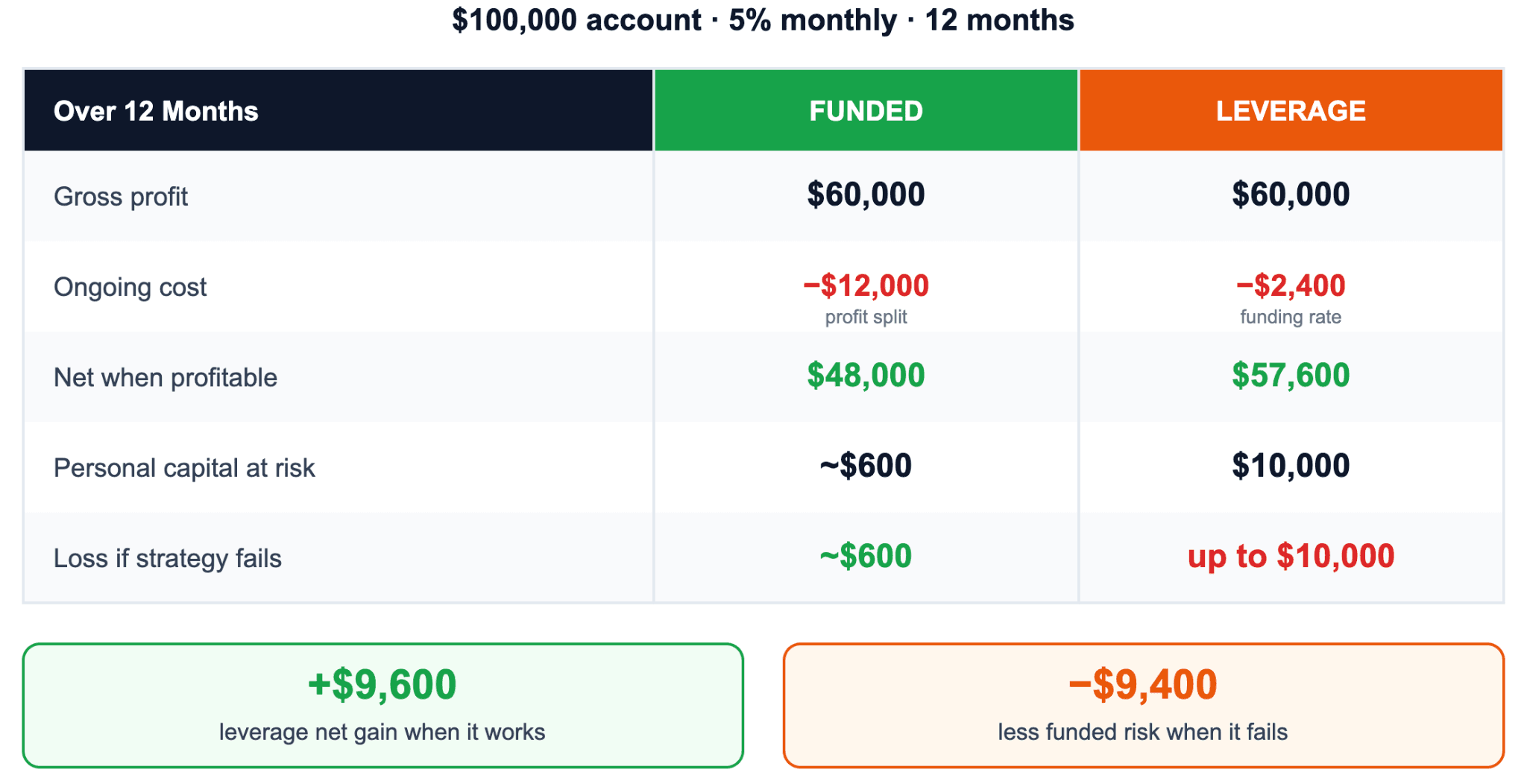
The clearest way to compare these models is to use identical numbers in both structures. Take a trader with a 60% win rate and a 1.5-to-1 reward ratio. Both scenarios use $100,000 in notional exposure at a 5% monthly return.
Funded Model Scenario With Real Numbers
The trader pays a $300 evaluation fee and passes the challenge. The firm allocates a $ 100,000-funded account with an 80/20 profit split.
A monthly gross return of 5% equals $5,000. The trader keeps 80%, or $4,000 per month. Over 6 months, gross earnings reach $30,000. The trader nets $24,000 after the firm's 20% share is deducted.
Personal capital at risk throughout all 6 months equals $300. If the trader breaches a rule in month 2, the personal loss is $300. The firm absorbs trading losses on its own capital.