

Trading Strategies

Jun 22, 2026 - 13 min

Beginner

How to Create a Trading Plan That Keeps You Profitable

how to create a trading plan

A profitable trading process starts with written rules for entries, exits, and risk limits. A solid trading plan separates the 1% of consistently profitable traders from the 72% who lose every year. This guide gives you a template, a real forex example, and every step to build yours.

Justin Freeman
Reviewed by:
Share

Key Facts About Trading Plan in 2026

  • Most profitable traders set plan risk at 1% to 2% per trade.
  • 88% of profitable traders include stop-loss orders in their plan.
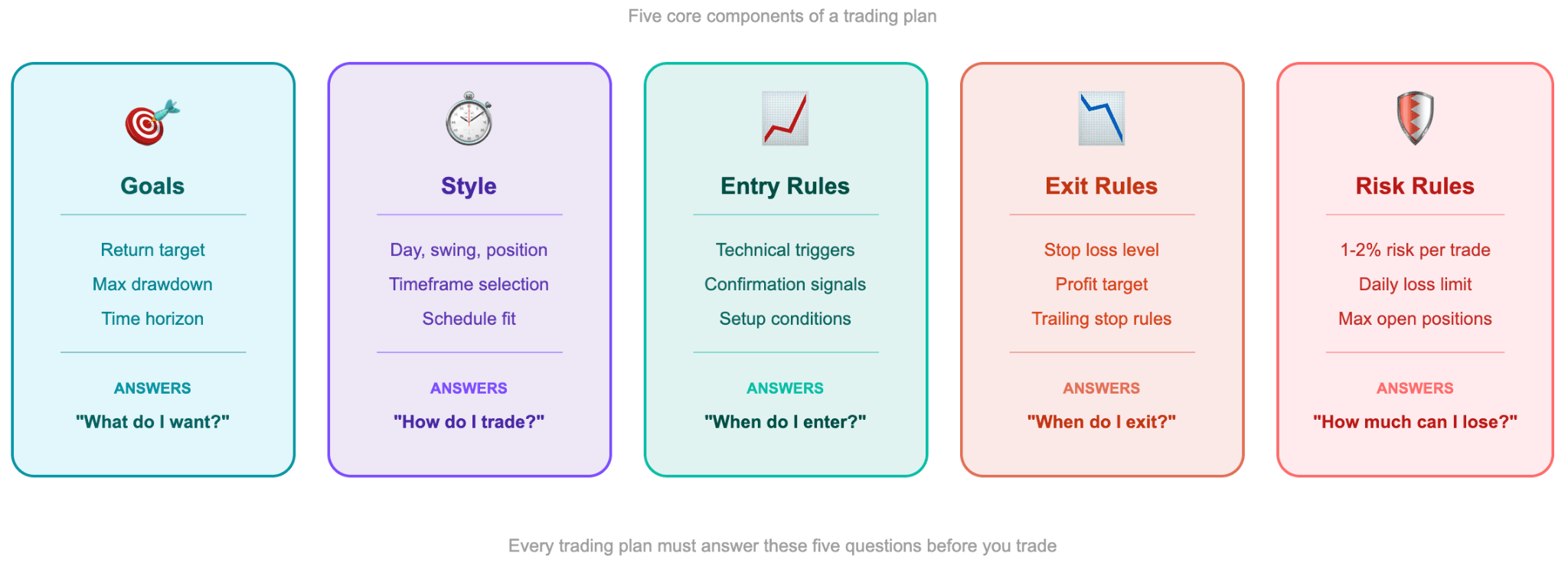
  • A solid plan covers five components: goals, style, entry rules, exit rules, and risk limits. 
  • FINRA warns traders to expect a total loss of funds without proper preparation. 
  • FINRA eliminated the $25,000 PDT minimum equity rule effective June 4, 2026. 
  • 80% of day traders quit within two years without a structured plan.

What Is a Trading Plan
What Is a Trading Plan

What is a trading plan in practice? A written document that defines which markets you trade, what triggers your entries, where you exit, and how much you risk. Most traders skip this step and rely on gut feeling or social media signals instead. FINRA data show that this approach results in losses for 72% of traders every year.

Trading Plan Meaning in Simple Terms

A trading plan answers every question before you open a position. It defines which markets you trade and what signals trigger your entries. It sets where you place exits and how much capital you risk per trade. It tells you when to stay out of the market entirely.

Think of it as a business manual for your trading account. Without a plan, every decision becomes emotional and reactive. With one, you follow a repeatable process regardless of market noise. The plan does not predict the market. It protects you from yourself.

Why 72% of Traders Lose Money Without a Plan

FINRA warns that day trading can lead to losses for traders with limited experience and low risk tolerance. The numbers confirm this warning across all markets and timeframes.

72% of day traders ended the year with financial losses. 80% quit within their first two years of trading. Only 1% to 4% achieve consistent returns over five or more years. Traders without written rules lose money, quit early, or both. A trading plan does not guarantee profits. It prevents behavioral errors that cause most trading losses.

Key takeaway: A trading plan is a written rulebook for entries, exits, and risk limits. 72% of traders lose money annually, and 80% quit within two years. The small group that survives in the long term follows a documented, repeatable process every single trading day.

How to Create a Trading Plan Step by Step
How to Create a Trading Plan Step by Step

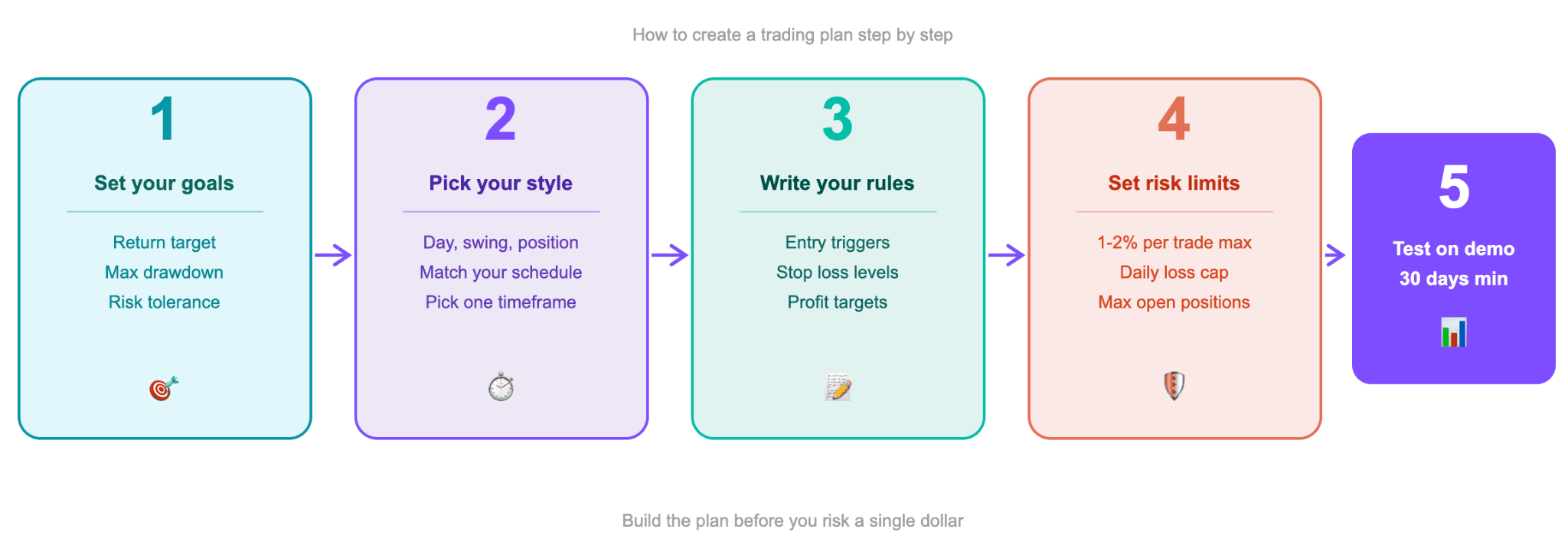
Creating a trading plan requires answering specific questions about your goals, strategy, and risk tolerance. Every answer becomes a written rule you follow without exception. The plan works only when every rule is specific enough to execute without interpretation.

Define Your Goals and Risk Tolerance

Your goals determine every decision in your trading plan. A trader aiming for a 15% annual return builds a different plan than one targeting a 5% monthly return. Write your target return and your maximum acceptable drawdown before anything else.

Define your risk tolerance with a specific number, not a feeling. Most successful traders risk 1% to 2% of their account per trade. If losing $200 on a single trade causes anxiety, your position size needs to go down.

Write your maximum daily loss limit and your maximum weekly drawdown. These numbers protect your capital when emotions push you to overtrade. Treat these limits as non-negotiable regardless of how confident you feel.

Choose Your Trading Style and Timeframe

Your trading plan must match your daily schedule and personality. A full-time employee who tries to day trade for eight hours will fail fast.

Pick one style based on your available timeframe and commit to it fully. Swing traders check charts once or twice daily and hold positions for days. Scalpers need full-time access to a screen and make dozens of trades per session. Position traders review charts weekly and hold for weeks or months. The right style depends on your schedule, not your ambition.

Set Entry and Exit Rules

Your entry and exit rules must be specific enough that any trader could replicate them. "Buy when it looks bullish" is not a rule. "Buy when price breaks above the 50-day moving average on above-average volume" is a rule.

Write separate rules for entries, profit targets, and stop losses. Never enter a trade without knowing your exact exit point first. You define both the profit target and the stop-loss level before opening any position.
Become a Confident Trader

Master trading with our structured course designed for beginners and intermediate traders.

Step-by-step lessons
Real strategies
Risk management training

Join 10,000+ traders improving their skills

Start Course Now

88% of profitable traders use stop-loss orders as standard practice. If your plan lacks written exit rules, it is not a plan yet.

Risk Management Rules Every Plan Needs

Risk management keeps you in the game long enough to become profitable. Without it, one bad week erases months of progress. Your plan needs at least four risk limits.

  • Maximum risk per trade
  • Daily loss limit
  • Weekly drawdown cap
  • Maximum open positions at once

These four numbers protect your account from emotional decisions and losing streaks. Post them where you can see them during every trading session. Never override these limits regardless of how confident you feel about a specific trade.

Here’s a trading plan template that works in 2026

Component:Your Plan:
Trading goalAnnual return target and max drawdown
Risk per trade1% to 2% of the total account balance
Daily loss limitFixed dollar amount or percentage
Trading styleDay, swing, or position
MarketsSpecific pairs or instruments only
Entry rulesTechnical or fundamental triggers
Exit rulesProfit target and stop-loss levels

Here is an example forex trading plan for a swing trader with a $10,000 account.

Component:Example:
Goal15% annual return, 8% max drawdown
Risk per trade1.5% ($150 per trade)
Daily loss limit3% ($300 max per day)
StyleSwing, 4H, and daily charts
MarketsEUR/USD and GBP/USD only
Entry ruleBuy at support with RSI above 40
Stop loss50 pips below entry
Take profit100 pips (2 to 1 risk reward)
Trading hoursAnalysis 7 AM, orders during London
JournalEvery trade with a screenshot and notes

This trading plan example works because every rule is specific and measurable. The trader knows the exact dollar risk before every single position opens.

Key takeaway: Build your trading plan around specific numbers for goals, risk limits, entry and exit points. The template and example above give you a starting structure to fill with your own data. A plan works only when every rule is measurable, and every limit is non-negotiable.

Trading Plan for Beginners and Common Mistakes to Avoid

Trading Plan for Beginners and Common Mistakes to Avoid

A trading plan for beginners does not need to be complex. It needs to be clear, specific, and followed without exception. Most beginners fail not because their plan is bad, but because they abandon it after the first losing streak.

Five Mistakes That Destroy a Trading Plan

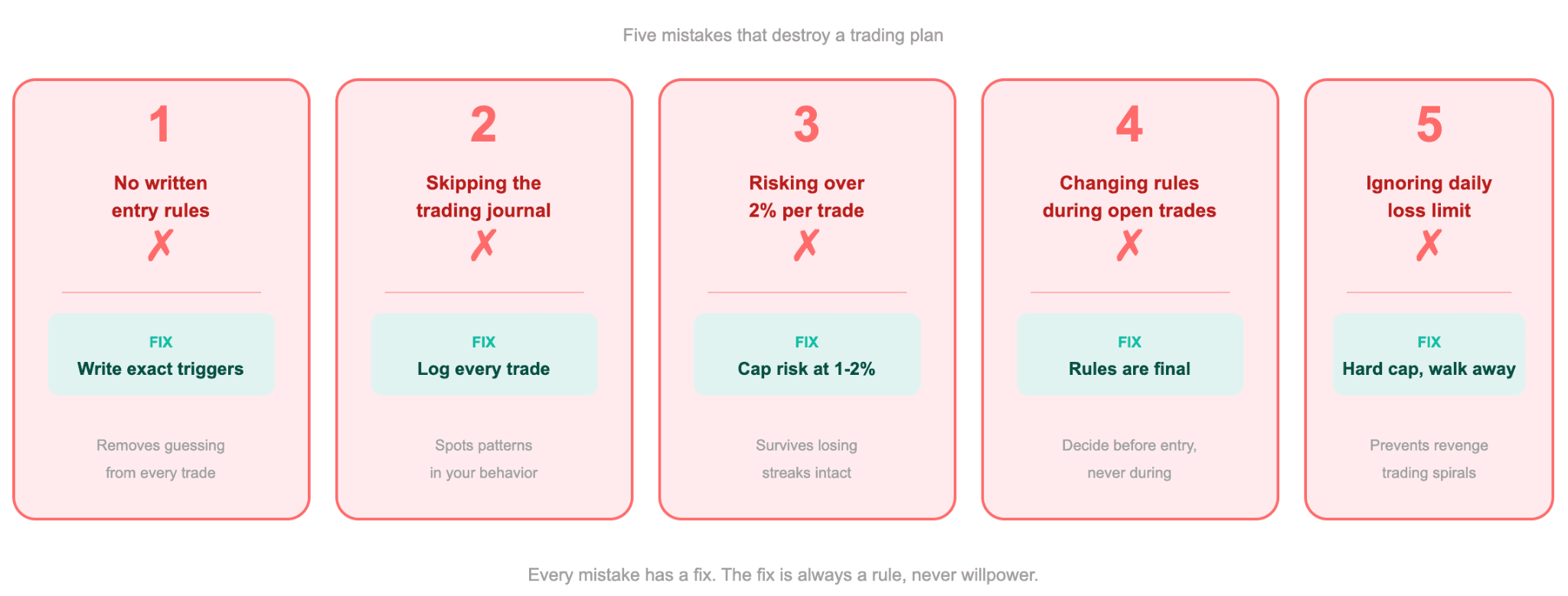
Every new trader makes planning mistakes early on. These five errors cause the most damage to accounts and confidence.

  1. No written entry rules
  2. Skipping the trading journal
  3. Risking over 2% per trade
  4. Changing rules during open trades
  5. Ignoring daily loss limits

Investopedia's trading plan guide lists trade journaling as one of ten essential plan components that most traders skip. Without a journal, you cannot spot patterns in your own behavior. You repeat the same errors month after month

Without a journal, you cannot spot patterns in your own behavior. You repeat the same errors month after month and wonder why results never improve.

Discipline fails most often when traders change rules while in a position. Moving a stop loss because "the market will turn around" destroys more accounts than bad analysis ever will. The rule existed for a reason. Follow it.

How Trading Psychology Breaks Your Plan and How to Fix It

Psychology breaks more trading plans than poor analysis does. A 2024 Schwab survey found that 41% of active traders planned to spend more time researching trades before executing.

Fear pushes traders to close winning positions before hitting the profit target. Greed keeps them holding losers past the stop-loss level. Both errors compound across dozens of trades and erase months of progress in a single week.

The fix requires removing decisions from emotional moments entirely. Set your stop-loss and profit targets before every entry, then commit. Never adjust either level while the trade runs. Your trading plan made the decision when you had a clear head. Trust it over your in-the-moment feelings.

Trading Plan Checklist Before Every Trade

Review these ten questions before every trade. If you cannot answer yes to all ten, do not enter the position.

  • Entry rule triggered?
  • Stop-loss level set?
  • Profit target defined?
  • Risk under 2% of the account?
  • Daily loss limit still intact?
  • Does trade match your plan style?
  • Journal entry prepared?
  • News events checked today?
  • Position size calculated?
  • Emotions neutral before entry?

Print this checklist and use it before every single trade. The ten seconds it takes to review will prevent the emotional errors that end trading careers.

Key takeaway: Beginners fail because they skip the journal, change rules during open trades, or risk too much per position. Psychology breaks plans through fear and greed under live market pressure. A pre-trade checklist turns discipline into a mechanical process.

Working Plan Vs. a Failing One

Working Plan Vs. a Failing One

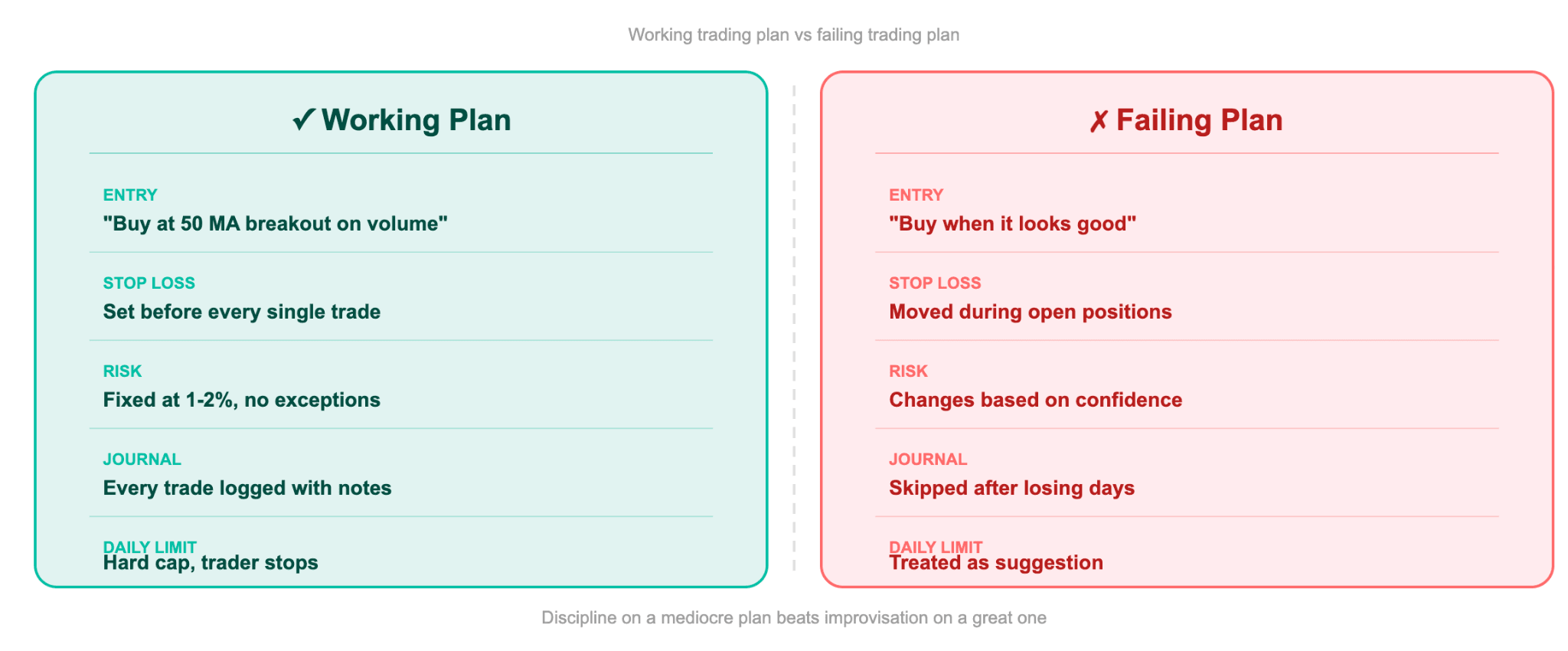
A written plan alone does not produce results. The gap between plans that work and plans that fail comes down to specificity and enforcement. Here is what that difference looks like in practice across six core components:

  • Entry rules. A working plan says "buy at 50 MA breakout on above-average volume." A failing plan says, "buy when it looks good."
  • Stop loss. A working plan sets it before every single trade. A failing plan moves it during open positions when pressure builds.
  • Risk per trade. A working plan fixes risk at 1% to 2% with no exceptions. A failing plan adjusts risk based on the trader's confidence.
  • Journal. A working plan logs every trade with notes and a screenshot. A failing plan skips the journal after losing days.
  • Review schedule. A working plan includes monthly performance reviews with real data. A failing plan never gets reviewed at all.
  • Daily loss limit. A working plan enforces a hard cap, and the trader stops. A failing plan treats the limit as a suggestion after bad trades.

Every failing plan shares one flaw. The rules exist on paper but bend under live market pressure. The trader who follows rigid rules on a mediocre strategy beats the trader who improvises on a great one. Discipline over talent wins across every timeframe and every market.

Final Thoughts On Creating a Trading Plan

A trading plan defines your entries, exits, risk limits, and trading style in one written document. 72% of day traders lose money, and 80% quit within two years. The minority who survive long-term follow a documented, repeatable process at every session. Use the template and checklist in this guide as your starting point. 

Test your plan on a demo account for at least 30 days before risking real capital. Discipline and risk management matter more than strategy complexity across all market conditions.

Frequently Asked Questions

Disclaimer: This article is for informational purposes only and does not constitute financial advice. Trading involves risk and may result in loss of capital.

Related Articles

The First Move Is Yours

Discover how Supertrade can transform your trading career. Explore challenges, access instant funding, and join a growing community of Supertraders.

Stay Ahead of the Game

Sign up to receive exclusive tips, market insights, and the latest updates from Supertrade. Don’t miss out on opportunities to grow your trading success.
Discord

Our Community

Do not skip any beat.

The Ultimate Trading Community. Join our Discord server to get the latest updates, news and more.

2026 Supertrade. All rights reserved
DiscordInstagramTelegramYouTubeX
Trading involves significant risk. Past performance is not indicative of future results. This is a simulated trading environment. Supertrade provides educational trading services.
Supertrade
Supertrade Ltd, a company incorporated under the laws of Saint Lucia with registered number 2024-00699, located at Ground Floor, Rodney Court Building, Rodney Bay, Gros Islet, Saint Lucia, LC01 101, operates and owns this website, as well as provides services under the Terms and Conditions posted on the website. Supertrade Prop Ltd, a company incorporated under the laws of England and Wales with registered number 16234284, located at 52-56 Standard Road, London, England, NW10 6EU, acting as a payment agent.