
Forex Trading

Jul 29, 2025 - 13 min

Beginner

Updated: Jun 1, 2026

Pips, Ticks, and Points Explained: What They Mean and How to Use Them

Pips, Ticks, and Points Explained: What They Mean and How to Use Them

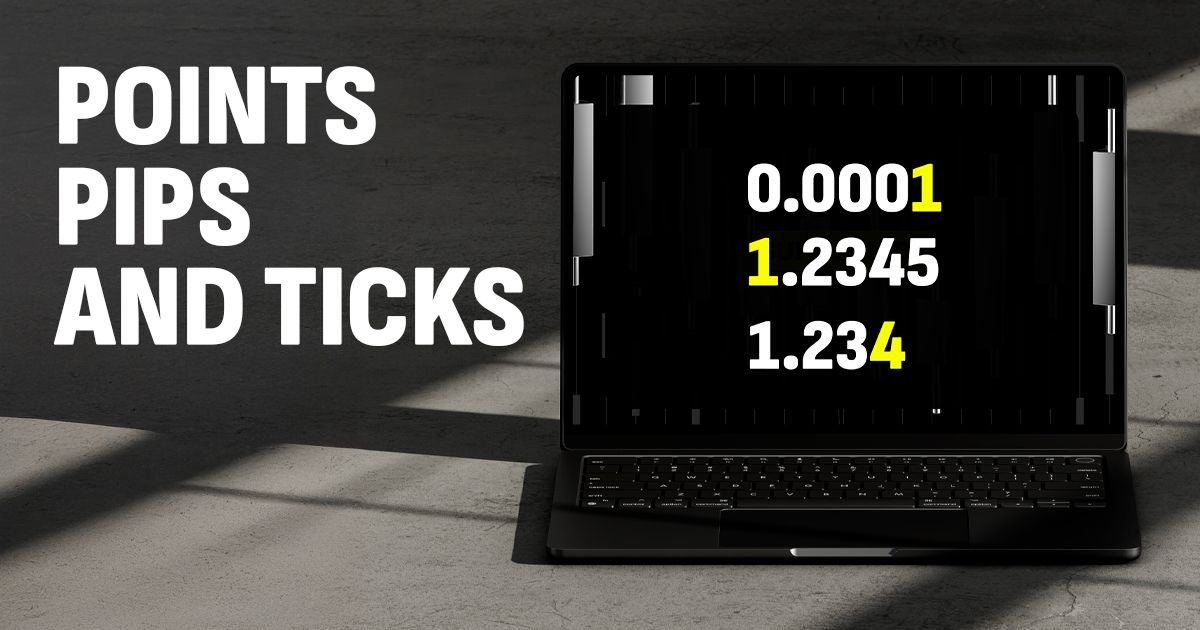
Traders switch between forex, futures, and stocks and hit three different words for the same idea: minimum price movement. Pips, ticks, and points are not interchangeable. Each term belongs to a specific market, and confusing them costs real money when you size positions, place stops, or calculate how many ticks in a point on a contract you just started trading.

Evgenij Pakhomov
Reviewed by:
Share

Pips, Ticks, and Points at a Glance: Key Facts

QuestionAnswer
What is a tick?The smallest price increment in futures and stock markets, set by the exchange per contract
What is a pip?The standard minimum price move in forex, typically the fourth decimal place (0.0001)
What is a point?A full whole-number price move; in futures it equals a set dollar value per contract
How many ticks in a point on ES?4 ticks (each tick is 0.25 points, worth $12.50)
How many ticks in a point on NQ?4 ticks (each tick is 0.25 points, worth $5.00)
Are pips and ticks the same thing?No. Pips apply to forex pairs; ticks apply to futures and equities

What a Tick Is and How It Works in Futures

A tick is the smallest valid price move a futures contract can make. The exchange defines the tick size for each contract, and no order can be filled at a price that falls between ticks. The tick size is not the same across markets. It varies by asset class and by the specific contract you trade.

The dollar impact of a single tick depends on two numbers: the tick size and the contract multiplier. Multiply them together to get the tick value — the cash gain or loss from a one-tick move on one contract.

Tick Size by Futures Contract

The four most actively traded futures contracts at prop firms each have different tick configurations. Here is a direct comparison:

ContractTick SizeTick Value (USD)Point Value (USD)
E-mini S&P 500 (ES)0.25 points$12.50$50.00
E-mini Nasdaq-100 (NQ)0.25 points$5.00$20.00
Crude Oil (CL)$0.01/barrel$10.00$1,000.00
Gold (GC)$0.10/troy oz$10.00$100.00

The wide range in point values explains why moving from ES to CL without adjusting your stop size in dollars — not in points — can destroy a position sizing plan immediately.

How Many Ticks in a Point, Contract by Contract

The number of ticks in a point depends entirely on the tick size for that contract. On ES and NQ, the tick size is 0.25 points, so four ticks make up one full point. On CL, the tick size is $0.01 and one point equals $1.00, so 100 ticks make up one point — a figure that surprises traders coming from equity index futures.

For gold (GC), the tick size is $0.10 per troy ounce and the contract covers 100 ounces. One full point equals $100.00, and it takes 10 ticks to move one point.

The practical rule: always work in dollar risk per trade, not in points. A four-point stop on ES is 16 ticks and $200 in risk per contract. A four-point stop on CL is 400 ticks and $4,000 in risk per contract — a completely different scale.

Key Takeaway: A tick is the exchange-defined minimum price increment in futures markets. On ES and NQ, one point equals four ticks. On CL, one point equals 100 ticks. On GC, one point equals 10 ticks. The only reliable way to set position size and stop distance is to convert everything into dollars using the tick value, not just count points.

What a Pip Is and How It Works in Forex

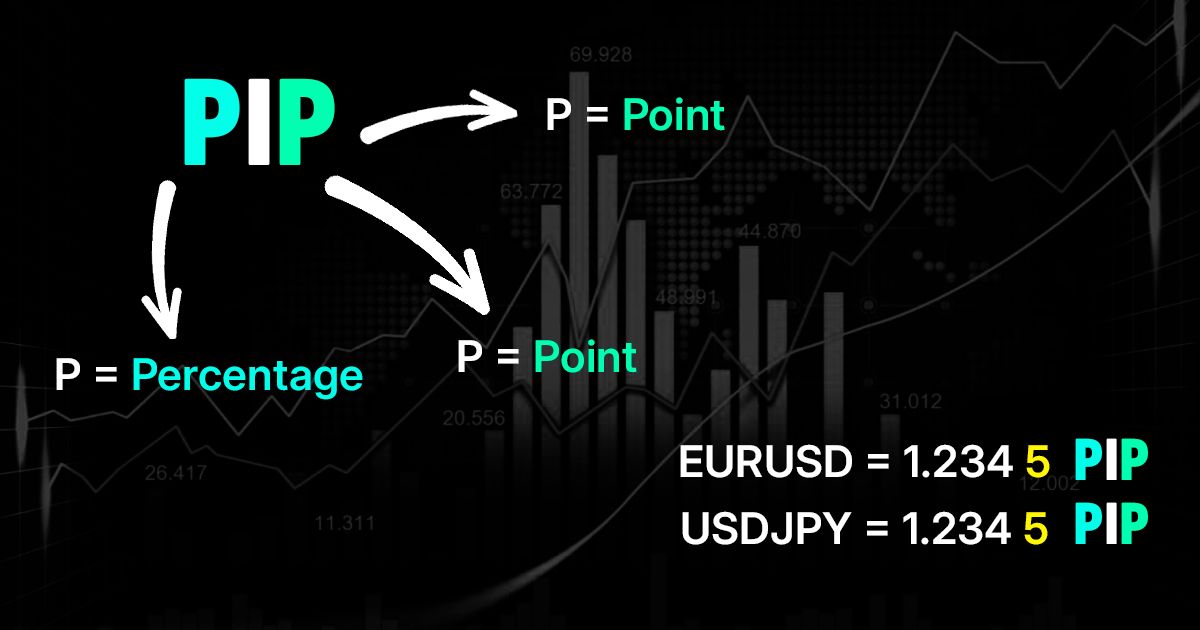
A pip stands for "percentage in point" or "price interest point." It is the standard unit of price movement in currency trading. For most major pairs, a pip sits at the fourth decimal place: a move from 1.1050 to 1.1051 on EUR/USD is exactly one pip.

The one consistent exception is pairs that include the Japanese yen. Because the yen trades at a different scale, one pip on USD/JPY equals 0.01 — the second decimal place, not the fourth. A move from 145.20 to 145.21 is one pip.

Pips vs Ticks — Same Concept, Different Market

The core idea behind pips vs ticks is identical: both represent the smallest standard price movement in their respective markets. The difference is market-specific terminology. Forex traders use pips; futures and stock traders use ticks. You will occasionally see "tick" used in forex platform settings to describe the minimum price increment, which is where confusion starts.

In forex, the pip is standardized by market convention. In futures, the tick size is set by the exchange and printed in the contract specifications. Neither is negotiable — you trade at these increments or not at all.

Pip Value in Practice

Pip value is not a fixed number. It changes based on three factors: the currency pair, the position size, and whether USD is the quote currency. For a standard lot (100,000 units) of EUR/USD where USD is the quote currency, one pip equals approximately $10.00. A mini lot (10,000 units) gives you roughly $1.00 per pip, and a micro lot (1,000 units) gives $0.10.

The pip value formula for pairs where USD is the quote currency:
Become a Confident Trader

Master trading with our structured course designed for beginners and intermediate traders.

Step-by-step lessons
Real strategies
Risk management training

Join 10,000+ traders improving their skills

Start Course Now

Pip Value = (0.0001 / Exchange Rate) x Trade Size

For EUR/USD at 1.0850 trading 100,000 units: (0.0001 / 1.0850) x 100,000 = approximately $9.22 per pip. For USD/JPY the pip is 0.01, so the numerator in the formula changes accordingly. Always recalculate when the exchange rate moves significantly.

Some brokers offer five-decimal pricing, adding a fractional pip called a pipette. One pipette equals one-tenth of a pip. It affects spread display but does not change how standard pip values are calculated.

Key Takeaway: A pip is the forex equivalent of a tick — the minimum standard price move. For most pairs it is 0.0001; for JPY pairs it is 0.01. Pip value per trade depends on lot size and the pair traded, and it shifts as the exchange rate moves. Always calculate pip value in your account currency before entering a position.

What a Point Is and Why the Term Appears in Multiple Markets

The word "point" means different things in different contexts. In futures, a point is a full whole-number price move with a defined dollar value per contract. In stocks, traders say a stock "moved three points" to mean it moved $3.00 per share. In fixed income and interest rate markets, a point has a third meaning that has nothing to do with either of those.

The term is context-dependent. When you hear it, the first question to ask is: which market and which instrument?

Points in Futures vs Points in Stocks

In futures, a point carries a specific dollar value defined by the contract multiplier. One ES point is worth $50.00 per contract. One NQ point is worth $20.00. One CL point is worth $1,000.00. These are fixed numbers.

In equities, a "point" is a shorthand for one dollar of price movement per share. If SPY moves from $520 to $521, stock traders say it moved one point. The dollar value of that move depends on how many shares you hold, not on an exchange-defined multiplier. The two uses of "point" look similar on the surface but function very differently in P&L calculations.

Pip vs Basis Point — Fixed Income and Rate Markets

A basis point (often called a "bip") is a separate unit used in interest rate, bond, and fixed income markets. One basis point equals 0.01%, or one one-hundredth of a percentage point.

When the Federal Reserve raises its benchmark rate from 5.25% to 5.50%, that is a 25 basis point increase. The conversion from basis points to a percentage is straightforward:

Basis Points / 100 = Percentage Change

25 basis points / 100 = 0.25%

A pip and a basis point are not the same thing, though both express small changes. A pip describes exchange rate movement in forex. A basis point describes yield or interest rate movement in bond and rate markets. Mixing them up when trading rate-sensitive instruments like 10-Year Treasury futures (ZN) introduces calculation errors immediately.

Key Takeaway: "Point" is a market-specific term. In futures it has a fixed dollar value per contract. In stocks it means one dollar per share. In rate markets a basis point (0.01%) is the standard unit, not a pip or a futures tick. Checking which definition applies to your instrument is not optional — it changes every number in your trade plan.

Why Getting These Terms Right Affects Your P&L and Prop Evaluation

Misidentifying the unit of price movement on a new contract is one of the most common sizing errors in prop trading evaluations. A trader familiar with ES who opens a CL position and sets a "10-point" stop is not risking $500 per contract. The actual risk is $10,000 per contract — twenty times larger — because one CL point equals $1,000.

This is the practical reason why exchange-defined tick values matter more than the price level you see on screen.

Stop Loss and Target Placement Errors

Most prop trading platforms display stops and targets in points by default. If you set a 5-point stop on NQ without knowing the point value, you are risking $100 per contract (5 x $20.00). The same 5-point stop on CL risks $5,000 per contract. Same number on the screen, completely different outcomes.

The correct process is:

  • Identify the tick size and tick value for your specific contract
  • Decide your maximum dollar risk per trade first
  • Divide that dollar amount by the tick value to get your stop distance in ticks
  • Convert ticks to points if needed for platform entry

Working from dollar risk backward to tick count keeps your sizing accurate regardless of which contract you trade.

How Prop Trading Firms Define P&L Units

At SuperTrade, account performance is tracked in dollars, not in ticks or points. Your drawdown limit and profit target are denominated in USD. That means every trade needs a dollar-based position sizing calculation before entry — the point or pip count alone tells you nothing about whether a trade fits within your account parameters.

Traders who switch between contracts mid-evaluation without recalculating tick values frequently hit their daily loss limit on the very first trade in the new instrument. Verifying the tick value before you trade any new contract takes 30 seconds on the CME Group product page. That 30 seconds protects your entire evaluation.

Key Takeaway: Prop trading evaluations measure performance in dollars. A stop loss that looks identical in points carries completely different dollar risk depending on the contract. Converting your stop and target from points into dollar values before every trade is a non-negotiable part of risk management, especially when moving between instruments.

Key Takeaways: What You Need to Know About Pips, Ticks, and Points

Ticks belong to futures and equity markets; pips belong to forex. Both describe the minimum price increment, but the dollar value attached to each unit varies widely by contract and lot size. Points are a full whole-number move in futures with a fixed exchange-defined dollar value, while basis points are a separate unit used exclusively in rate and bond markets. On ES and NQ, four ticks equal one point. On CL, 100 ticks equal one point. On GC, 10 ticks equal one point. The fastest way to prevent sizing errors is to calculate every stop and target in dollars first, then convert to ticks or pips from there.

Frequently Asked Questions

Disclaimer: This article is for informational purposes only and does not constitute financial advice. Trading involves risk and may result in loss of capital.

Related Articles

The First Move Is Yours

Discover how Supertrade can transform your trading career. Explore challenges, access instant funding, and join a growing community of Supertraders.

Stay Ahead of the Game

Sign up to receive exclusive tips, market insights, and the latest updates from Supertrade. Don’t miss out on opportunities to grow your trading success.
Discord

Our Community

Do not skip any beat.

The Ultimate Trading Community. Join our Discord server to get the latest updates, news and more.

2026 Supertrade. All rights reserved
DiscordInstagramTelegramYouTubeX
Trading involves significant risk. Past performance is not indicative of future results. This is a simulated trading environment. Supertrade provides educational trading services.
Supertrade
Supertrade Ltd, a company incorporated under the laws of Saint Lucia with registered number 2024-00699, located at Ground Floor, Rodney Court Building, Rodney Bay, Gros Islet, Saint Lucia, LC01 101, operates and owns this website, as well as provides services under the Terms and Conditions posted on the website. Supertrade Prop Ltd, a company incorporated under the laws of England and Wales with registered number 16234284, located at 52-56 Standard Road, London, England, NW10 6EU, acting as a payment agent.