

Prop Trading

Jul 21, 2026 - 14 min

●●●Advanced

Prop Firm Taxes and What Every Funded Trader Needs to Know Before Filing

Prop Firm Taxes and What Every Funded Trader Needs to Know Before Filing

Prop firm payouts count as taxable income in every major jurisdiction worldwide. Understanding prop firm taxes before your first payout prevents costly surprises at filing time. Most funded traders do not realize that the IRS classifies their earnings as self-employed income. This guide covers how taxes work in the US, UK, Canada, and Australia, what you can deduct, and how to file correctly.

Evgenij Pakhomov
Reviewed by:
Share

This article provides general tax information for educational purposes only. It is not tax advice. Consult a qualified tax professional for guidance specific to your situation and jurisdiction.

Prop Firm Tax Facts at a Glance

  • The IRS treats prop firm payouts as self-employed income reported on Schedule C. 
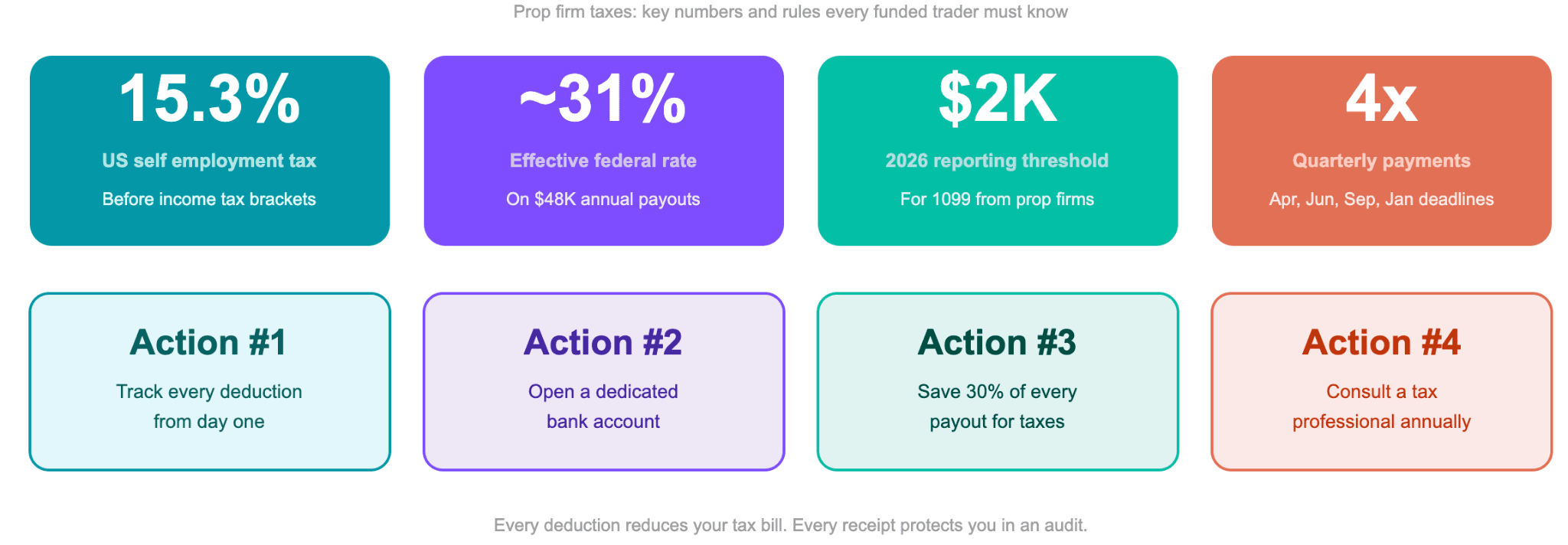
  • Self-employment tax applies when net earnings exceed $400 per year. 
  • For 2026, the 1099 reporting threshold increased from $600 to $2,000. 
  • Funded traders must make quarterly estimated payments to avoid penalties.
  • Tax treatment varies globally. The US classifies payouts as self-employment. The UK classifies them as trading income. Some countries treat them as capital gains.

How the IRS Taxes Prop Firm Payouts
How the IRS Taxes Prop Firm Payouts

The United States taxes prop firm income as self-employment earnings, not as investment gains. This classification carries specific reporting requirements, tax rates, and filing deadlines. Over 60% of search traffic for prop trading taxes comes from US-based traders. Understanding IRS rules is the essential first step for most funded traders.

Why the IRS Treats You as Self-Employed

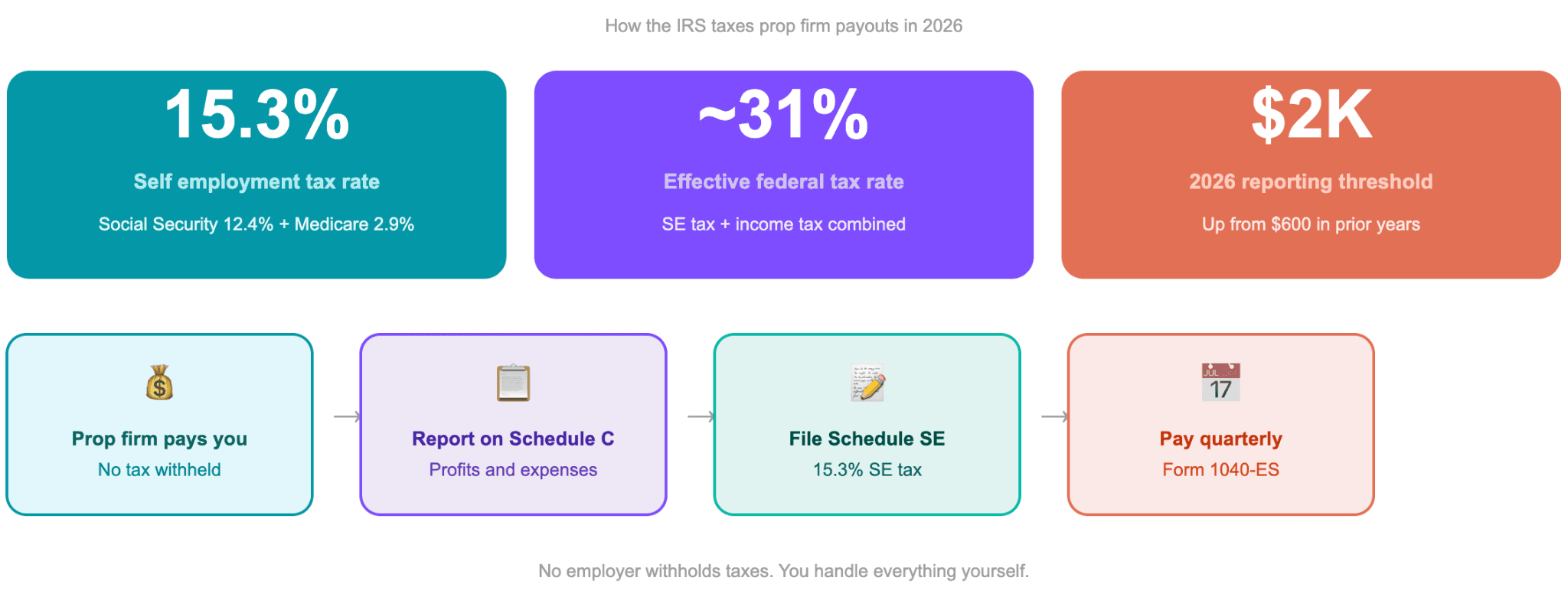
Prop firms do not hire you as an employee. They pay you as an independent contractor for services performed. You receive no W-2 or tax withholding on your payouts. The firm may issue a 1099-NEC or 1099-MISC if your total payouts exceed $2,000 during 2026.

Even without a 1099, all income remains taxable. The IRS requires you to report every dollar you earn, regardless of whether you receive a tax form. Funded trader taxes are reported on Schedule C for profits and on Schedule SE for self-employment tax. 

Self-employment tax equals 15.3% of net earnings. This covers Social Security (12.4%) and Medicare (2.9%). You pay both the employer and employee portions yourself. Regular employees split this cost with their employer. Funded traders pay the full amount.

IRS Topic 429 covers additional rules specific to traders in securities. This includes the mark-to-market election under Section 475(f). Most prop firm traders do not qualify for this election because they trade the firm's capital rather than their personal holdings. Consult a tax professional before making any election.

A Real Tax Calculation With 2026 Numbers

The following example uses simplified 2026 US federal rates for illustration only. State taxes, filing status, and total income affect your actual liability. This is not a substitute for professional tax advice.

LineDescriptionAmount
1Total prop firm withdrawals$48,000
2Deductible business expenses($6,200)
3Net self-employment income$41,800
4Self-employment tax (15.3%)$6,395
5SE tax deduction (50% of line 4)($3,198)
6Adjusted gross income$38,602
7Federal income tax (est. 22% bracket)$8,492
8Total federal tax liability$14,887
9Effective tax rate~31%


This trader keeps approximately $33,113 after federal taxes on $48,000 in payouts. State income taxes range from 0% to 13% depending on the state. A trader in Texas pays no state tax. A trader in California adds roughly 9% more.

The $6,200 in deductions reduced taxable income and saved approximately $1,900 in federal taxes. Every legitimate deduction lowers your bill. Track them from day one.

Quarterly Estimated Payments and How to Avoid Penalties

The IRS requires self-employed individuals to pay estimated taxes four times per year. No employer withholds taxes from your prop firm withdrawals. You handle this yourself.

The four quarterly deadlines are April 15, June 15, September 15, and January 15 of the following year. Missing any deadline triggers underpayment penalties. Use Form 1040-ES to calculate and submit each payment.

The safe harbor rule protects you from penalties in two ways. Pay 100% of your prior-year tax liability in four installments. Or pay 90% of your current year's liability. Either approach avoids penalties regardless of how much you actually owe at the time of filing.

A simple quarterly calculation works for most funded traders—estimate total annual prop firm income. Subtract expected deductions. Multiply by 30% as a conservative tax rate. Divide by four. Adjust each quarter as actual income arrives.

Key takeaway: The IRS classifies prop firm taxes as self-employment income. You pay 15.3% SE tax plus federal income tax at your bracket rate. The effective rate for most funded traders falls between 25% and 35%. Make quarterly estimated payments to avoid penalties. Every deduction reduces your liability directly.
Become a Confident Trader

Master trading with our structured course designed for beginners and intermediate traders.

Step-by-step lessons
Real strategies
Risk management training

Join 10,000+ traders improving their skills

Start Course Now

Prop Firm Taxes Outside the United States

Prop Firm Taxes Outside the United States

Tax rules for funded trader taxes vary significantly by country. The classification of prop firm income determines the applicable rate. Some countries tax payouts as business income at marginal rates. Others may apply lower capital gains rates depending on the specific arrangement.

Tax Treatment by Country

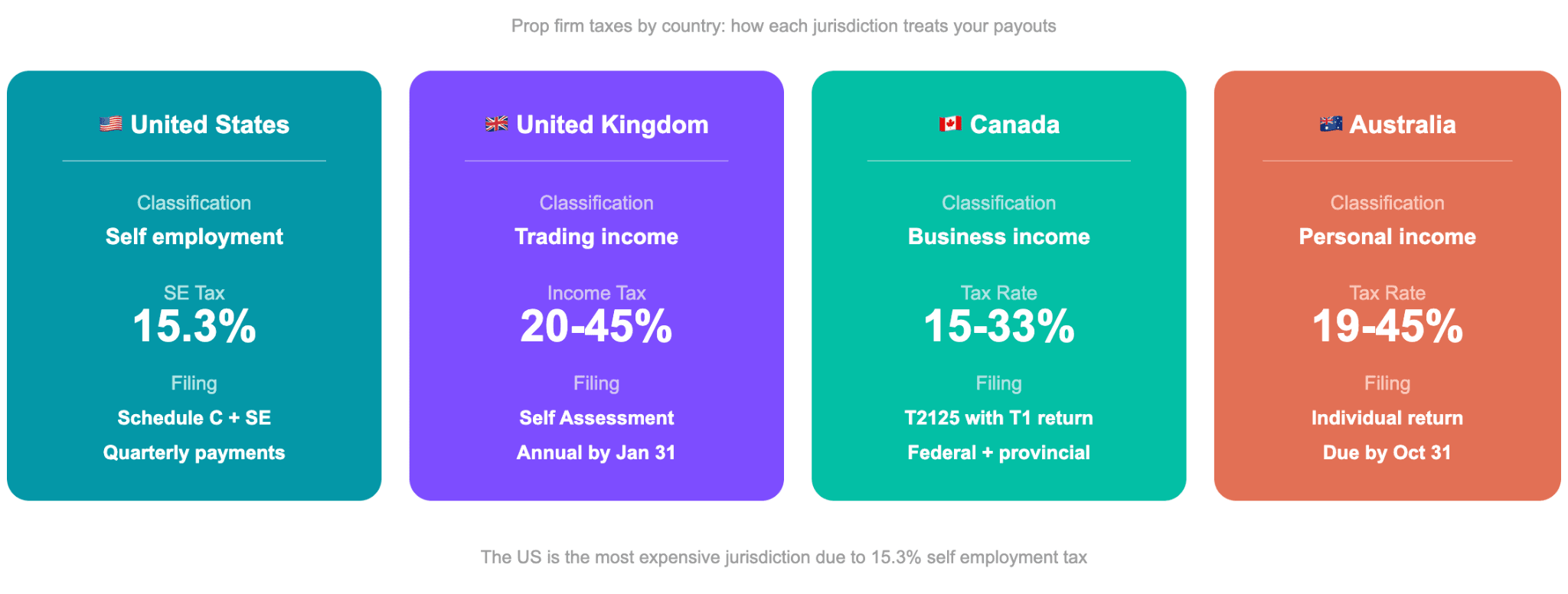
Four major jurisdictions handle prop firm payouts differently. The table below compares the core structure for each.

CountryTax ClassificationKey RateFiling Requirement
United StatesSelf-employment income15.3% SE + income bracketsSchedule C + SE, quarterly
United KingdomTrading income, self-assessed20% to 45% + NICsSelf Assessment by Jan 31
CanadaBusiness incomeFederal + provincial marginalT2125 with T1 return
AustraliaPersonal income, sole trader19% to 45% marginalIndividual tax return by Oct 31

The UK charges no equivalent to the US 15.3% self-employment tax. National Insurance Contributions apply, but at lower rates. UK traders register for Self Assessment and file their tax return annually.

Canada treats prop firm payouts as business income on Form T2125. Federal rates range from 15% to 33% plus provincial taxes. Australia classifies payouts as personal income for sole traders, subject to marginal tax rates up to 45%.

Key Differences That Affect Your Net Income

The biggest variable across countries is the self-employment tax layer. US traders pay 15.3% before income tax even begins. UK, Canadian, and Australian traders avoid that specific charge. This makes the US the most expensive jurisdiction for funded traders at equivalent income levels.

A second variable is the threshold for mandatory reporting. The US requires filing when net SE income exceeds $400. The UK requires registration when self-employment income exceeds £1,000. Canada and Australia require reporting of all business income, regardless of the amount.

A third variable is deduction treatment. The US allows a deduction of 50% of self-employment tax from adjusted gross income. Other jurisdictions do not have this specific mechanism. Each country has its own list of allowable business deductions that funded traders can claim.

Key takeaway: Prop firm taxes vary significantly by country. The US adds a 15.3% self-employment tax that other jurisdictions do not charge. Filing requirements and thresholds differ. Know your country's classification before your first payout arrives. Consult a tax professional familiar with trading income in your specific jurisdiction.

What Funded Traders Can Deduct From Prop Firm Profits

What Funded Traders Can Deduct From Prop Firm Profits

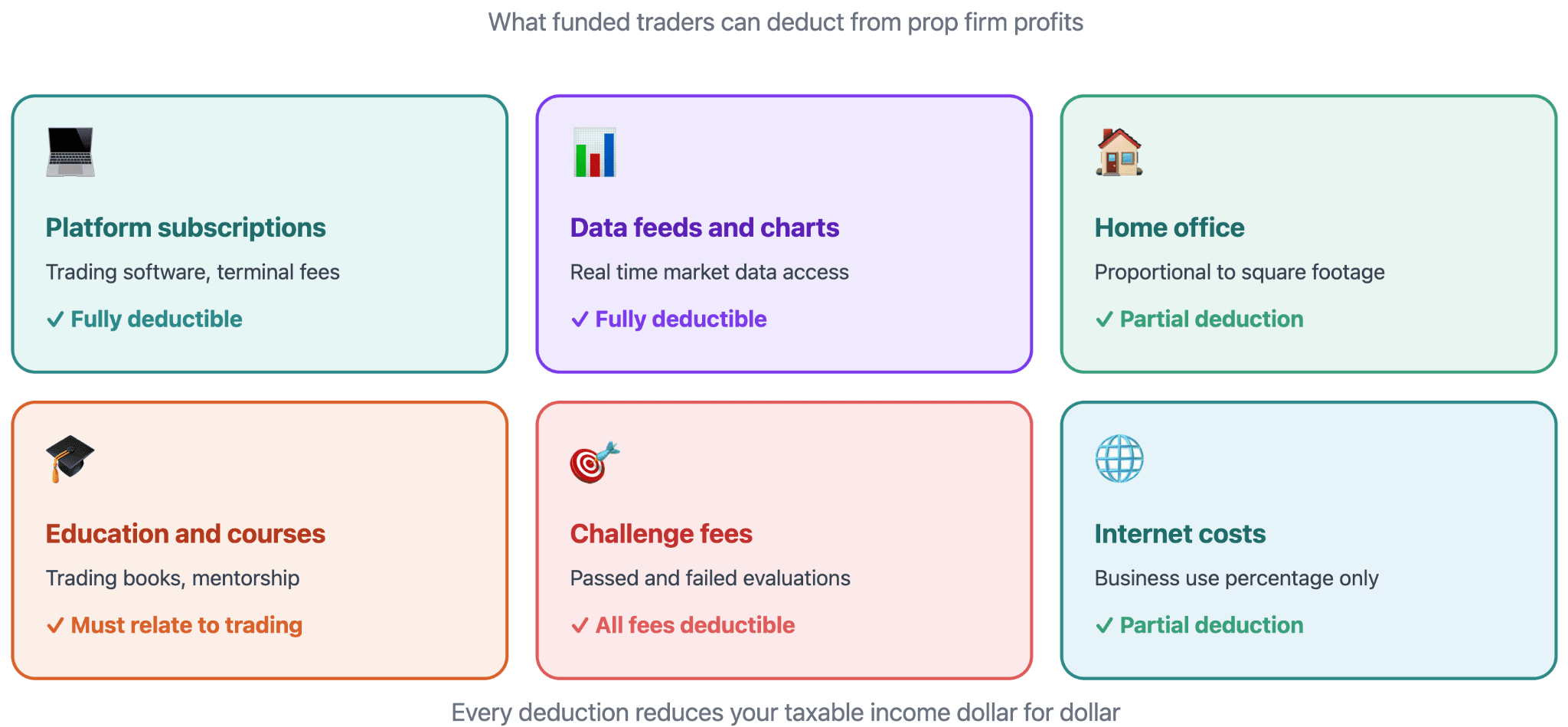
Every legitimate business expense reduces your taxable income dollar for dollar. Most funded traders miss deductions because they do not track expenses from day one. Bookkeeping starts when you buy your first evaluation, not when you file your taxes.

Deductions Every Funded Trader Should Track

IRS Publication 334 covers deductible business expenses for sole proprietors. The following expenses typically qualify for funded traders.

  • Platform and software subscriptions
  • Data feeds and charting tools
  • Home office (proportional square footage)
  • Internet (business use percentage)
  • Trading education and courses
  • Evaluation and challenge fees

Challenge fees deserve special attention—every evaluation fee you paid counts as a business expense. Failed evaluations are deductible too. A trader who spent $1,500 on five evaluations before passing deducts the full $1,500 against prop firm profits. This reduces taxable income directly.

Trading education includes courses, books, and mentorship programs related to your trading activity. General "get rich" courses without specific trading content do not qualify. The expense must relate directly to your trade or business.

Record Keeping That Protects You at Tax Time

The IRS requires you to keep records supporting every deduction for at least 3 years from the filing date. (https://www.irs.gov/publications/p334) Missing documentation means lost deductions and potential audit complications.

Build a simple bookkeeping system from your first trading day. Track four categories consistently throughout the year.

  • Every payout date and amount
  • Every withdrawal from the platform
  • Every deductible expense with a receipt
  • Every challenge fee paid with confirmation

A spreadsheet works for most funded traders. Dedicated bookkeeping software, such as QuickBooks Self-Employed or Wave, adds automation. The key is consistency, not complexity. Enter expenses weekly, not annually.

Separate your trading income from personal finances completely. Open a dedicated bank account for all prop firm withdrawals and deductible expenses. This creates a clean audit trail and significantly simplifies tax preparation.

Save every receipt digitally. Take photos or scan paper receipts immediately. Store them in a cloud folder organized by month. Three years of organized records protect you from any audit questions the IRS or your local tax authority can ask.

Key takeaway: Every challenge fee, platform subscription, and home office cost directly reduces your prop firm taxes. Track deductions from day one using a spreadsheet or bookkeeping software. Keep all receipts for at least 3 years. A dedicated bank account separates trading income from personal finances and simplifies filing.

Final Words On Prop Firm Taxes

Final Words On Prop Firm Taxes

Prop firm taxes apply to every funded trader in every jurisdiction. The IRS classifies payouts as self-employment income, subject to the 15.3% SE tax plus income tax brackets. The effective rate for most funded traders falls between 25% and 35%. 

UK, Canadian, and Australian traders face different structures, but all must report prop firm income. Deductions reduce your bill dollar for dollar. Track every expense from day one. Make quarterly estimated payments in the US to avoid penalties. Consult a qualified tax professional before filing.

Frequently Asked Questions

Disclaimer: This article is for informational purposes only and does not constitute financial advice. Trading involves risk and may result in loss of capital.

Related Articles

The First Move Is Yours

Discover how Supertrade can transform your trading career. Explore challenges, access instant funding, and join a growing community of Supertraders.

Stay Ahead of the Game

Sign up to receive exclusive tips, market insights, and the latest updates from Supertrade. Don’t miss out on opportunities to grow your trading success.
Discord

Our Community

Do not skip any beat.

The Ultimate Trading Community. Join our Discord server to get the latest updates, news and more.

2026 Supertrade. All rights reserved
DiscordInstagramTelegramYouTubeX
Trading involves significant risk. Past performance is not indicative of future results. This is a simulated trading environment. Supertrade provides educational trading services.
Supertrade
Supertrade Ltd, a company incorporated under the laws of Saint Lucia with registered number 2024-00699, located at Ground Floor, Rodney Court Building, Rodney Bay, Gros Islet, Saint Lucia, LC01 101, operates and owns this website, as well as provides services under the Terms and Conditions posted on the website. Supertrade Prop Ltd, a company incorporated under the laws of England and Wales with registered number 16234284, located at 52-56 Standard Road, London, England, NW10 6EU, acting as a payment agent.