

Technical Analysis

Jul 7, 2026 - 7 min

●●Intermediate

What the Exponential Moving Average Is and How to Trade With It

What the Exponential Moving Average Is and How to Trade With It

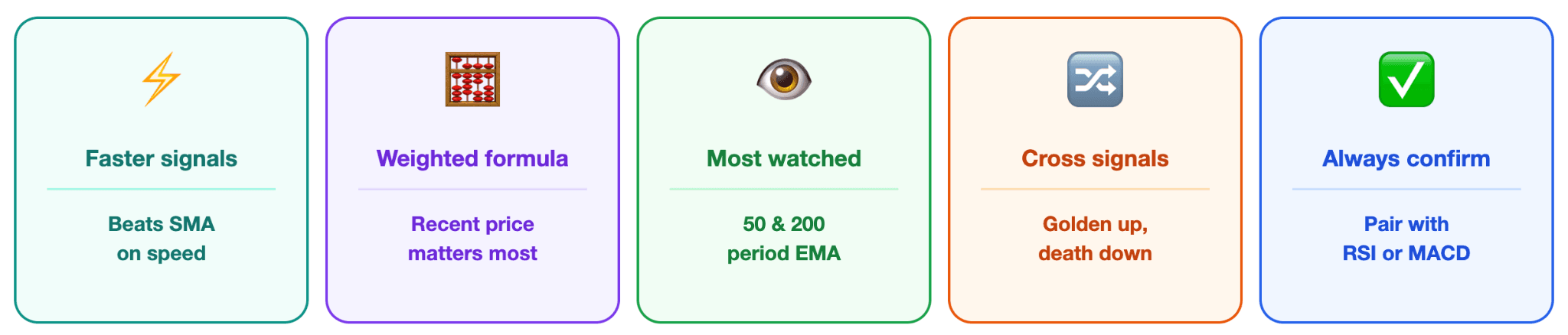
The EMA is a moving average that gives more weight to recent prices and responds more quickly to market changes. The exponential moving average helps traders spot trend shifts before slower indicators do. This guide covers the formula, the key periods, and crossover strategy methods you can apply right now.

Evgenij Pakhomov
Reviewed by:
Share

Key Facts on EMA

  • The EMA applies a smoothing multiplier of 2 divided by (periods + 1), giving recent prices more weight. 
  • The 12- and 26-period EMAs form the basis of the MACD indicator used by traders worldwide
  • The 50- and 200-period EMAs are the most-watched moving averages among institutional desks. 
  • The S&P 500 trades above both its 50-day and 200-day EMAs as of June 2026
  • EMA reacts faster than SMA because older data points carry exponentially less weight over time.

What Does EMA Mean and How the Indicator Works

This technical tool calculates a weighted average that puts more emphasis on the latest price data. EMA's meaning comes down to one principle. The most recent price carries the heaviest weight, and older prices fade over time. That structure makes the EMA indicator faster than the simple moving average at detecting new trend direction.

EMA Meaning and the Formula Behind It
EMA Meaning and the Formula Behind It

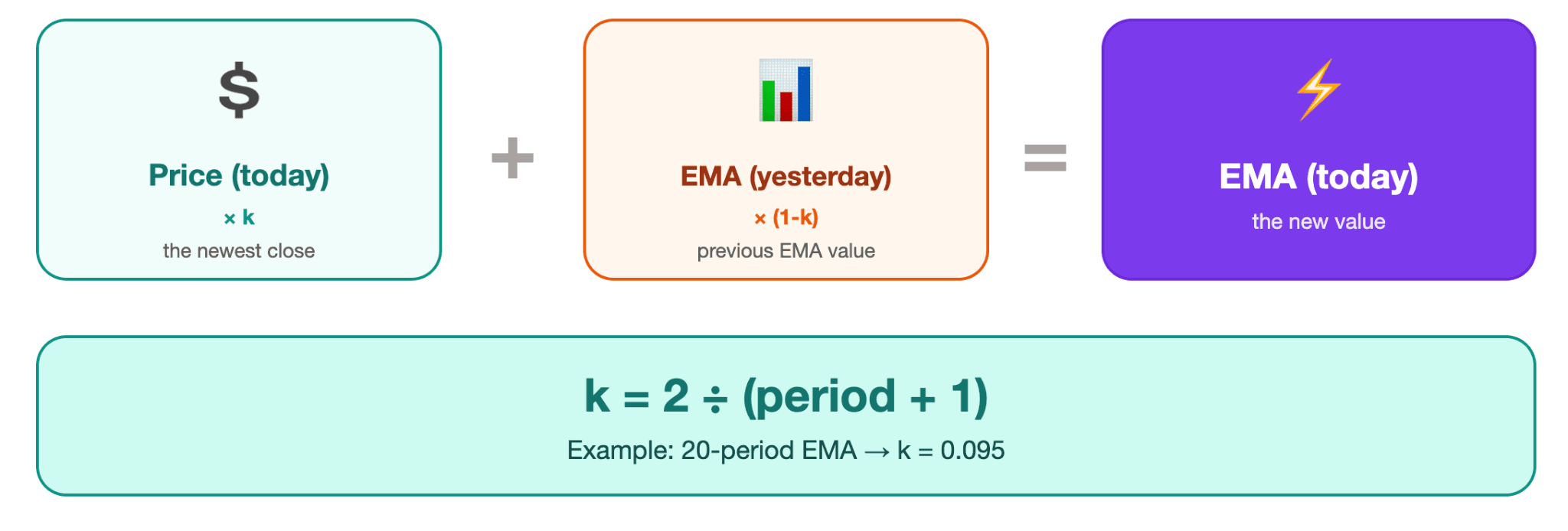
A simple moving average treats every price equally across the full period. The exponential moving average formula changes that by applying a smoothing multiplier to the most recent closing price.

The multiplier equals 2 divided by (number of periods plus 1). For a 20-period EMA, the multiplier is 2/21. That gives a value of 0.095.

The calculation then works as a recursive process. Multiply today's closing price by 0.095. Then add yesterday's EMA multiplied by (1 minus 0.095). The result is today's EMA value.

This recursive structure means every past price still contributes to the average. But each older price carries exponentially less influence than the one before it. That is the core logic behind the name "exponential."

“You do not need to run this formula manually. Every trading platform calculates it automatically in real time. Understanding the logic matters more than memorizing the math behind it.”

EMA vs SMA Key Differences

The EMA vs SMA comparison helps determine which moving average fits your trading approach. Both smooth out price noise, but they respond very differently under live market conditions.
Become a Confident Trader

Master trading with our structured course designed for beginners and intermediate traders.

Step-by-step lessons
Real strategies
Risk management training

Join 10,000+ traders improving their skills

Start Course Now
FeatureEMA SMA
WeightMore on recent pricesEqual across all prices
SpeedFaster reaction to changesSlower and more stable
Best forShort-term trend shiftsLong-term trend confirmation
LagLess lagMore lag

The EMA follows price action more closely than the SMA. That speed gives traders an edge in fast markets. But it also creates more false signals when markets trade sideways without a clear trend.

The SMA provides a smoother line that filters out daily noise. It reacts late to reversals, which means it confirms trends rather than catching them early.

Key takeaway: The exponential moving average applies a multiplier to give recent prices more influence than older data. The formula uses a recursive calculation that exponentially fades older prices. Compared to the SMA, the EMA reacts faster but produces more noise in choppy markets. Choose EMA for speed and SMA for stability, depending on your strategy.

How to Trade With the EMA and Which Periods to Use

How to Trade With the EMA and Which Periods to Use

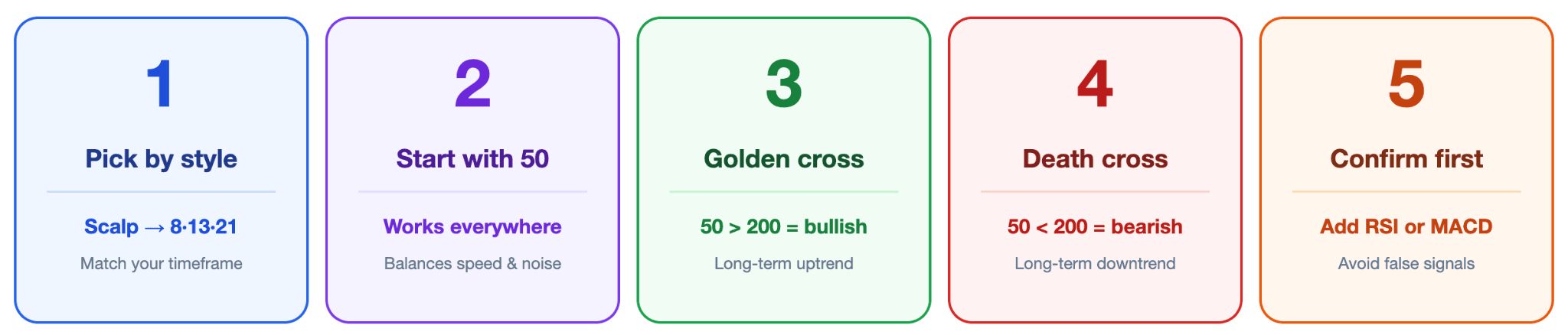
The right EMA period depends on your trading style and the chart timeframe you watch. Short-term traders need fast EMAs that react to intraday moves. Long-term position traders need slower EMAs that confirm major structural trends. Matching the period to your style is more important than picking a "best" number.

Which EMA Period Fits Your Trading Style

Each trading style corresponds to a different set of EMA periods. The table below maps four styles to their most effective settings and chart timeframes.

StyleEMA PeriodsChart Timeframe
Scalping8, 13, 211 min to 15 min
Day trading9, 20, 5015 min to 1 hour
Swing trading20, 50, 1004 hours a day
Position trading50, 100, 200Daily and weekly

The 50-period EMA works across almost every style and timeframe. It balances responsiveness with noise reduction effectively. Start with the 50 EMA and add a faster or slower period based on your results over 30 or more trades.

The EMA Crossover and Golden Cross Strategy

The crossover strategy generates a signal when two EMAs of different periods cross each other. This is one of the most widely followed methods in technical analysis across all asset classes.

A Golden Cross forms when the 50-period EMA crosses above the 200-period EMA. This pattern signals the beginning of a potential long-term uptrend. A Death Cross forms when the 50-period drops below the 200-period. This pattern warns of a potential downtrend.

The S&P 500 trades above both its 50-day and 200-day EMA s as of June 2026. Both averages act as dynamic support levels as long as the index holds above them.

Crossovers perform best in trending markets with clear directional momentum. In choppy sideways conditions, they produce false signals that lead to losing trades. Combine the EMA crossover with RSI or MACD to filter your entries and reduce false triggers.

The 12- and 26-period EMAs power the MACD indicator itself. When the MACD line confirms the crossover direction, the signal becomes more reliable for your entry.

Key takeaway: Match your EMA periods to your trading style and chart timeframe. The Golden Cross and Death Cross use the 50- and 200-period EMAs to flag major trend shifts. Crossovers work best in trending markets with momentum behind them. Filter every signal with RSI or MACD to avoid false entries in sideways price action.

Final Words On the Exponential Moving Average

Final Words On the Exponential Moving Average

The exponential moving average gives more weight to recent prices and reacts faster to market changes than the SMA. The formula applies a smoothing multiplier that fades older data exponentially with each new period. The 50- and 200-period EMAs are among the most tracked levels across global markets. 

Crossover strategies generate clear buy and sell signals but need confirmation from momentum tools like RSI or MACD. Select your EMA periods based on your own trading style, not on what looks popular online.

Frequently Asked Questions

Disclaimer: This article is for informational purposes only and does not constitute financial advice. Trading involves risk and may result in loss of capital.

Related Articles

The First Move Is Yours

Discover how Supertrade can transform your trading career. Explore challenges, access instant funding, and join a growing community of Supertraders.

Stay Ahead of the Game

Sign up to receive exclusive tips, market insights, and the latest updates from Supertrade. Don’t miss out on opportunities to grow your trading success.
Discord

Our Community

Do not skip any beat.

The Ultimate Trading Community. Join our Discord server to get the latest updates, news and more.

2026 Supertrade. All rights reserved
DiscordInstagramTelegramYouTubeX
Trading involves significant risk. Past performance is not indicative of future results. This is a simulated trading environment. Supertrade provides educational trading services.
Supertrade
Supertrade Ltd, a company incorporated under the laws of Saint Lucia with registered number 2024-00699, located at Ground Floor, Rodney Court Building, Rodney Bay, Gros Islet, Saint Lucia, LC01 101, operates and owns this website, as well as provides services under the Terms and Conditions posted on the website. Supertrade Prop Ltd, a company incorporated under the laws of England and Wales with registered number 16234284, located at 52-56 Standard Road, London, England, NW10 6EU, acting as a payment agent.