What Is a Stock Buyback and What Does It Mean for Your Shares
When a profitable company has more cash than it knows what to do with, it faces a real choice. What is a stock buyback in that context? A company enters the market and buys back its own shares from investors. Fewer shares in circulation means each remaining share is worth more. This article breaks down the 2026 mechanics, the real reasons companies do it, and the three ways it goes wrong.
A share repurchase is exactly what it sounds like: the company purchases its own stock in the open market. The purchased shares get retired or held as treasury stock. The share count drops. Every remaining share now represents a bigger slice of the same company.
The Share Repurchase Mechanics Step by Step
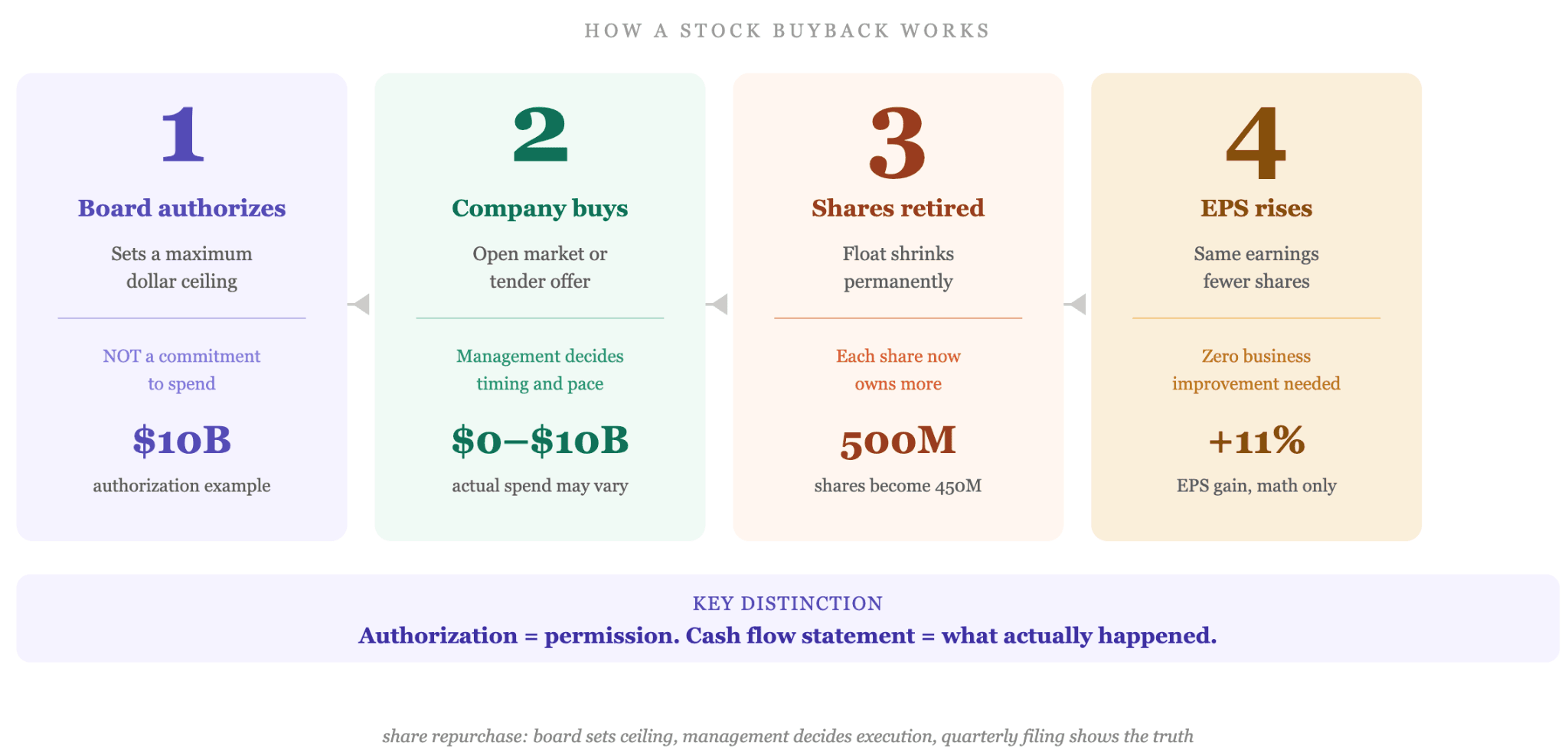
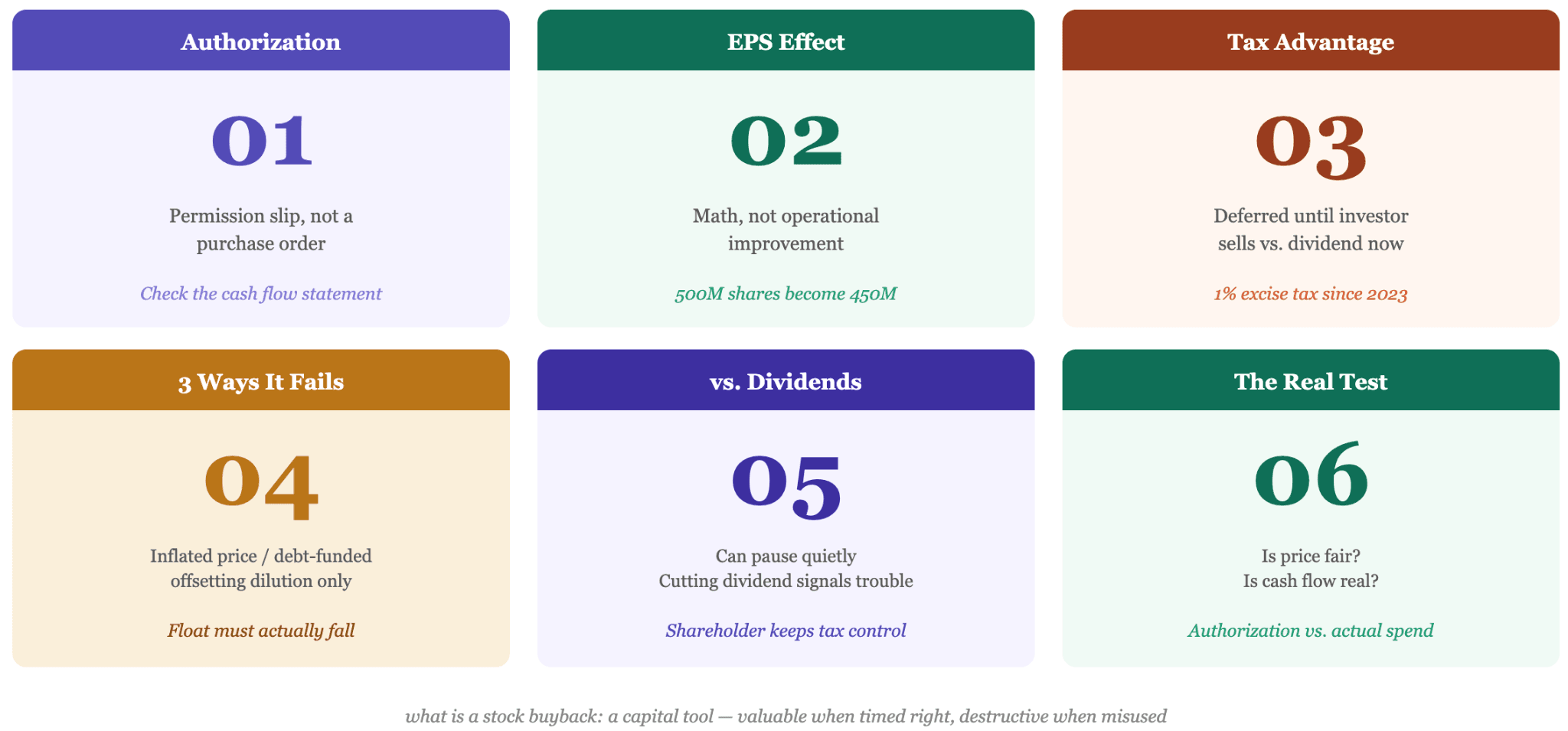
The board authorizes a maximum repurchase amount. That is the ceiling. Management then decides when to buy, how much to spend, and at what price. They are under no obligation to use the full authorization. If the stock runs up, they can wait. If it drops, they can accelerate.
Two methods exist to execute a repurchase:
Open-market repurchase: buys at market price
Tender offer: fixed price above market
Open-market repurchases dominate. The company enters the market like any other buyer, with full flexibility to time its purchases around price movements. A tender offer is different: the company names a specific price above the current market rate, sets a deadline, and shareholders choose whether to tender their shares. Tender offers move faster but cost more.
Buyback Authorization vs Actual Execution
Here is what most investors miss. A buyback announcement is a permission slip, not a purchase. Apple authorizes $110 billion, and the headline writers run with it. But the actual spend shows up in the cash flow statement of the next quarterly filing, not in the press release.
Management can slow down, pause, or walk away from an authorization entirely.
No rule forces execution. A company that announces a $5 billion buyback and spends $800 million has not lied. It used its discretion. Track the shares outstanding line in quarterly filings. That number does not lie.
"An authorization tells you what management is allowed to do. The cash flow statement tells you what they actually did. Those two numbers are often very different."
Key takeaways: A stock buyback retires shares, shrinking the float and increasing each shareholder's ownership percentage. The board sets a ceiling. Management decides the pace. Press releases announce authorizations. Quarterly filings show actual repurchases. Read the filing, not the headline.
Why Would a Company Buy Back Stock
Become a Confident Trader
Master trading with our structured course designed for beginners and intermediate traders.
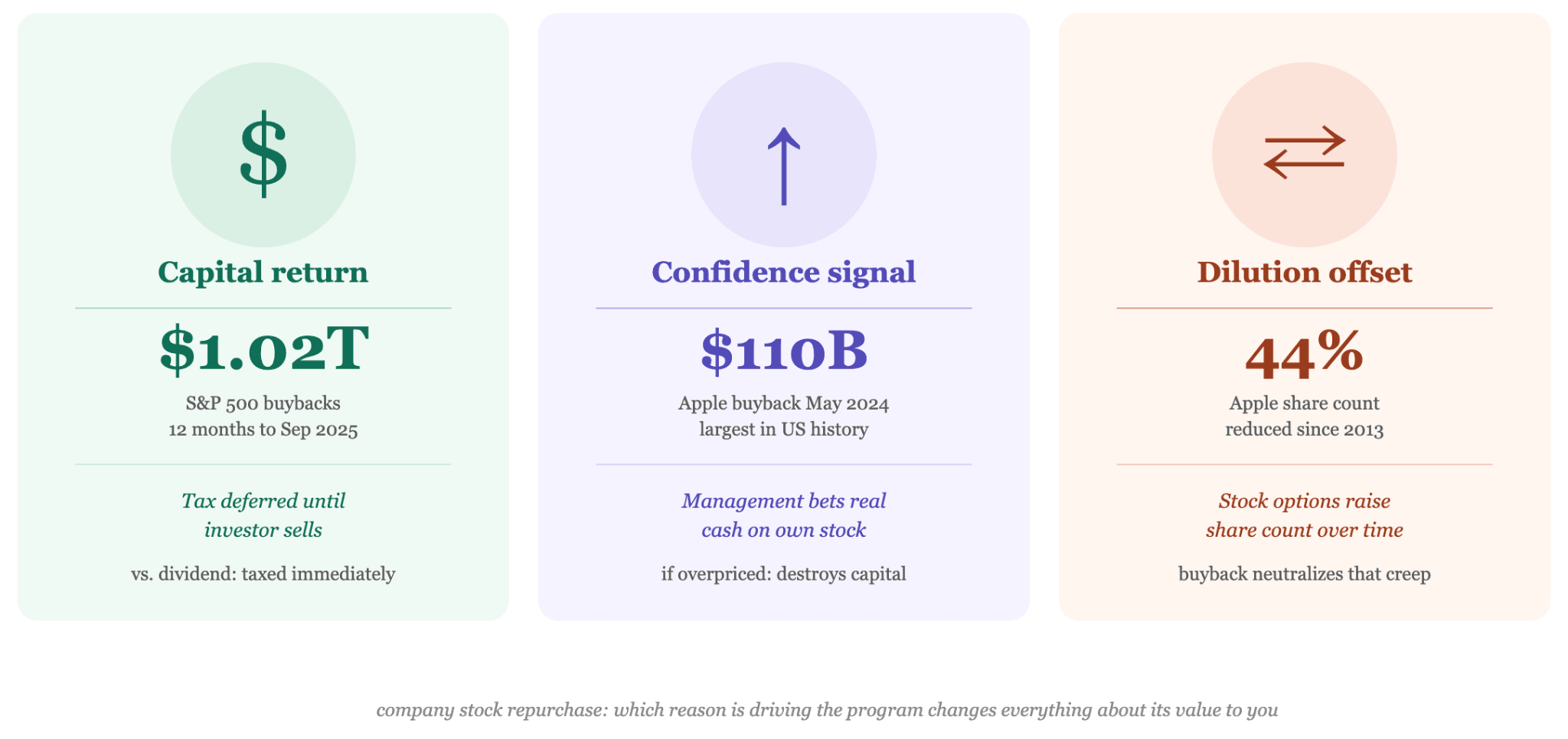
The textbook answer is capital return. The real picture is more complicated. A company might buy back stock because it genuinely believes the shares trade below fair value. It might do it to offset the dilution caused by handing stock to executives. It might do so because interest rates are low, allowing it to borrow cheaply to reduce its float. Which of those is true in a specific case changes everything about how you read the program.
Returning Capital More Efficiently Than Dividends
A dividend and a buyback both move cash from the company to shareholders. The mechanics are different enough to matter.
Factor
Share Buyback
Dividend
Tax for investor
Deferred until shares are sold
Taxable when received
Company flexibility
Can pause or cancel at any time
Cutting signals financial stress
EPS effect
Increases earnings per share
No direct EPS effect
Shareholder choice
An investor decides whether to sell
All shareholders receive cash
Signal
Management sees a stock as undervalued
A company has a predictable cash flow
With a buyback, you only owe tax when you sell. That is a real advantage over dividends, which create a tax bill whether you want the cash or not. It also gives the company a way out: pausing a buyback is quiet. Cutting a dividend is a public statement that something went wrong.
Signaling Confidence and Offsetting Dilution
When management spends corporate cash on its own stock, it makes a bet with real money that the shares are cheap. That is the signal. If they thought the stock was overpriced, buying it back would destroy value, and they know it.
The less glamorous use case is dilution offset. Every stock option and restricted stock unit a company grants to employees increases the share count. Left unmanaged, that creep erodes existing shareholders' ownership over time. A buyback removes those shares, keeping the count flat or falling.
"A buyback that only offsets dilution returns nothing to outside shareholders. A buyback that actually reduces the float, done at a fair price, is one of the most effective capital allocation tools in finance."
Key takeaways: Companies use buybacks to return cash more tax-efficiently than dividends, to signal that management thinks the stock is undervalued, and to neutralize dilution from employee stock awards. The reason behind a specific program changes its value to you as an investor.
How Buybacks Affect EPS, Valuation, and Share Price
A company's stock repurchase automatically increases EPS. That is arithmetic, not performance. The risk is that investors confuse the two.
The EPS Effect With Real Numbers
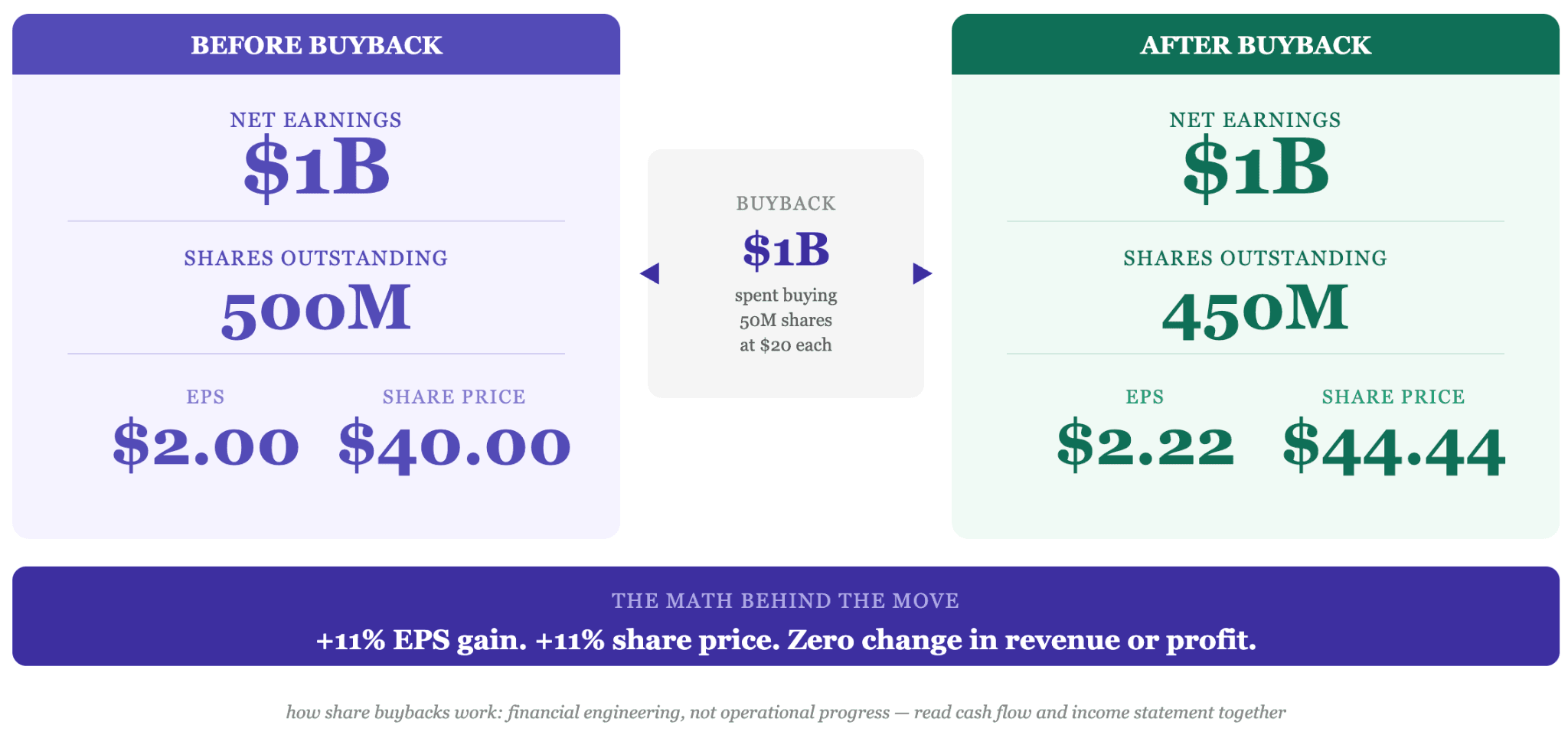
Take a company earning $1 billion a year with 500 million shares outstanding. EPS is $2.00. It spends $1 billion buying back 50 million shares at $20 each. Share count drops to 450 million. EPS rises to $2.22. That is an 11% jump. Revenue did not change. Margins did not improve. The business is identical.
If the market keeps the same P/E multiple of 20, the share price climbs from $40.00 to $44.44. The company engineered a price increase through financial structure. The cash flow statement shows the $1 billion leaving the business. The income statement shows only the cleaner EPS. You need both to know what actually happened.
When Buybacks Destroy Value Instead of Creating It
Three situations make a share repurchase a bad trade. Ensure to remember them, especially if you’re about to analyze a company's stocks to buy:
Buying above intrinsic value: destroys capital
Debt-funded programs: dangerous when rates rise
Offsetting dilution only: float never actually falls
The Inflation Reduction Act of 2022 added a 1% excise tax on net buybacks by US public companies, effective January 1, 2023, per the US Department of the Treasury. That tax does not kill a well-timed buyback at a fair price. It does make an overpriced, debt-funded buyback meaningfully worse. S&P Dow Jones Indices data shows the tax cut Q4 2024 S&P 500 operating earnings by 0.37%. At a trillion dollars in annual buyback volume, that drag adds up fast.
Key takeaways: Buybacks lift EPS by shrinking the share count, not by growing the business. An 11% EPS gain from a 10% share reduction is math, not progress. Buybacks go wrong at inflated prices, with borrowed money, or when the whole program just papers over executive stock grants without reducing the actual float.
Summary
What is a stock buyback comes down to this: a company spending its cash to buy its own shares. Done right, it creates real value for shareholders who stay invested. Done wrong, it burns capital, inflates debt, and flatters EPS numbers that do not reflect business performance. The authorization number is not the story. The cash flow statement is.
The 2024 buyback figure was 18.5% higher than 2023, per S&P Dow Jones Indices. The Q1 2025 record came in 23.9% above the same quarter a year before. For the 12 months ending September 2025, S&P 500 companies spent $1.020 trillion on buybacks versus $664.9 billion on dividends, per S&P Dow Jones Indices. Buybacks outpaced dividends by more than $355 billion over that period.
Frequently Asked Questions
Disclaimer: This article is for informational purposes only and does not constitute financial advice. Trading involves risk and may result in loss of capital.
Discover how Supertrade can transform your trading career. Explore challenges, access instant funding, and join a growing community of Supertraders.
Stay Ahead of the Game
Sign up to receive exclusive tips, market insights, and the latest updates from Supertrade. Don’t miss out on opportunities to grow your trading success.
Our Community
Do not skip any beat.
The Ultimate Trading Community. Join our Discord server to get the latest updates, news and more.
Trading involves significant risk. Past performance is not indicative of future results. This is a simulated trading environment. Supertrade provides educational trading services.
Supertrade Ltd, a company incorporated under the laws of Saint Lucia with registered number 2024-00699, located at Ground Floor, Rodney Court Building, Rodney Bay, Gros Islet, Saint Lucia, LC01 101, operates and owns this website, as well as provides services under the Terms and Conditions posted on the website. Supertrade Prop Ltd, a company incorporated under the laws of England and Wales with registered number 16234284, located at 52-56 Standard Road, London, England, NW10 6EU, acting as a payment agent.

 En
En Es
Es