

Fundamental Analysis

May 21, 2026 - 10 min

●●●Advanced

Black Swan Events in Finance: What They Are, How They Hit Markets, and What Traders Do Next

Black Swan Events in Finance: What They Are, How They Hit Markets, and What Traders Do Next

Markets move on information. But some events arrive with no warning and no precedent. A black swan event is a shock that no model catches before it lands. This article breaks down what defines these rare events, how they move markets, and how traders prepare.

Justin Freeman
Reviewed by:
Share

Black Swan Events at a Glance: Key Facts Every Trader Should Know

The core data before reading further:

  • The Dow Jones fell 22.6% in a single day on October 19, 1987
  • The S&P 500 dropped 57% from peak to trough during the 2008 crisis
  • Brexit erased over $3 trillion in global market value in two trading sessions
  • The S&P 500 fell 34% in 33 days during the COVID crash of 2020
  • The NASDAQ took 13 years to recover its dot-com bubble peak
  • Nassim Taleb introduced the concept in his 2007 book "The Black Swan"

Each number marks a moment where standard risk models got it completely wrong.

What Is a Black Swan Event
What Is a Black Swan Event

A black swan event sits far outside what any model or institution expects. It lands with consequences large enough to reshape entire systems. Nassim Nicholas Taleb argued in his 2007 book that markets consistently underestimate extreme outcomes. He was a former Wall Street trader. You cannot rely on historical data to prepare for events without historical precedent.

"Most risk models assume tomorrow will resemble yesterday. Black swans exist precisely because that assumption is wrong."

The Three Defining Characteristics

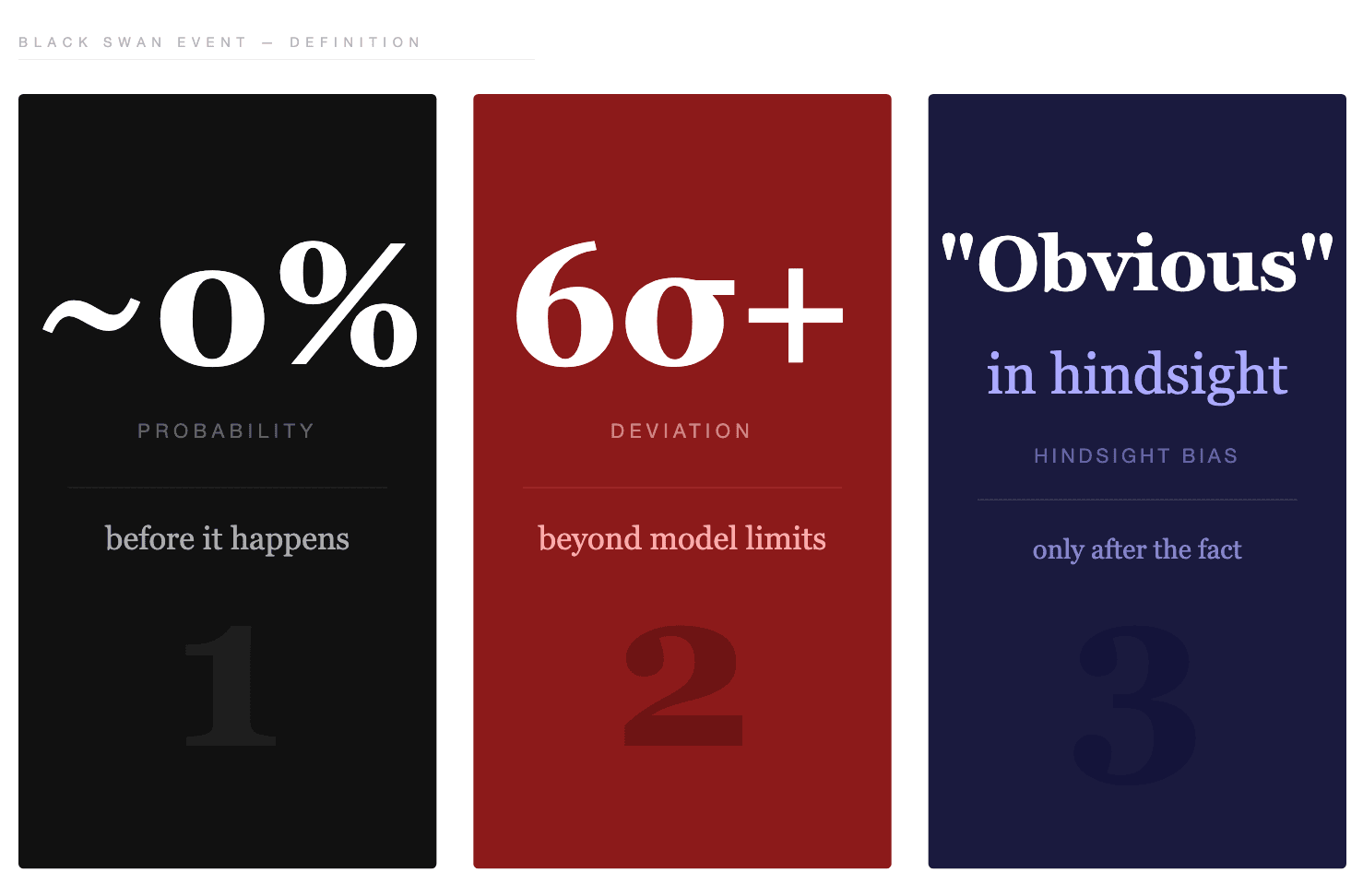
Taleb identified three features that separate a true black swan from an ordinary market shock. Every confirmed black swan event shares all three:

  • Extreme rarity before it happens
  • Catastrophic impact when it lands
  • Obvious explanation only in hindsight

The third point is where traders get hurt twice. First, the event destroys value. Then, experts explain why it was inevitable all along. That narrative creates false confidence that the next shock will arrive with warning. It will not.

Black Swan vs Grey Swan vs White Swan

Not every unexpected event qualifies as a black swan. The distinction shapes how you build a risk strategy. A grey swan is a low-probability event that analysts can at least imagine. Major earthquakes, cyberattacks, or regional banking failures all qualify. A white swan is a near-certain event that most people ignore because the timing remains unclear. 

Taleb argued COVID-19 was a white swan. Virologists had warned of exactly this type of pandemic for years. A black swan sits entirely outside what any model or prior experience can anticipate.

Why Normal Distribution Models Miss Extreme Events

Standard financial models assume returns follow a bell curve. Under that assumption, a six-standard-deviation move should rarely occur in a human lifetime. Markets produce those moves regularly. Financial returns follow fat-tailed distributions. 

“Extreme outcomes appear far more often than a normal curve predicts.” 

Taleb described this as the difference between Mediocristan, where averages dominate, and Extremistan, where single rare events drive total outcomes. Gaussian models leave you blind to the events that matter most.

Key takeaway: A black swan is an event that existing models cannot assign a meaningful probability to. Grey and white swans carry different risk profiles you can plan for. Black swans require a fundamentally different approach.

Black Swan Event Examples That Reshaped Financial Markets
Black Swan Event Examples That Reshaped Financial Markets

The history of markets includes a small number of events that fall into a different category from ordinary crashes. Each black swan event example below permanently changed how traders, regulators, and institutions think about risk. Speed, scale, and source of shock exceeded anything markets had priced in.

Black Monday 1987: 22.6% in One Day

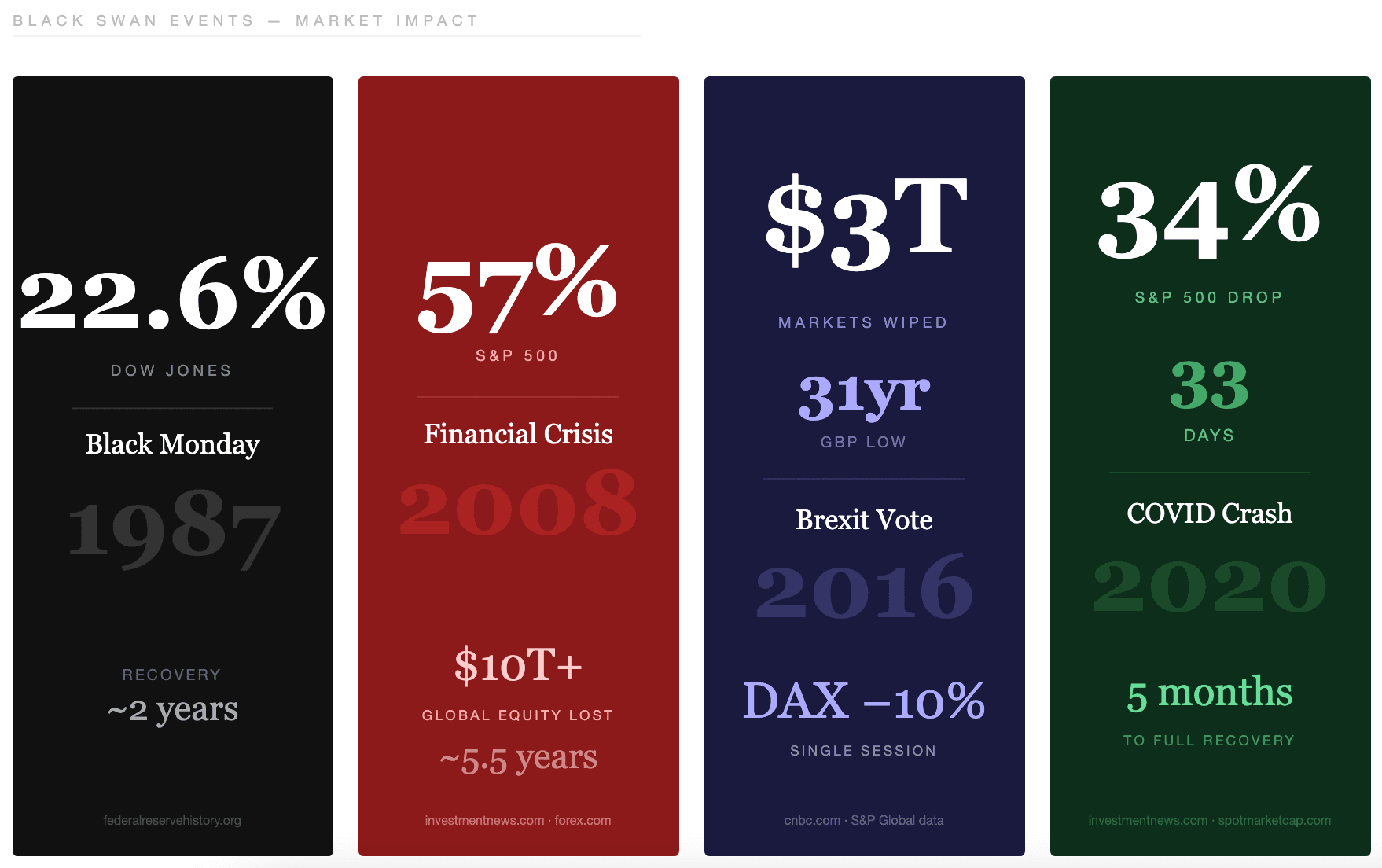
On October 19, 1987, the Dow Jones Industrial Average fell 22.6%. That remains the largest single-day percentage drop in its history. The NYSE lost over $500 billion in market capitalization that session. 
Become a Confident Trader

Master trading with our structured course designed for beginners and intermediate traders.

Step-by-step lessons
Real strategies
Risk management training

Join 10,000+ traders improving their skills

Start Course Now

London's FTSE 100 fell 25% across the next four days. Tokyo's Nikkei dropped 13.2%. Trading halted simultaneously on the Chicago Board Options Exchange and the Chicago Mercantile Exchange. The Federal Reserve injected liquidity to prevent a freeze in credit markets. Recovery took approximately two years.

The 2008 Global Financial Crisis

The US housing market collapse triggered the deepest global financial crisis since the Great Depression. The S&P 500 fell 57% from its October 2007 peak to its March 2009 low. Global equity markets lost over $10 trillion in value. US unemployment doubled to over 10%. 

GDP declined 4.3%. Banks used historical data to rate securities. That data contained no precedent for a nationwide housing price collapse. When defaults accelerated, every model failed at scale. Recovery took 5.5 years.

Brexit 2016 and the COVID-19 Crash 2020

The UK voted to leave the EU on June 23, 2016. Markets had priced in a Remain outcome. The British pound fell to a 31-year low. Worldwide markets lost over $3 trillion in paper wealth over two trading sessions, according to S&P Global data. Germany's DAX fell 10% in a single session. Spain's IBEX and Italy's FTSE MIB each fell by more than 12%.

Four years later, the S&P 500 fell 34% in 33 days. That run from February 19 to March 23, 2020, stands as the fastest drawdown in modern market history. By August 2020, five months later, the index had fully recovered and set new highs.

Comparison table: Major Black Swan events and the market impact they deliver:

EventMarket DropEstimated LossRecovery Time
Black Monday 1987Dow: 22.6% in one day$500B+ NYSE cap~2 years
Financial Crisis 2008S&P 500: down 57%$10T+ global equities~5.5 years
Brexit 2016GBP: 31-year low, DAX: 10%$3T+ paper wealthWeeks to months
COVID-19 Crash 2020S&P 500: 34% in 33 daysTrillions across assets~5 months

Sources: FED, CNBC

Recovery time is the variable most traders underestimate. The NASDAQ took 13 years to recover its dot-com peak. The S&P 500 recovered from the COVID crash in five months. Structural economic damage, not drop size, drives that difference.

Key takeaway: Every event here shared one feature: markets had not priced in the actual outcome. Recovery times range from five months to over a decade. The depth of structural damage determines how long recovery takes.

How a Black Swan Event Disrupts Markets

How a Black Swan Event Disrupts Markets

When an extreme market event hits, the mechanics of how markets function change. Liquidity disappears. Spreads widen. Assets that normally move independently begin to move together. Understanding these mechanics is the first step toward building a position that survives.

"In a crisis, markets do not just fall. They transform. The rules that worked yesterday stop working across every asset class at once."

Why Market Volatility Spikes Beyond All Models

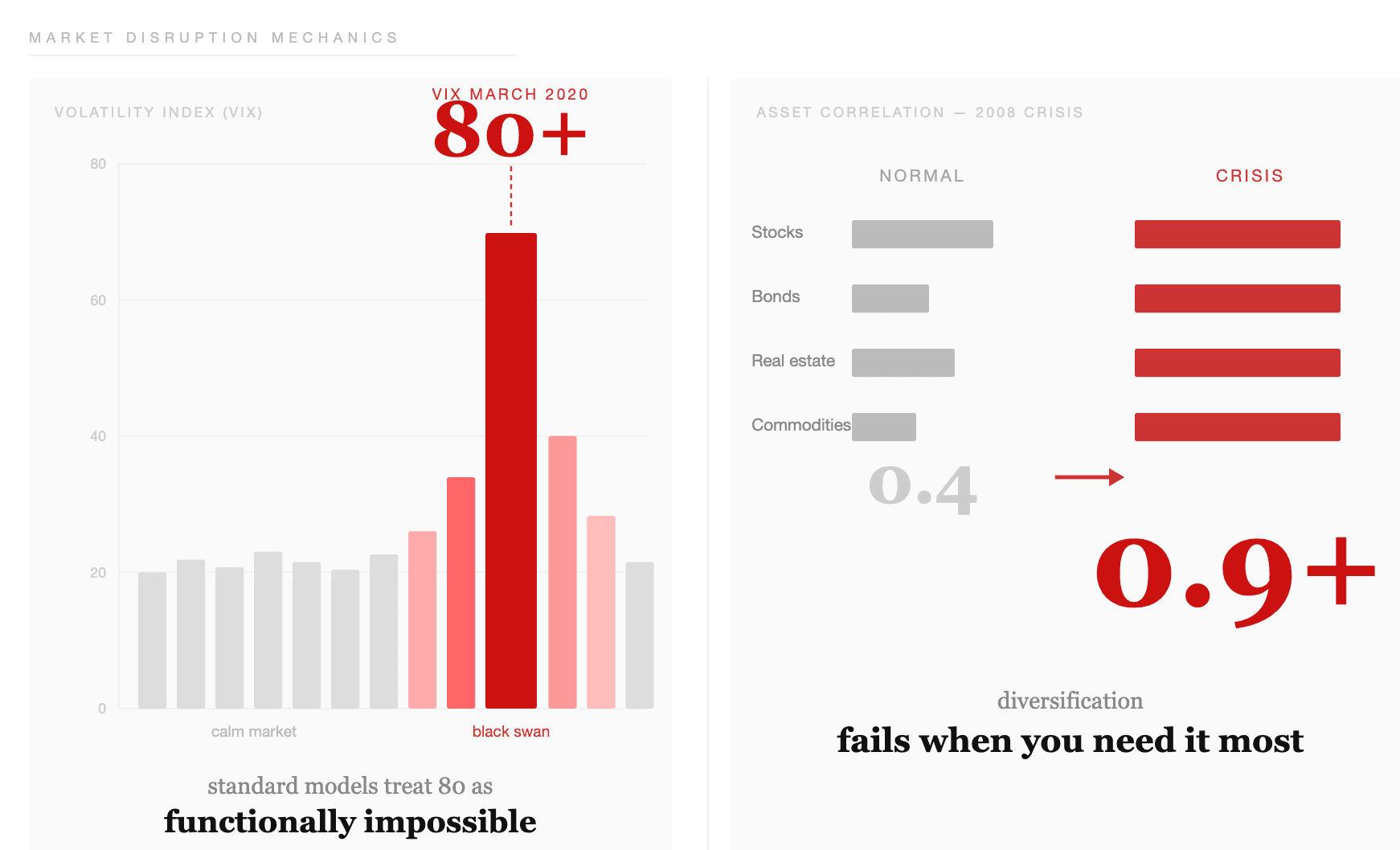
Market volatility during a black swan does not simply increase. It falls outside the range used by risk systems to calculate position sizing and margin requirements. The VIX spiked above 80 in March 2020. Standard value-at-risk models treat that level as functionally impossible. 

Margin calls force traders to liquidate positions they would otherwise hold. Those liquidations push prices lower and trigger more margin calls. The selling feeds itself without any new negative information entering the market.

Why Traditional Diversification Breaks Down in a Crisis

Diversification works when assets move independently. During a global financial crisis, that independence collapses. In normal conditions, correlations between equities, bonds, and commodities average between 0.3 and 0.5. During the 2008 crisis, those correlations spiked above 0.9 across stocks, real estate, commodities, and corporate bonds. 

A portfolio built to spread low probability risk suddenly behaves like a single concentrated position. In an unexpected economic shock, correlation itself becomes the systemic risk.

Key takeaway: Black swans change how markets function, not just how far they fall. Volatility triggers forced selling that amplifies the initial move. Diversification collapses when correlations converge toward 1. Build your preparation before the event, not during it.

How Traders Prepare for Unpredictable Market Shocks

How Traders Prepare for Unpredictable Market Shocks

No preparation eliminates a black swan event. What preparation determines whether the impact destroys a portfolio or leaves it positioned to recover? Every effective approach builds a structure that holds regardless of what form the shock takes.

Tail-Risk Hedging With Options

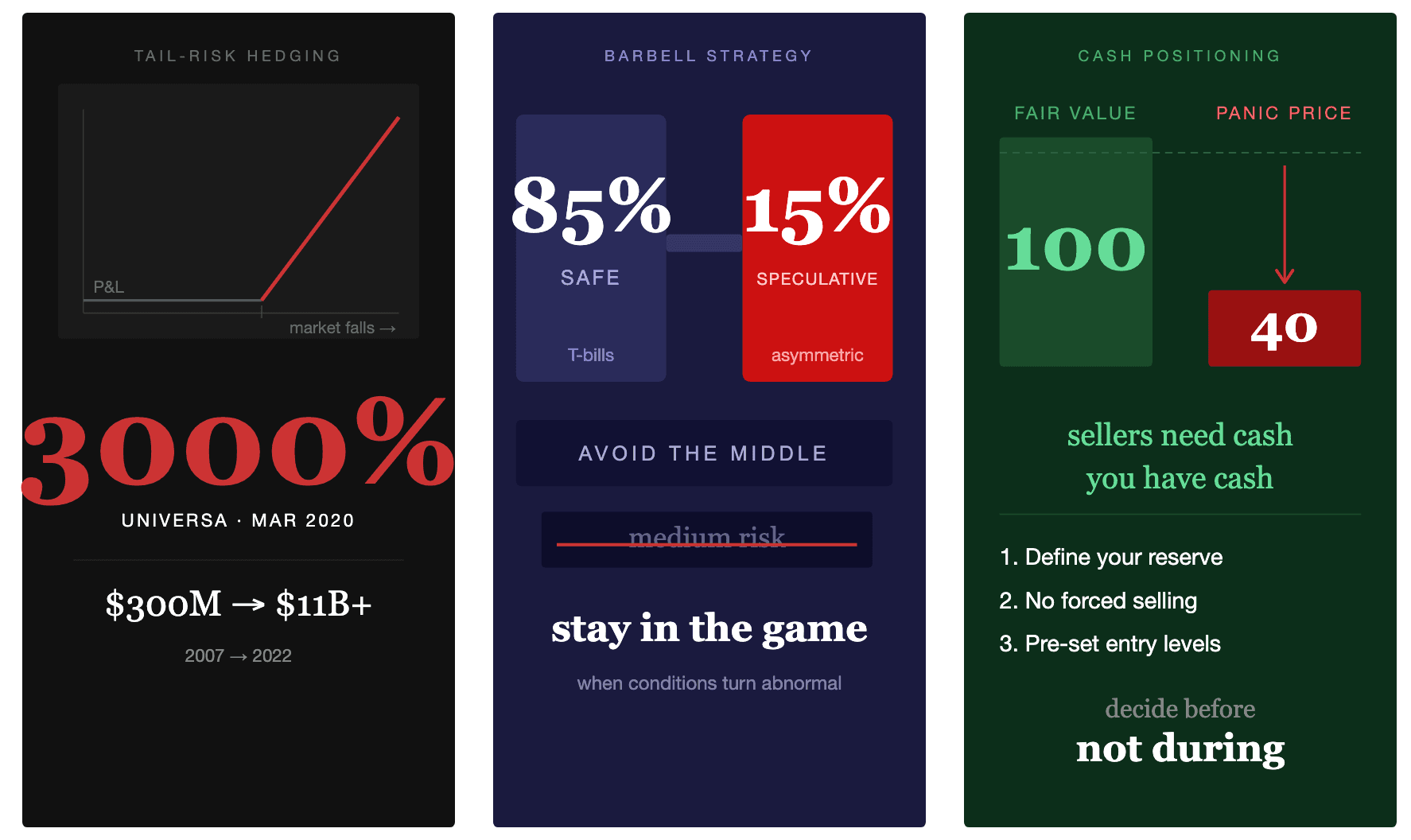
Tail-risk hedging uses options to produce payoffs that grow as markets fall sharply. The most direct approach is to buy out-of-the-money put options struck at 15% to 25% below the current market price. Statistically rare events mean these options carry low premiums. Most expire worthless. 

Universa Investments grew from $300 million in 2007 to over $11 billion by 2022 using this exact structure. In March 2020, tail-risk funds following this strategy posted returns above 3,000% for the month. Equity markets fell 34% in the same period.

The Barbell Strategy: Taleb's Own Approach

Taleb built the barbell approach across two books: "The Black Swan" and "Antifragile." Put 85% to 90% of capital into extremely safe instruments, such as Treasury bills. Deploy the remaining 10% to 15% into speculative positions with asymmetric upside. 

You avoid the middle entirely. Medium-risk investments offer returns that do not justify the real possibility of catastrophic loss. The barbell approach keeps you in the game when conditions become abnormal.

Cash Positioning and Liquidity During Extreme Events

Liquid capital is a strategic asset in a black swan environment. When markets dislocate, high-quality asset prices fall because sellers need cash immediately, not because the assets have lost value. Traders with a cash buffer buy at prices that reflect panic rather than fundamentals. Three practical elements:

  • Maintain a defined cash reserve always
  • Avoid leverage that forces selling under pressure
  • Set pre-defined entry levels before any crisis

Decide your entry prices before any crisis. The trader with a plan outperforms the one who decides while everything falls.

Key takeaway: Traders cannot predict the next black swan. Tail-risk hedging pays off when markets collapse. The barbell strategy keeps most capital safe while preserving upside. Cash reserves let you act when others sell at any price.

Final Take

A black swan event carries three features: extreme rarity, catastrophic impact, and explanation only in hindsight. Standard risk models rely on historical data that contains no precedent for these events. The four major examples here each moved markets by tens of percentage points in days or weeks. Recovery times ranged from five months to over a decade. Traders who came through without permanent damage built their risk structure before the event, not after it.

Frequently Asked Questions

Disclaimer: This article is for informational purposes only and does not constitute financial advice. Trading involves risk and may result in loss of capital.

Related Articles

The First Move Is Yours

Discover how Supertrade can transform your trading career. Explore challenges, access instant funding, and join a growing community of Supertraders.

Stay Ahead of the Game

Sign up to receive exclusive tips, market insights, and the latest updates from Supertrade. Don’t miss out on opportunities to grow your trading success.
Discord

Our Community

Do not skip any beat.

The Ultimate Trading Community. Join our Discord server to get the latest updates, news and more.

2026 Supertrade. All rights reserved
DiscordFacebookInstagramTelegramYouTubeXTikTok
Trading involves significant risk. Past performance is not indicative of future results. This is a simulated trading environment. Supertrade provides educational trading services.
Supertrade
Supertrade Ltd, a company incorporated under the laws of Saint Lucia with registered number 2024-00699, located at Ground Floor, Rodney Court Building, Rodney Bay, Gros Islet, Saint Lucia, LC01 101, operates and owns this website, as well as provides services under the Terms and Conditions posted on the website. Supertrade Prop Ltd, a company incorporated under the laws of England and Wales with registered number 16234284, located at 52-56 Standard Road, London, England, NW10 6EU, acting as a payment agent.