
Trading Basics

May 7, 2026 - 10 min

Beginner

What Is a Short Squeeze in Stocks: A Trader's Guide

What Is a Short Squeeze in Stocks: A Trader's Guide

Some of the sharpest single-day price spikes in market history had nothing to do with earnings or revenue. What is a short squeeze – is the question behind those moves. Forced buying, trapped positions, and collapsing share supply can drive a stock from $20 to $400 in a matter of days. If you trade stocks, this is the mechanism you cannot afford to misread.

Justin Freeman
Reviewed by:
Share

Short Squeeze: 6 Key Facts

The points below come from the SEC, FINRA, Bloomberg, and Wikipedia. They reveal the scale of what a short squeeze can do in real markets with real money on the line.

  1. A short squeeze creates rapid forced buying
  2. Short sellers borrow then sell shares
  3. GME short interest hit 140% float
  4. Above 20% float signals squeeze risk
  5. Melvin Capital lost $6.8 billion
  6. FINRA reports short data twice monthly

Each of these facts connects directly. High short interest creates the fuel. A catalyst lights it. Forced buying pressure does the rest.

What Is Short Selling?
What Is Short Selling

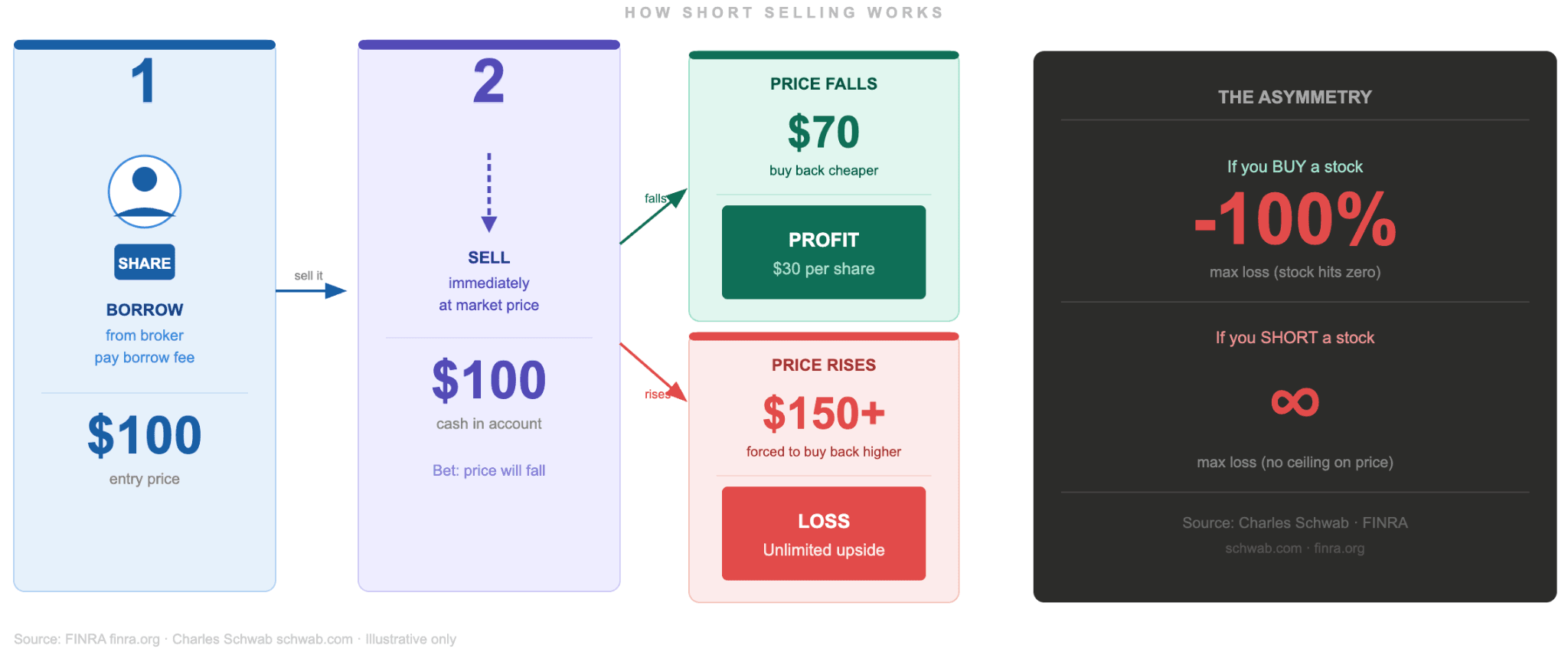
Short selling is a bet that a stock will fall. A trader does not own the shares they sell. They borrow them, sell them immediately at the market price, plan to buy them back later at a lower price, and return them to the lender.

“That gap between the sale price and the buyback price is the profit. When the gap runs the wrong way, the losses have no ceiling.”

Borrowing Shares to Open a Position

Every short trade starts with borrowed stock. The short seller opens a margin account, borrows shares from a broker, and pays a daily borrowing fee as long as the position remains open. For stocks with high short interest, FINRA data show that the borrow rate can exceed 100% annualised. That cost compounds daily and eats directly into any potential profit.

What Happens When the Price Rises

A rising price turns a short position into a liability that grows by the minute the trade remains open. Every dollar the stock gains past the entry price adds a dollar of loss per share. At some point, the broker does not wait for the trader to decide. The margin call forces a mandatory buyback regardless of the trader's wishes.

Key takeaway: Short selling means selling borrowed shares and betting that the price will fall. When prices rise instead, forced buybacks begin automatically, and losses have no theoretical limit.

What Is a Short Squeeze in Stocks

What is a short squeeze in stocks precisely? It is a self-reinforcing buying cycle triggered entirely by forced exits, not by any improvement in the company behind the stock. The SEC confirmed this in its October 2021 staff report on GME, stating that short covering contributed directly to the stock's price increase during January 2021.

How the Feedback Loop Forms
How the Feedback Loop Forms

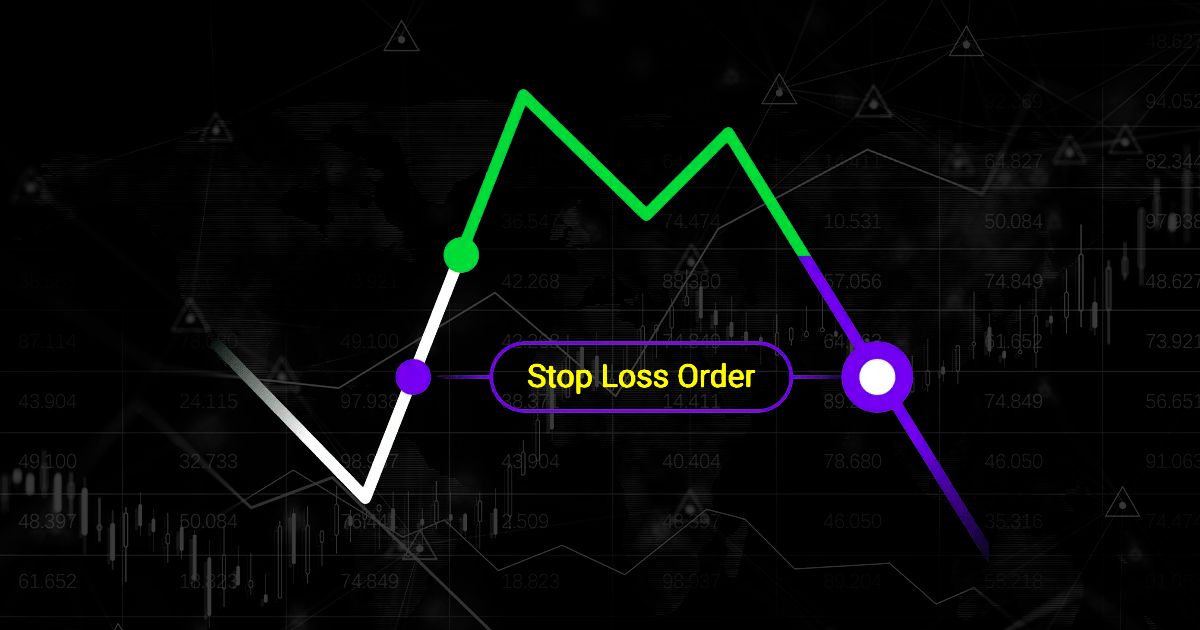
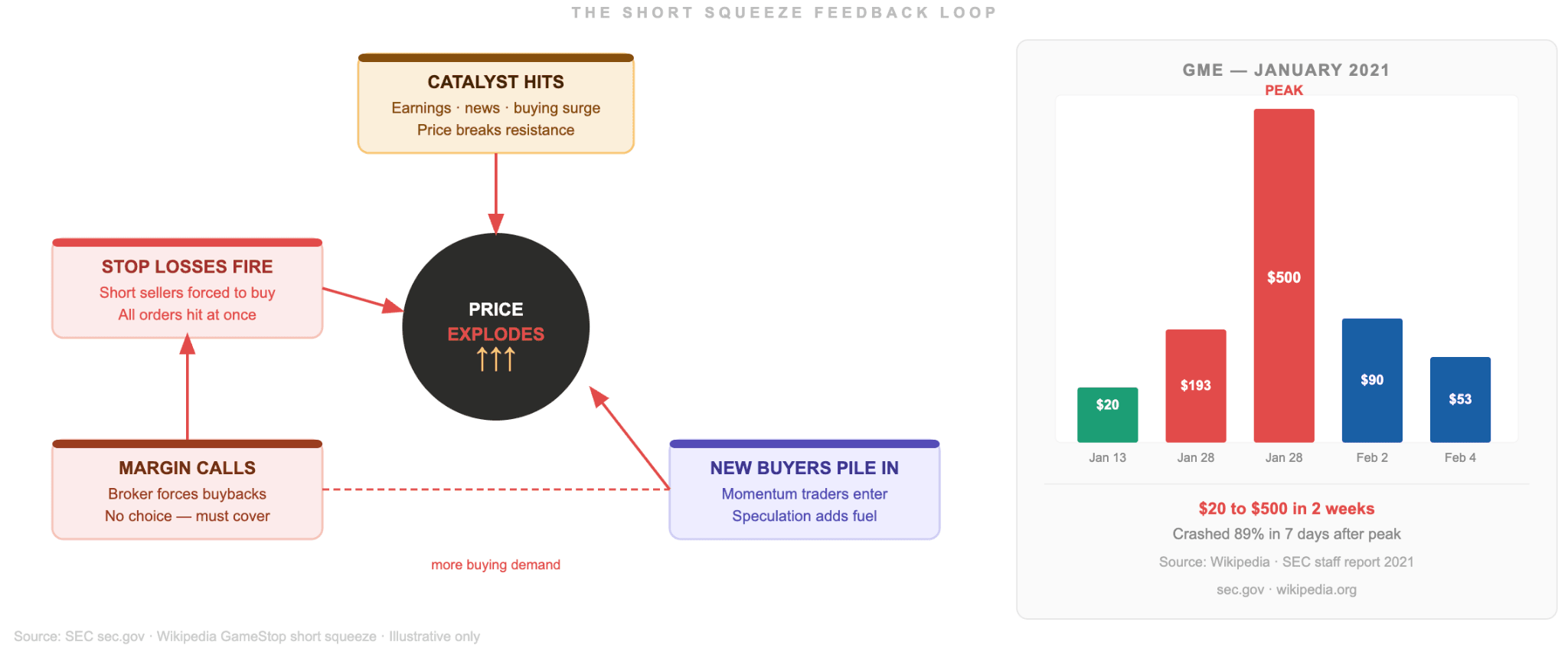
The loop needs one spark to start. Positive news, an earnings surprise, or a coordinated surge in buying pressure from retail traders can push a heavily shorted stock above a key resistance level. Short sellers who placed stop-loss orders at that level get triggered all at once. Their buy orders flood the market simultaneously, and that burst of concentrated demand drives the price sharply higher.

New traders watching the move enter on momentum. Market speculation adds more fuel to a fire that is already burning. Price volatility escalates fast. Wikipedia documents that GameStop moved from under $20 to above $500 pre-market in under two weeks during January 2021. Once the loop accelerates, it becomes almost impossible to slow down until the short interest runs dry.

What Drives the Price Higher

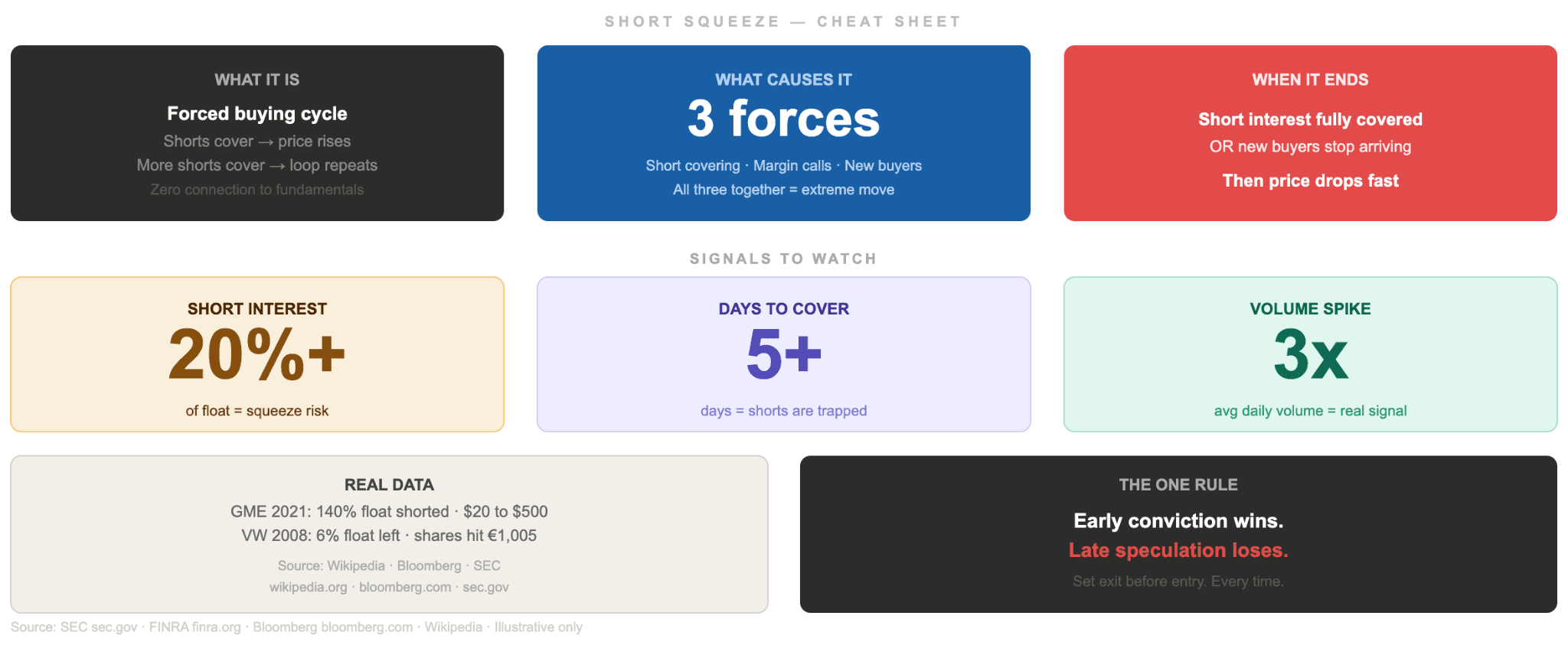
Three distinct forces combine during the most violent short squeezes. Understanding each one separately helps explain why these moves are so much faster and larger than ordinary rallies driven by fundamentals.

  1. Short sellers cover to limit losses.
  2. Margin calls force involuntary buybacks.
  3. New buyers pile in on momentum.

When all three forces fire simultaneously, the price move becomes extreme and fast. The SEC confirmed that GME experienced large price moves, large volume changes, and elevated short interest all at once during January 2021, a confluence of conditions the report described as unlike anything previously documented in US equity markets. 

Key takeaway: A short squeeze is purely mechanical forced buying with no connection to business fundamentals. It ends when trapped sellers finish covering, and new buyers stop arriving.

How to Spot a Short Squeeze
How to Spot a Short Squeeze

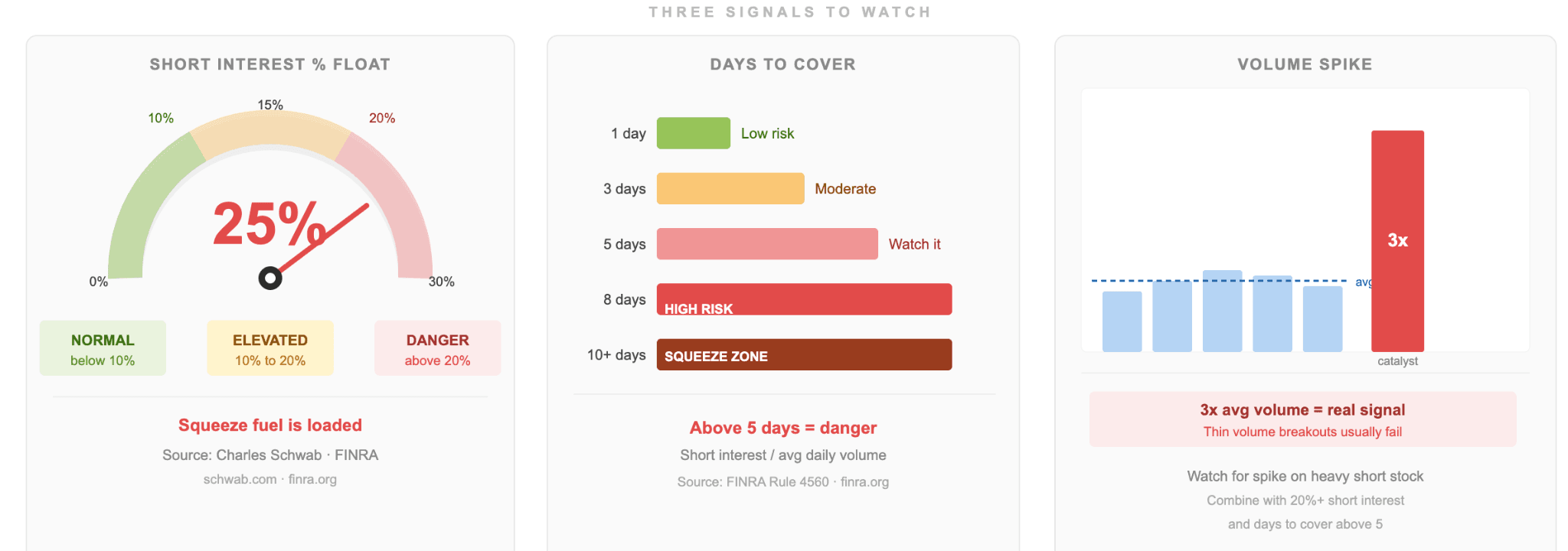
Spotting short squeeze conditions requires reading several data points together. No single number confirms a squeeze is coming, and no combination guarantees one either. FINRA publishes short interest data twice monthly under Rule 4560, with a reporting lag of seven to ten business days.
Become a Confident Trader

Master trading with our structured course designed for beginners and intermediate traders.

Step-by-step lessons
Real strategies
Risk management training

Join 10,000+ traders improving their skills

Start Course Now

Short Interest and Days to Cover

Short interest as a percentage of float is the primary structural measure of squeeze potential. Charles Schwab outlines the thresholds professional traders use when evaluating a heavily shorted name. The higher the reading, the more crowded the short trade and the more violent the potential unwind if a catalyst hits

These levels are not guarantees, but they define how much fuel is sitting in the tank:

  • Above 10% float is elevated
  • Above 20% signals squeeze risk
  • Above 30% is historically extreme

Days to cover divides total short interest by average daily volume. A reading above 5 means it would take five full trading days for all short sellers to exit at normal volume. 

Volume, Catalysts, and Price Action

Volume is the confirmation tool that separates a real signal from noise. A stock breaking upward on thin volume usually fades within hours. The same price move on three times average daily volume signals real buying pressure that has genuine follow-through potential.

Catalysts matter enormously. Positive news, such as an earnings beat, a product approval, or a significant contract announcement, gives short sellers a concrete reason to cover immediately rather than wait. 

Prices rising on high volume against a backdrop of short interest above 20% is the clearest combination of conditions that has preceded every major documented squeeze in recent US market history. 

Let’s compare the normal market vs short squeeze conditions below:

FactorNormal MarketShort Squeeze
Short interestBelow 10% floatAbove 20% float
Days to cover1 to 3 daysAbove 5 days
VolumeNear average3x to 10x average
Price moveGradual, news-drivenSharp, forced buying
Borrow rateBelow 1% annualisedCan exceed 100%
CatalystNot requiredUsually present

Source: FINRA Rule 4560 and Charles Schwab short interest monitor

Key takeaway: High short interest above 20% combined with days to cover above 5 and a volume spike signals real squeeze conditions. No single metric is enough on its own.

Short Squeeze in Stocks: Two Real Examples

Short Squeeze in Stocks: Two Real Examples

History gives two textbook examples of a short squeeze in stock market mechanics playing out in real money. Both are supported by primary-source data from the SEC, Bloomberg, and Wikipedia. Both show that the setup was visible before the price exploded.

GameStop 2021: The Numbers

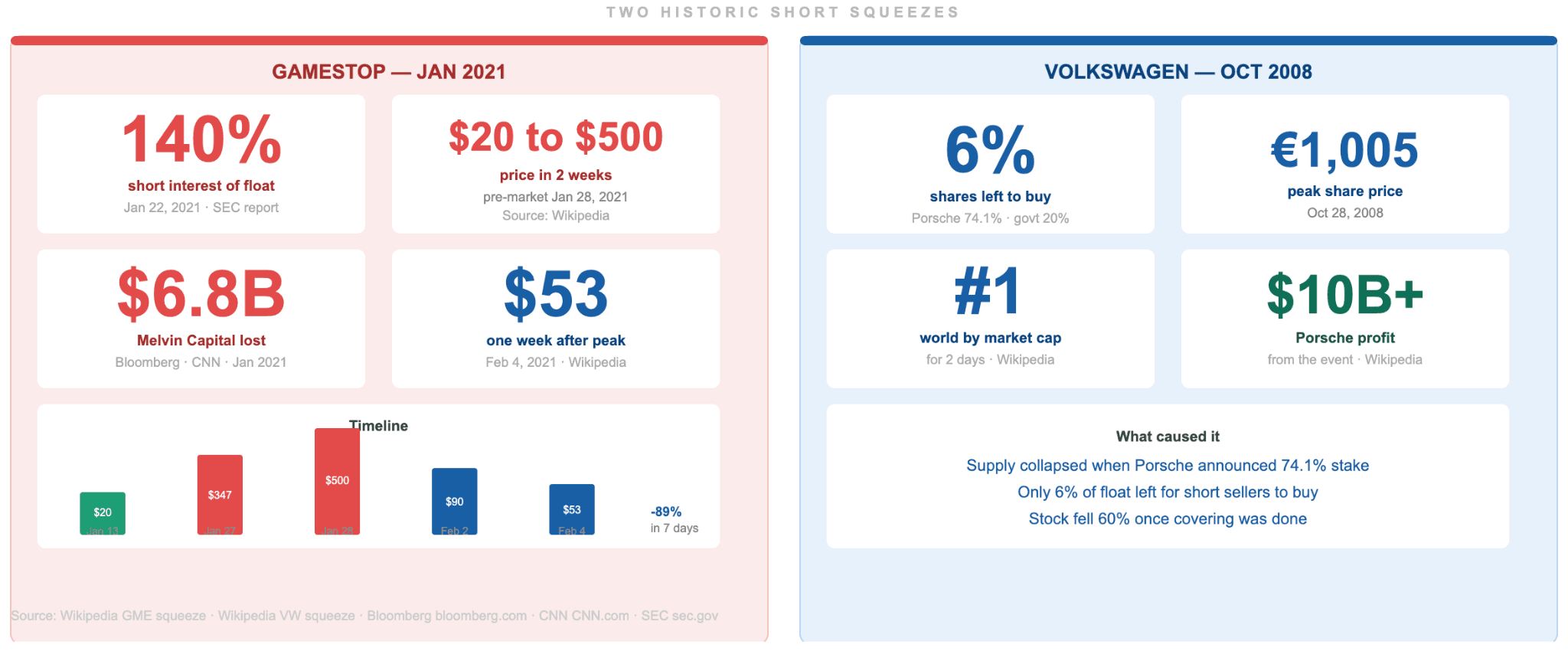
GameStop's short squeeze remains the most data-rich modern example in US equity markets. By January 22, 2021, short interest stood at 140% of the public float. GME was the only US-listed stock the SEC observed with short interest exceeding shares outstanding. Shorted shares were re-lent and shorted multiple times again.

Selling pressure reversed when retail buyers coordinated through Reddit's WallStreetBets forum. The stock ran from under $20 to a pre-market high above $500 per share by January 28. Bloomberg reported that Melvin Capital, a hedge fund heavily short on GME, lost 53% of its value in January 2021, equivalent to $6.8 billion in a single month. 

CNN Business confirmed the same figure independently. Melvin Capital never recovered and permanently closed its fund in May 2022.

"140% short interest was public FINRA data for months. The winners read numbers. The losers read headlines."

Volkswagen 2008: The Mechanics

The 2008 Volkswagen squeeze was structural rather than retail-driven. Porsche announced it had quietly acquired a 74.1% stake in Volkswagen through options. The German government held another 20% stake. That left less than 6% of Volkswagen's voting stock available in the open market for short sellers who needed to buy shares to close their position.

Supply collapsed while demand from forced covering spiked. Volkswagen shares reached EUR 1,005 per share. For two days, it briefly became the most valuable company in the world by market capitalization according to Wikipedia. Porsche booked over $10 billion in profit. Short sellers lost billions. The stock then fell nearly 60% within days once covering demand was fully exhausted, and price volatility subsided.

Key takeaway: Both GME and VW squeezes were triggered by a collapse in available share supply against concentrated short interest. The structural data was visible before both moves began.

Risks of Trading a Short Squeeze

Risks of Trading a Short Squeeze

Most traders who lose money in a short squeeze do not lose it by shorting the wrong stock. They lose it by buying too late on the long side after the move is already mostly finished. The squeeze environment creates an illusion that prices will keep rising indefinitely, but the moment forced buying stops, the price has nothing holding it up.

The SEC is direct on the legal line. Trading a short squeeze is legal. Coordinating with others to manipulate prices and deliberately trigger a squeeze is market manipulation under federal securities law. The SEC investigated the January 2021 meme-stock events and published findings regarding this boundary.

Why Timing Destroys Late Entries

Short squeezes in stock situations give no warning before they end. Once short interest is fully covered, forced buying stops completely. There is no new source of demand to replace it and no business fundamentals supporting the elevated price level.

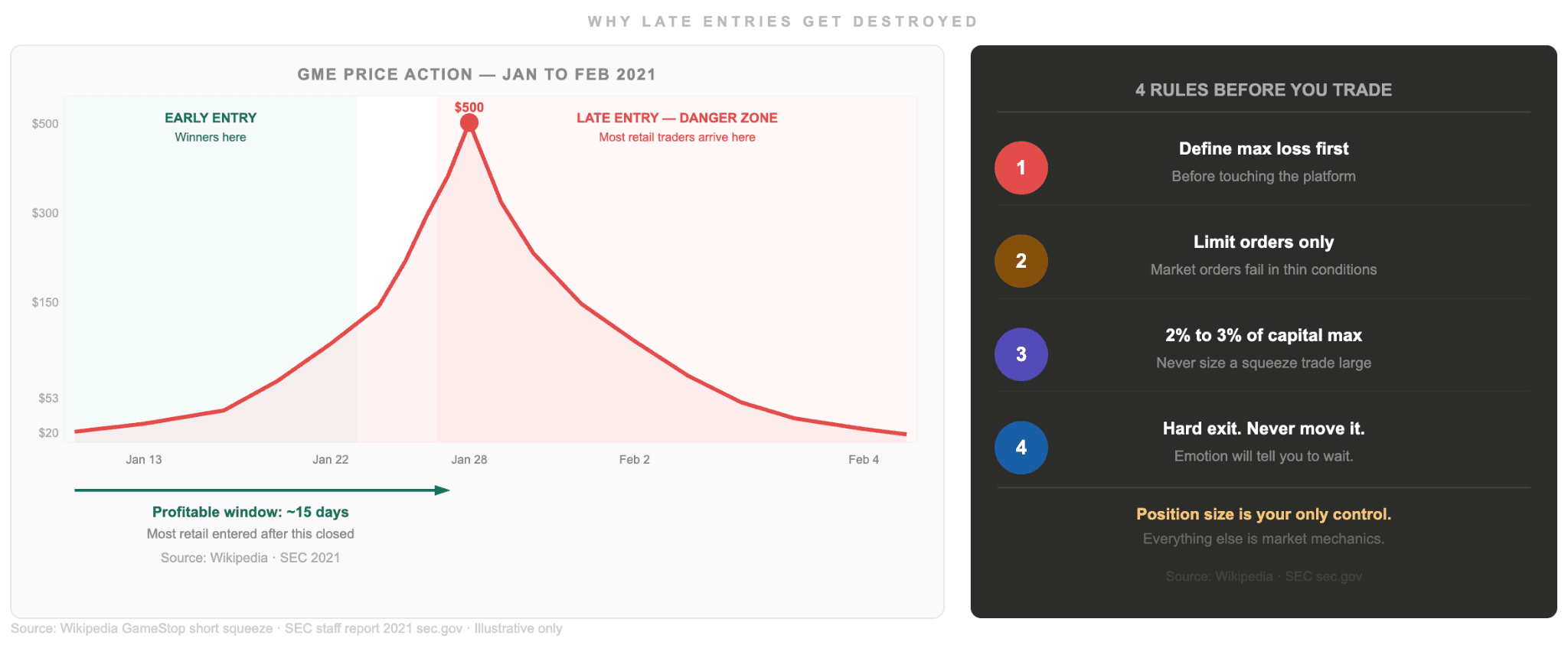
Traders who bought GameStop near $400 based on market speculation about further gains saw the stock close below $200 the same day and fall to $53 within one week, according to Wikipedia. The profitable window lasted hours, not days. Most retail traders who entered after the peak lost a significant portion of their capital.

How to Protect Your Position

Risk management in a squeeze environment cannot be improvised in the moment. Decisions made while a stock is moving 30% in an hour are almost always wrong because emotion completely overrides analysis. These four rules apply to any short squeeze trade and must be set before the position is opened, not during it.

  1. Define maximum loss before entry.
  2. Use limit orders only in thin markets.
  3. Size the trade at 2% to 3% of capital.
  4. Set a hard exit and never move it under pressure.

Price volatility during a squeeze makes every one of these rules feel wrong while the stock moves higher. That feeling is the trap. The only variable fully within a trader's control once a squeeze starts is position size. Everything else is driven by market mechanics beyond any individual's ability to influence.

Key takeaway: Squeezes reward early conviction and punishes late entries hard. Set your maximum loss and exit price before you open the trade, not after.

Wrapping It Up

short squeeze happens

A short squeeze happens when forced buying from short sellers creates a self-reinforcing price cycle with no connection to company fundamentals. FINRA short interest data, days to cover above 5, and a volume spike of three times average together provide the clearest early read on conditions before a squeeze develops.

Frequently Asked Questions

Disclaimer: This article is for informational purposes only and does not constitute financial advice. Trading involves risk and may result in loss of capital.

Related Articles

The First Move Is Yours

Discover how Supertrade can transform your trading career. Explore challenges, access instant funding, and join a growing community of Supertraders.

Stay Ahead of the Game

Sign up to receive exclusive tips, market insights, and the latest updates from Supertrade. Don’t miss out on opportunities to grow your trading success.
how it works

Our Community

Do not skip any beat.

The Ultimate Trading Community. Join our Discord server to get the latest updates, news and more.

2026 Supertrade. All rights reserved
DiscordFacebookInstagramTelegramYouTubeXTikTok
Trading involves significant risk. Past performance is not indicative of future results. This is a simulated trading environment. Supertrade provides educational trading services.
Supertrade
Supertrade Ltd, a company incorporated under the laws of Saint Lucia with registered number 2024-00699, located at Ground Floor, Rodney Court Building, Rodney Bay, Gros Islet, Saint Lucia, LC01 101, operates and owns this website, as well as provides services under the Terms and Conditions posted on the website. Supertrade Prop Ltd, a company incorporated under the laws of England and Wales with registered number 16234284, located at 52-56 Standard Road, London, England, NW10 6EU, acting as a payment agent.