En
En Es
Es

Revenge Trading in 30 Seconds
| Question: | Answer: |
|---|---|
| What is revenge trading | Opening a new trade to recover a recent loss instead of following your plan |
| What is a revenge trade | A trade driven by emotion after a loss, not by a valid setup |
| Why is revenge trading dangerous | It turns a single planned loss into a cascading drawdown within hours |
| What percent of traders revenge trade | Around 37 percent show a measurable revenge trading pattern |
| Which style is hit hardest | Scalpers at 47 percent, then day traders at 38 percent |
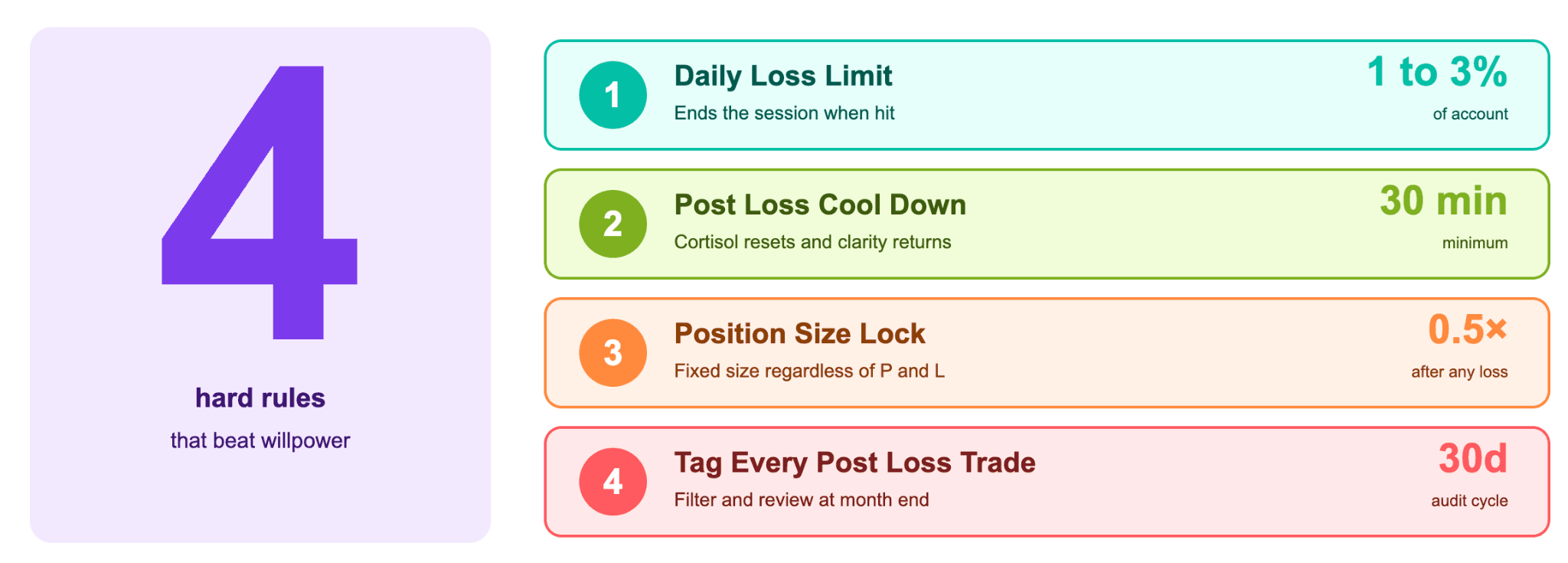
| How to stop revenge trading fast | Set a daily loss limit and a 30-minute post-loss cool-down |
What Is Revenge Trading
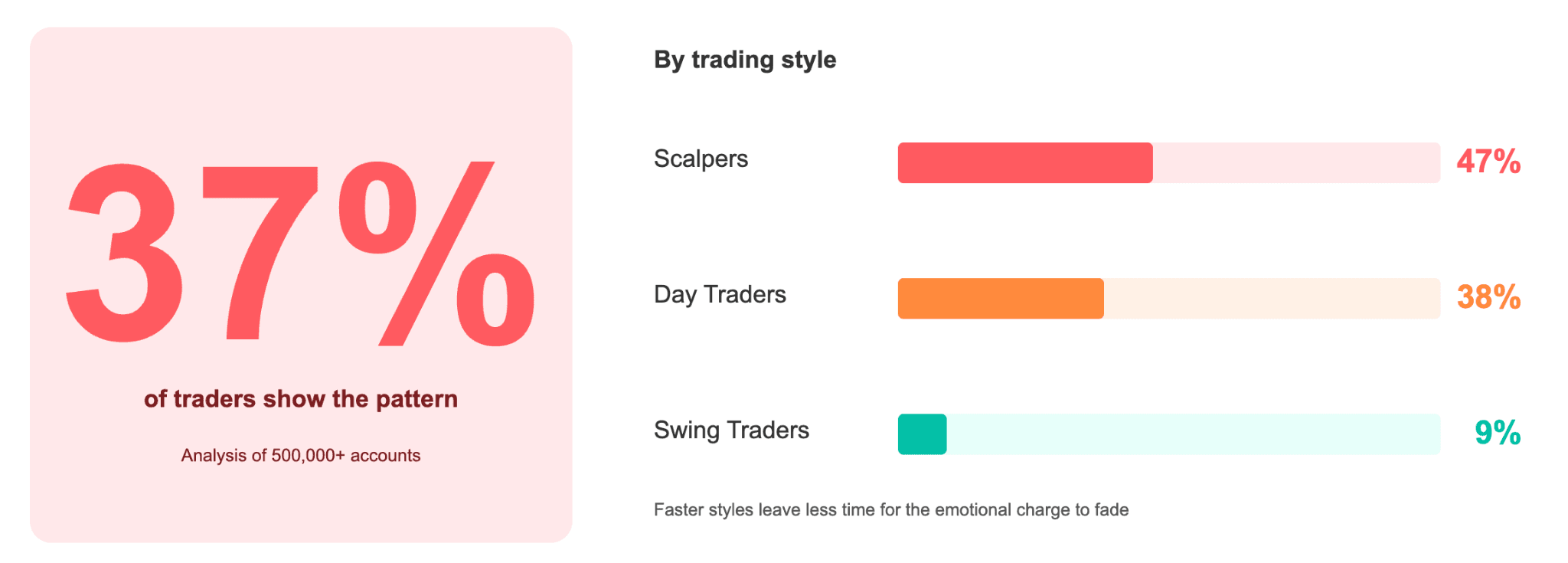
Revenge trading is opening a new trade to recover a recent loss instead of following your plan. Around 37 percent of traders show a measurable pattern, and it hits scalpers hardest. The behavior always shows four clear signs. Every sign links directly to a specific emotion under the surface.
- Position size grows after loss.
- Setup checks skipped or ignored.
- Re-entry within 5 minutes.
- Break-even fixation for session.
Naming which sign hit you today makes the next entry easier to catch. Traders who track these markers cut their own revenge damage within weeks.
Revenge Trading Definition and Meaning
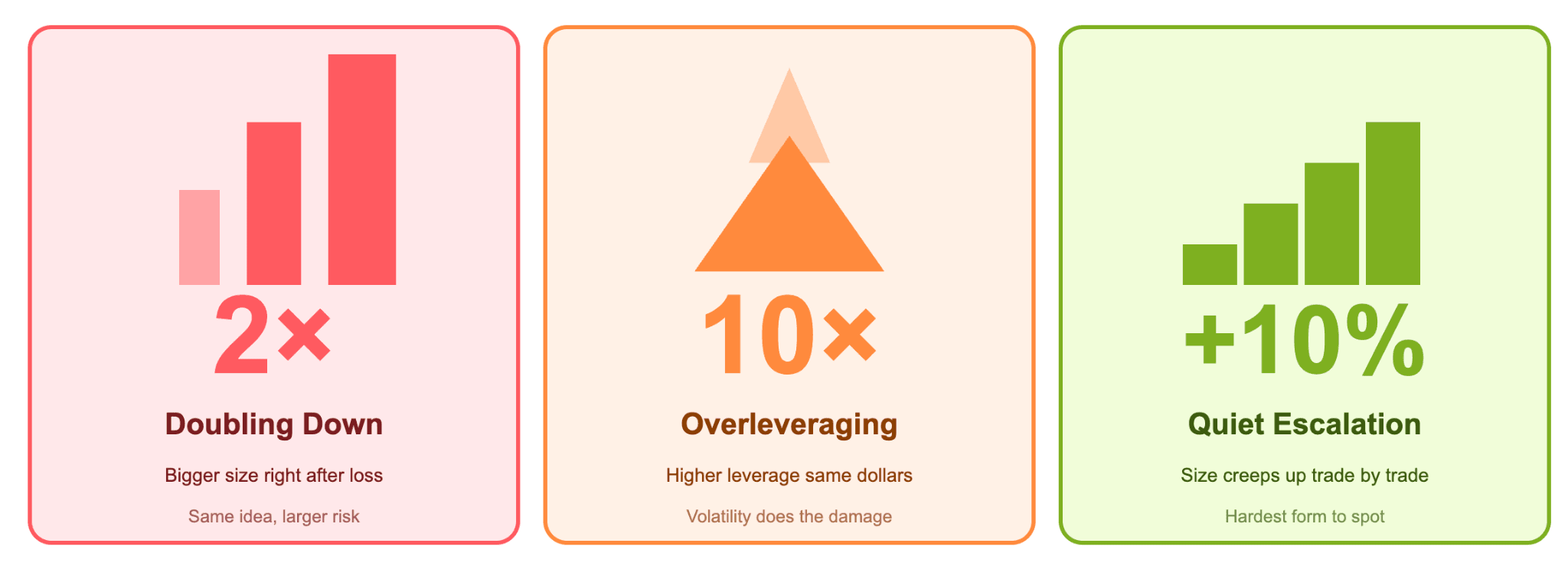
The revenge trading meaning is straightforward. It means placing a new trade because a previous one hurt, not because the market offered a valid setup. The trader wants to erase the loss quickly, so the next entry skips the usual checks. Size often grows, stops get looser, and the setup quality drops. This shift is what turns one planned loss into a cascade of avoidable ones.
How a Revenge Trade Differs From a Planned Trade
A planned trade starts from a written setup and stops when the stop level is hit. A revenge trade starts from a feeling and stops only when the pain fades, or the account cannot take more. The first uses the market as an opportunity. The second uses the market as a way to fix an emotion.
| Metric | Revenge Trade | Planned Trade |
|---|---|---|
| Win rate | 25 to 35 percent | 50 to 60 percent |
| Average loss | 1.5R to 3R | Around 1R |
| Position size | Larger than plan | Fixed by rules |
| Stop discipline | Widened or ignored | Honored |
| Trigger | Recent loss | Valid setup |
How Often Traders Fall Into Loss Chasing
One industry analysis of more than 500,000 accounts found the pattern in around 37 percent of traders. Scalpers show it in 47 percent of cases, day traders in 38 percent, and swing traders in only 9 percent. Faster styles leave less time for the emotional charge to fade. Newer traders are hit hardest, and the pattern fades with experience.
Key takeaway. Revenge trading turns a single planned loss into a cascading drawdown. It affects roughly 37 percent of traders and hits scalpers hardest. Naming the pattern is the first step to catching it before the cascade starts.
Revenge Trading Psychology and Why the Brain Chases Losses
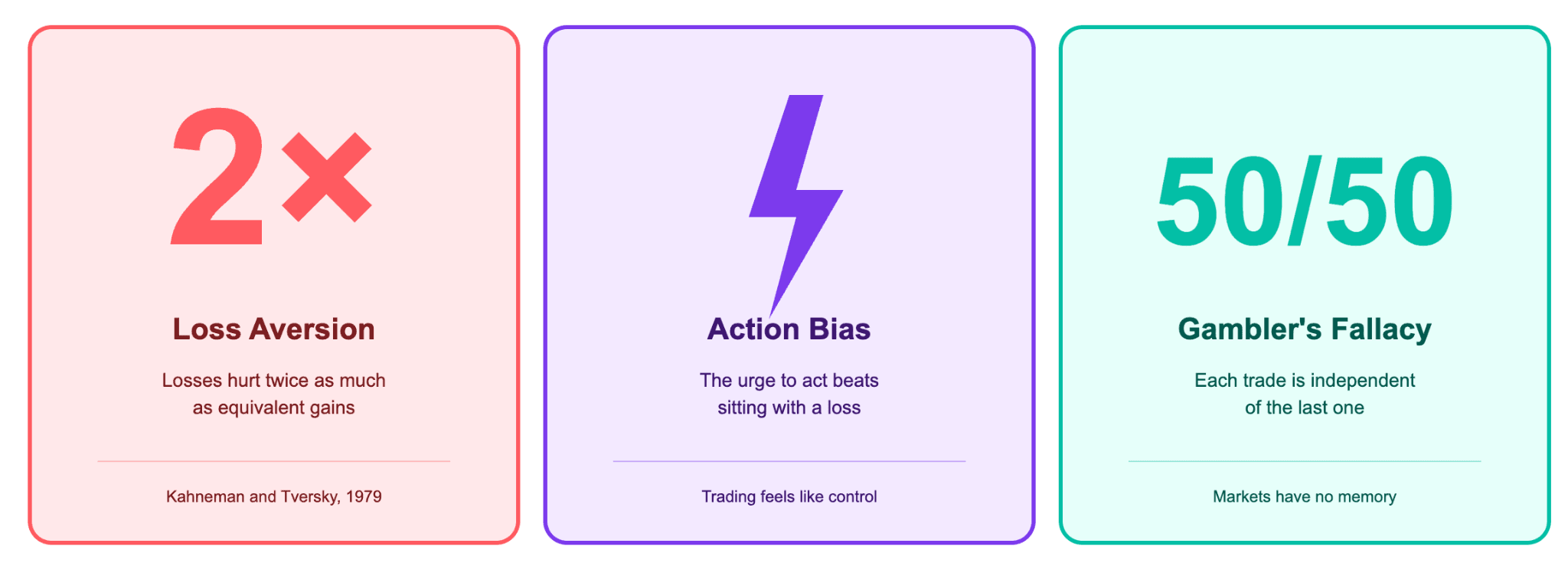
Revenge trading psychology is not a discipline problem. Three behavioral forces lie beneath it, each with decades of research behind it. Understanding them makes the pattern easier to break than trying harder.
Loss Aversion Makes Losses Feel Twice as Strong
Loss aversion is the finding that losses hurt twice as much as gains. Kahneman and Tversky proved it in 1979. A 500 dollar loss creates roughly the emotional weight of losing 1,000 dollars in pure math terms. That imbalance sits at the root of every revenge trade. It ties directly to the wider fear and greed mechanics in trading. The pain feels urgent, and the brain looks for a fast way to make it stop.
Action Bias Turns Discomfort Into a Trade
Action bias is the pull to do something rather than sit with a bad outcome. After a loss, waiting feels like helplessness while trading feels like control. Research by Sokol-Hessner and colleagues shows the amygdala fires harder during losses and drives fast reactive choices. The fastest available action is another trade, so that becomes the outlet.
Gambler's Fallacy and Break-Even Anchoring
The gambler's fallacy is the belief that after a run of losses, a win is somehow due. Each trade is independent, and the market has no memory of your last result. But the mind still tells a story that the next trade must work. Break-even anchoring makes it worse because the starting balance becomes an emotional target you feel you must hit today.
Key takeaway. Loss aversion creates the pain, action bias turns it into a trade, and the gambler's fallacy justifies it. These forces are wired into every trader, not a personal weakness. A system that removes decisions in the moment works better than willpower.