
Trading Basics

Jul 7, 2026 - 12 min

Beginner

The Richest Traders in the World and Their Net Worth in 2026

The Richest Traders in the World and Their Net Worth in 2026

The wealthiest traders alive today built fortunes ranging from $4 billion to $47 billion through market positions and fund management. The title of the richest trader in the world belongs to Ken Griffin, founder of Citadel, with a Forbes-verified net worth of $47 billion as of 2026. This guide ranks the top traders by verified wealth, breaks down their strategies, and shows what separates billionaire traders from everyone else.

Evgenij Pakhomov
Reviewed by:
Share

Richest Traders at a Glance

  • Ken Griffin reached a net worth of $47 billion in 2026 through Citadel's market-making and macro strategies. 
  • George Soros earned $1 billion in a single day by shorting the British pound in 1992. 
  • Jim Simons' Medallion Fund averaged over 30% net annual returns for three decades before his death in May 2024. 
  • Ray Dalio's Bridgewater Associates managed over $160 billion at its peak.
  • Stanley Druckenmiller reached $8.4 billion through macro currency and equity trades.
  • Jesse Livermore earned $100 million during the 1929 crash, equal to roughly $1.5 billion in today's dollars. 

The Richest Traders in the World Ranked by Net Worth
The Richest Traders in the World Ranked by Net Worth

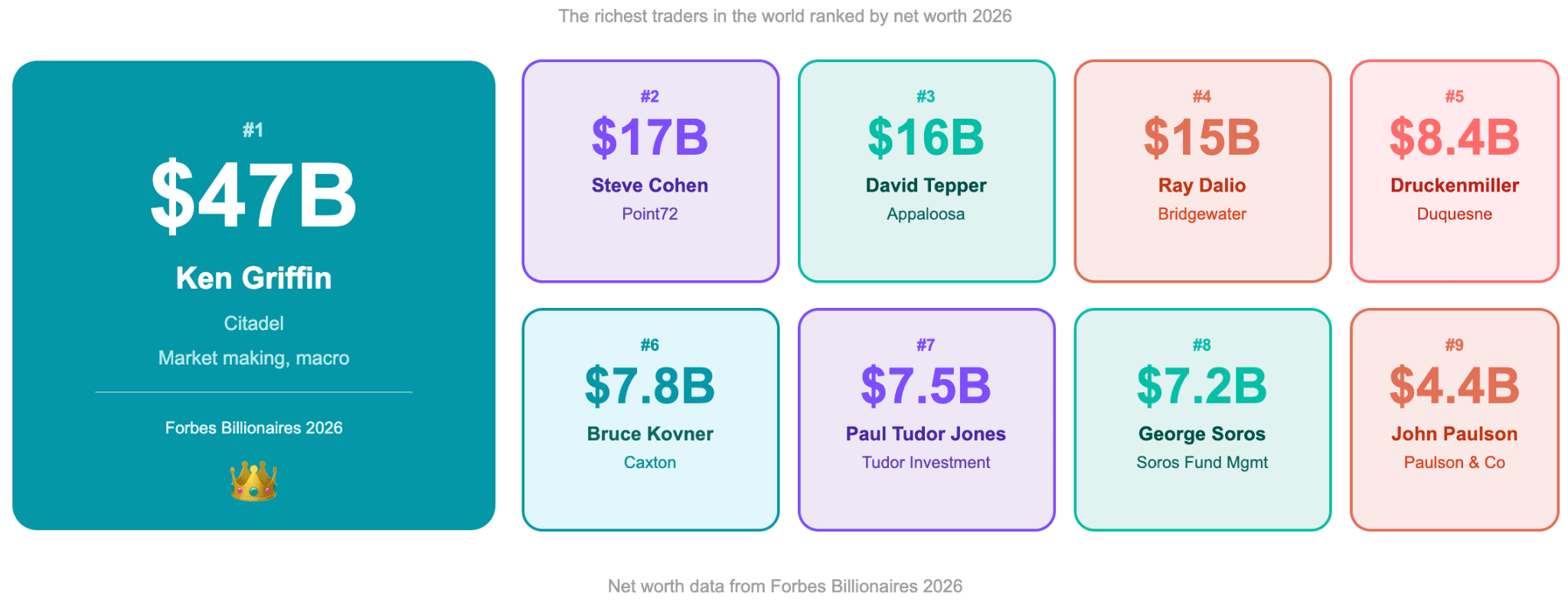
The Forbes 2026 Billionaires list features more than 15 traders and hedge fund managers with over $5 billion in personal wealth. These fortunes came from decades of compounding returns, not from single winning trades. The table below ranks the ten wealthiest traders using Forbes- and Bloomberg-verified data from 2026.

RankNameNet Worth 2026Primary MarketStrategy
1Ken Griffin$47BMulti assetMarket making, macro
2Steve Cohen$17BEquitiesShort-term trading
3David Tepper$16BEquities, distressedCrisis value investing
4Ray Dalio$15BMulti assetRisk parity, macro
5Stanley Druckenmiller$8.4BCurrencies, macroGlobal macro
6Bruce Kovner$7.8BCurrencies, futuresMacro and technical
7Paul Tudor Jones$7.5BFutures, macroTechnical and macro
8George Soros$7.2BCurrenciesGlobal macro
9John Paulson$4.4BCredit, equitiesEvent driven
Jim Simons (died May 2024)$31B estateMulti assetQuantitative algorithms

Sources: Forbes Billionaires 2026, Bloomberg Billionaires Index.

Every trader on this list manages or managed a fund, not just a personal account. Personal trading alone did not create any of these fortunes. Fund management fees and compounded performance built the wealth over decades.

Macro Traders Who Bet on Global Shifts

Five of the ten richest traders built their fortunes through global macro strategies. They analyze currencies, interest rates, and political events to place large directional bets.

George Soros shorted $10 billion of British pounds on Black Wednesday in 1992 and earned $1 billion in a single day. Stanley Druckenmiller managed the Quantum Fund alongside Soros and executed much of that trade. He later ran Duquesne Capital with average annual returns above 30% for 30 years.

Paul Tudor Jones predicted the 1987 Black Monday crash and earned over $100 million from his short positions. He combines technical chart analysis with macro fundamentals and treats capital preservation as his primary objective.

Bruce Kovner borrowed $3,000 on a credit card for his first trade in 1977. He founded Caxton Associates, which earned $3 billion in profits during its first decade with gross returns of 55.6% per year. Ray Dalio built Bridgewater Associates into the world's largest hedge fund by pioneering the "risk parity" approach to portfolio construction. 

What unites these five traders is not prediction accuracy. All five emphasize cutting losses fast and sizing positions based on conviction level. They bet big only when their analysis shows a strong structural imbalance.

Quantitative and Algorithmic Trading Pioneers

The three wealthiest names on the list built fortunes through data, not macroeconomic judgment. Ken Griffin, Steve Cohen, and Jim Simons represent a different model of trading entirely.

Ken Griffin founded Citadel from his Harvard dorm room in 1990. Citadel now manages $65 billion in assets and operates one of the largest market-making businesses globally. Griffin's net worth of $47 billion makes him the richest trader in the world by a wide margin in 2026.

Steve Cohen built SAC Capital into one of the most profitable short-term trading operations in history. His fund averaged 30% annual returns over two decades. Cohen now runs Point72 Asset Management and owns the New York Mets. 

Jim Simons, a mathematician and former codebreaker, founded Renaissance Technologies in 1982. His Medallion Fund delivered average gross returns of 66% per year before fees from 1988 to 2018. Simons died in May 2024 at age 86, leaving an estate valued at $31 billion. He remains the most successful quantitative trader in history.

These three traders prove that markets reward systematic approaches as much as discretionary judgment. The common thread is relentless data analysis and automated execution at scale.

Key takeaway: The richest traders in the world range from $4.4 billion (Paulson) to $47 billion (Griffin) in verified 2026 net worth—five built fortunes through macro trading, three through quantitative models. None relied on personal trading accounts alone. Fund management, compounded returns, and strict risk control created every fortune on this list.

Who Is the Best Stock Trader in the World
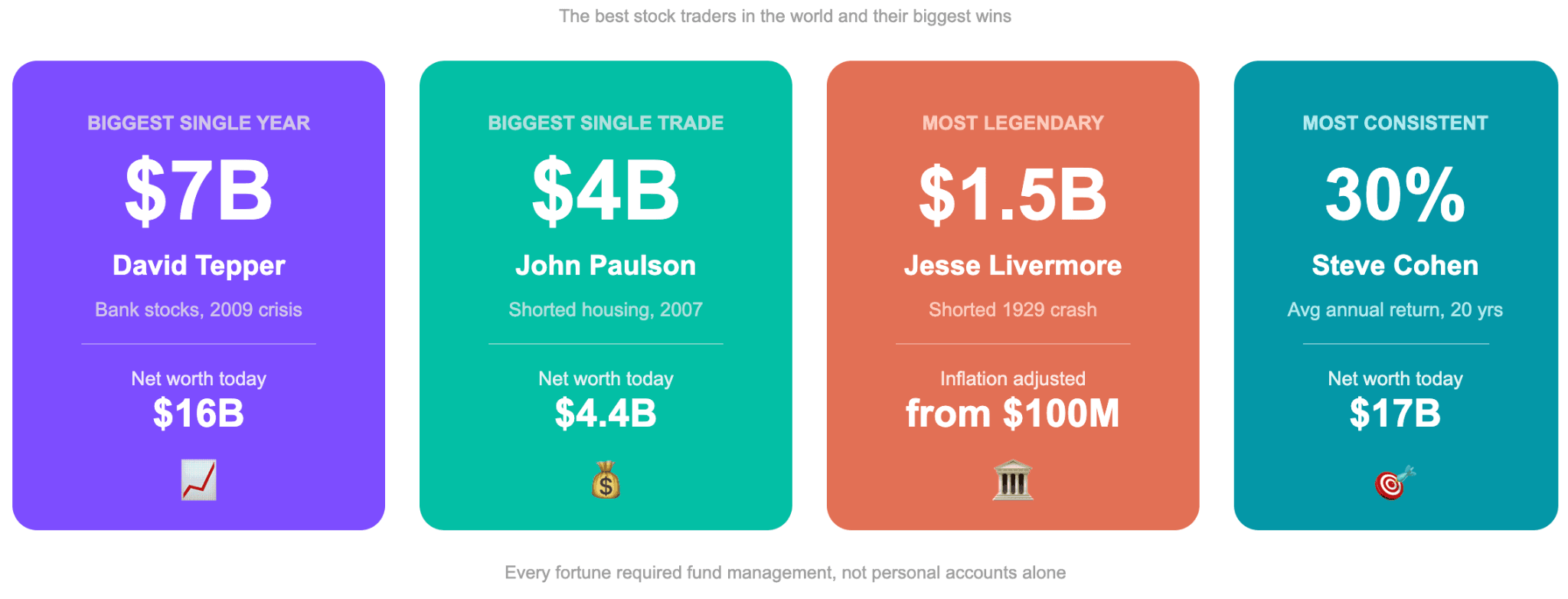
image.png

The best stock trader in the world is difficult to name because the term covers very different approaches. Some traders buy and sell stocks within hours. Others hold positions for months or years. The measurement changes based on timeframe, risk profile, and whether you measure by total return or consistency.

Legendary Stock Traders and Their Biggest Wins

David Tepper made one of the greatest stock trades in history during the 2009 financial crisis. He bought distressed bank stocks when the market expected total collapse. His fund earned $7 billion that year, making it the single most profitable year in hedge fund history at that time.

Steve Cohen at SAC Capital focused on short-term stock positions using advanced data analysis. His team processed information faster than competitors and executed at high volume. SAC averaged 30% returns annually for nearly 20 years. 
Become a Confident Trader

Master trading with our structured course designed for beginners and intermediate traders.

Step-by-step lessons
Real strategies
Risk management training

Join 10,000+ traders improving their skills

Start Course Now

Jesse Livermore remains the most legendary stock speculator in Wall Street history. During the 1929 crash, he shorted the market and earned approximately $100 million. Adjusted for inflation, that equals roughly $1.5 billion today. His book "Reminiscences of a Stock Operator" is still required reading for professional traders a century later.

John Paulson bet against the US housing market in 2007. His fund used credit default swaps to profit when mortgage-backed securities collapsed. Paulson personally earned $4 billion from that single trade. It remains one of the largest individual trading profits ever recorded.

How Stock Trading Fortunes Compare to Fund Management

How Stock Trading Fortunes Compare to Fund Management

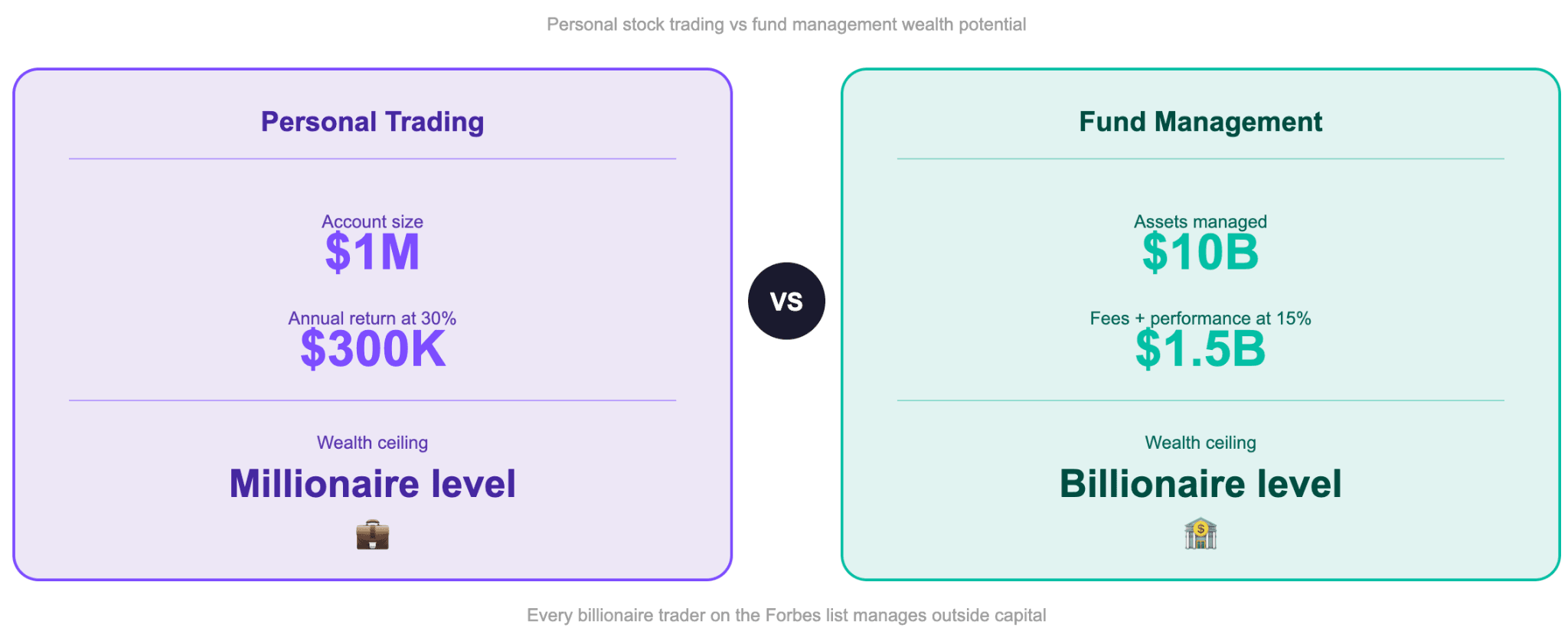
Every rich trader on the Forbes list earned the majority of their wealth through fund management, not personal stock trading. The math explains why. A $1 million personal account earning 30% annually generates $300,000. A fund managing $10 billion, earning 15,% generates $1.5 billion in fees and performance.

Fund management creates wealth through three layers. First, management fees typically run 1% to 2% of total assets. Second, performance fees take 15% to 20% of all profits. Third, the manager's own capital compounds alongside client funds.

Best stock trader status and billionaire net worth almost always require managing outside capital. Personal account trading can produce millionaire outcomes. Building a $10 billion fortune from stocks requires a fund structure behind it.

Key takeaway: The best stock traders in history include Tepper, Cohen, Livermore, and Paulson. Their biggest wins ranged from $1.5 billion to $7 billion on single trades or single-year returns. Every one of them used fund structures to reach billionaire status. Personal stock trading alone rarely creates fortunes above $50 million.

Who Is the Richest Day Trader

"Who is the richest day trader?" is one of the most-searched questions in trading forums and search engines. The honest answer challenges common expectations. No pure day trader appears on the Forbes Billionaires list. The wealthiest traders all hold positions for days, weeks, or months.

The Richest Day Traders in History

Jesse Livermore is often called the greatest day speculator of all time. His trading style combined rapid execution with multi-day holds during volatile markets. His $100 million fortune in 1929 makes him the wealthiest "short-term" trader in history by inflation-adjusted standards.

In the modern era, Ross Cameron is the most publicly documented retail day trader. Cameron turned a small account into over $10 million through momentum day trading. His verified broker statements make him the most transparent successful day trader of the 2020s. He is a multi-millionaire, not a billionaire.

Steve Cohen at SAC Capital held positions for hours to days, operating in the gray zone between day trading and swing trading. His approach produced billionaire wealth, but it required a fund structure staffed with hundreds of analysts and managing billions in capital.

Why Pure Day Traders Rarely Reach Billionaire Status

Day trading faces a structural ceiling that macro and quant strategies do not. Three factors limit the wealth potential for pure day traders.

  • Capital deployment limits
  • Transaction cost accumulation
  • Scalability constraints at high volume

Day traders who earn 50% annually on a $100,000 account make $50,000. Even scaling to $1 million produces $500,000 per year. That builds a comfortable income, not a billion-dollar fortune.

Billionaire traders solve this by managing other people's capital at scale. They collect management fees on billions under management and compound their own capital alongside. That layered structure is what separates a rich trader with $10 million from one with $10 billion.

This does not mean day trading lacks value. It builds skill, generates income, and teaches discipline. But the path from day trading to extreme wealth always runs through fund management or capital allocation at an institutional scale.

Key takeaway: Who is the richest day trader in history? Jesse Livermore by inflation-adjusted net worth. In the modern era, the most documented day trader is Ross Cameron, at the multi-million-dollar level. No pure day trader has reached the Forbes Billionaires list. Billionaire wealth requires fund management and compounding at an institutional scale.

What Separates Billionaire Traders From Everyone Else

What Separates Billionaire Traders From Everyone Else

The ten richest traders on this list share patterns that go beyond generic advice about discipline and patience. Every one of them made specific choices that compounded into billion-dollar outcomes over decades.

Patterns Across the Top 10 Richest Traders

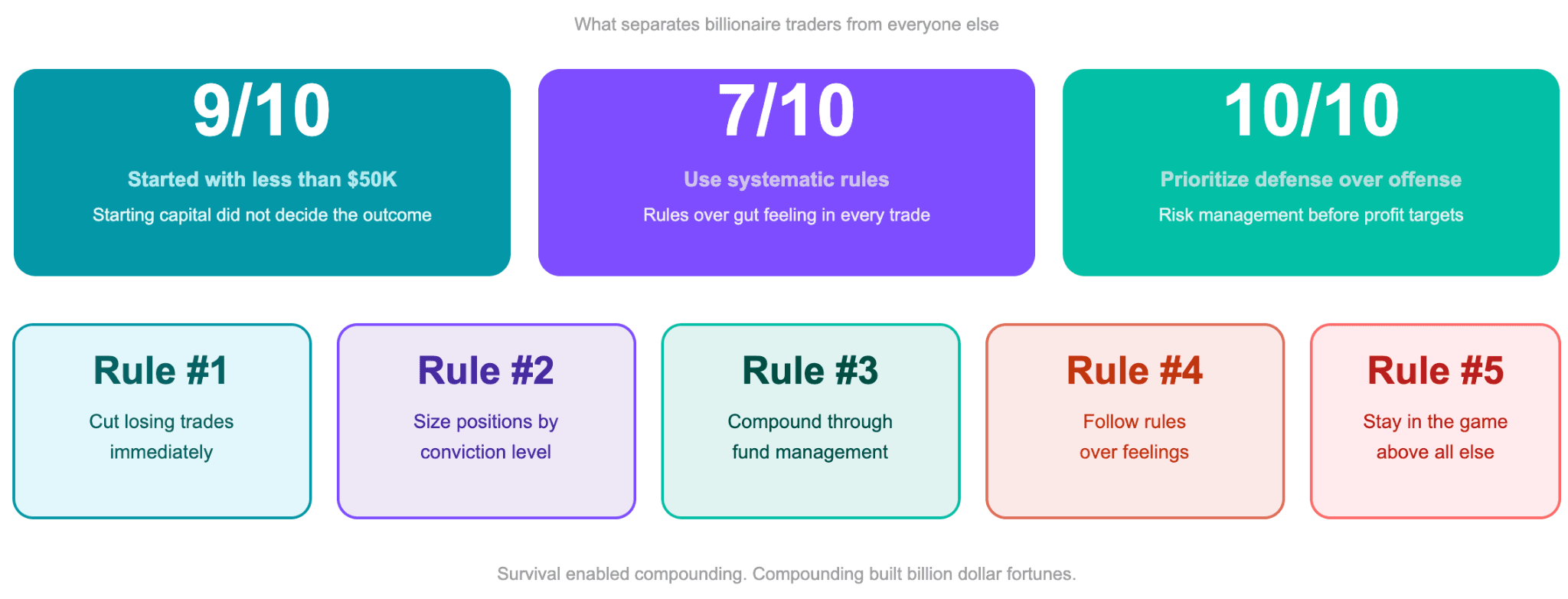
Nine out of ten started with less than $50,000 in personal capital. Kovner started with $3,000. Griffin started from a dorm room. Simons started with academic salary savings. Starting capital did not determine the outcome.

All ten prioritize defense over offense. Soros said, "It is not about being right. It is about how much you make when right and how little you lose when wrong." Jones said, "The most important rule of trading is to play great defense." Druckenmiller said, "The way to build long-term returns is through preservation of capital."

Seven out of ten use or used systematic rules rather than gut feelings. Simons built pure algorithms. Cohen built data-driven research teams. Even discretionary traders like Soros and Jones followed written rules for position sizing and stop placement.

No trader on this list diversified early. Every one of them concentrated capital on their best ideas when conviction was highest. Diversification came later, after the fortune was built. This pattern contradicts standard retail advice but matches every billionaire's trading career.

Five Rules Every Rich Trader Follows

These five principles appear across every biography, interview, and fund prospectus from the top ten traders.

  • Cut losing trades immediately
  • Size positions by conviction level
  • Compound through fund management
  • Follow rules over feelings
  • Stay in the game above all

The last rule matters most. Every legendary trader on this list survived multiple market crashes, corrections, and personal drawdowns. They stayed active through 1987, 1992, 2000, 2008, 2020, and 2022. Survival enabled compounding. Compounding enabled billion-dollar fortunes. Risk management is what made survival possible over three or four decades of active trading.

Key takeaway: The richest traders share specific patterns beyond generic discipline advice. They started with modest capital, concentrated on their best ideas, prioritized defense over offense, and used systematic rules. The single most important factor was staying in the game long enough for compounding to work across multiple decades.

Final Words On the Richest Traders

The richest traders in the world built fortunes from $4 billion to $47 billion through decades of compounding returns and fund management. Ken Griffin holds the title of the richest trader in 2026, with a net worth of $47 billion

No pure day trader appears on the Forbes Billionaires list. Billionaire wealth requires managing outside capital at an institutional scale. The common pattern across every name on this list is risk management, systematic rules, and the discipline to survive and compound through multiple market cycles.

Frequently Asked Questions

Disclaimer: This article is for informational purposes only and does not constitute financial advice. Trading involves risk and may result in loss of capital.

Related Articles

The First Move Is Yours

Discover how Supertrade can transform your trading career. Explore challenges, access instant funding, and join a growing community of Supertraders.

Stay Ahead of the Game

Sign up to receive exclusive tips, market insights, and the latest updates from Supertrade. Don’t miss out on opportunities to grow your trading success.
Discord

Our Community

Do not skip any beat.

The Ultimate Trading Community. Join our Discord server to get the latest updates, news and more.

2026 Supertrade. All rights reserved
DiscordInstagramTelegramYouTubeX
Trading involves significant risk. Past performance is not indicative of future results. This is a simulated trading environment. Supertrade provides educational trading services.
Supertrade
Supertrade Ltd, a company incorporated under the laws of Saint Lucia with registered number 2024-00699, located at Ground Floor, Rodney Court Building, Rodney Bay, Gros Islet, Saint Lucia, LC01 101, operates and owns this website, as well as provides services under the Terms and Conditions posted on the website. Supertrade Prop Ltd, a company incorporated under the laws of England and Wales with registered number 16234284, located at 52-56 Standard Road, London, England, NW10 6EU, acting as a payment agent.